IIM Calcutta · Joka, Kolkata
IIM Calcutta (IIM-C): Admissions, Programmes, Placements, Campus & Complete Guide
India’s first IIM, a triple-crown accredited business school with a finance-and-consulting reputation and a large lakeside campus. Everything an aspirant could want to know in one place: history, every programme, how admission actually works, what the placement process looks like, campus and student life, alumni, and how IIM Calcutta compares with the other top IIMs.
IIM Calcutta — IIMC, IIM-C, or simply “Joka” to the people who have lived there — is the oldest of India’s Indian Institutes of Management, set up in November 1961 with the MIT Sloan School of Management, the Ford Foundation and the Government of West Bengal. Decades later it holds the rare triple crown of global accreditations, has a long record of placing its flagship MBA batch across consulting, finance, technology and general management, and sits on one of India’s largest business-school campuses. It is also the IIM most closely associated with finance. This guide covers everything about IIM Calcutta in one place: its history, every programme it offers, how admission works, what to expect from placements, fees and financial aid, campus and student life, alumni, and how it compares with the other top IIMs. It is written to stay useful year after year, and where a figure changes annually, the guide tells you exactly where to find the current number.
IIM Calcutta at a Glance
Aiming for IIM Calcutta through CAT?
Get a free session — we’ll map your profile against IIMC’s selection approach and build a plan for CAT, WAT and PI.
History & Legacy
IIM Calcutta was established on 14 November 1961 as the first national institute for postgraduate study and research in management, created by the Government of India in collaboration with the MIT Sloan School of Management, the Ford Foundation, the Government of West Bengal and Indian industry. Several prominent academics formed its early nucleus, including Jagdish Sheth and J. K. Sengupta. Its institutional motto is Jñānam Sarvahitāya — “Knowledge for the benefit of all.”
Rankings & Accreditations
IIM Calcutta has consistently featured among India’s top management institutes in the government’s NIRF rankings and in leading business-media rankings, and has held the third position in the NIRF management category for several years in the past. Its exact rank moves from year to year and differs by publisher, so use the latest official edition rather than any number quoted in an article.
The Triple Crown
IIM Calcutta holds all three of the world’s leading business-school accreditations: AACSB (United States), AMBA (United Kingdom) and EQUIS (Europe). Very few business schools worldwide hold all three. Because IIMs are autonomous statutory institutes rather than conventional universities, these international accreditations serve as the main external quality benchmark. The institute is also a member of CEMS, a global alliance of leading business schools, and is part of international academic networks.
How to Read Rankings Sensibly
Different rankings measure different things
NIRF weighs teaching resources, research, graduation outcomes, outreach and perception. Media rankings often weigh placements, faculty and student perception. International rankings emphasise global salary and career progress. An institute can rank differently on each without any contradiction.
Small rank differences rarely matter
Among the top handful of IIMs, a one- or two-place gap on a single list says very little about your career outcome. Focus on programme fit, sector strength and admission chances instead.
Always use the latest edition
Rankings are published annually. Check the official NIRF site and the publisher’s latest list before quoting a number.
All Programmes at IIM Calcutta
Most aspirants think only of the two-year MBA, but IIM Calcutta runs a full portfolio, each with its own eligibility and admission route. The portfolio expands from time to time, so check the official programmes page for the current list.
| Programme | Format | Who It’s For | Typical Admission Route |
|---|---|---|---|
| MBA (PGP) — flagship | 2 years, full-time, residential | Freshers and early-career graduates | CAT → WAT + PI |
| MBAEx (MBA for Executives) | 1 year, full-time, residential | Professionals with substantial full-time work experience | GMAT + profile + interview (CAT not required) |
| PGPEX-VLM (Visionary Leadership in Manufacturing) | 1 year | Mid-career professionals in manufacturing | Profile + aptitude test + interview (CAT not required) |
| PGDBA (Business Analytics), joint with IIT Kharagpur and ISI Kolkata | 2 years | Quantitatively strong graduates | Valid CAT or GATE score + own written test + interview |
| CEMS MIM (Master in International Management) | Track within the MBA | Selected MBA students seeking a global track | Selection through the institute’s CEMS process |
| PhD / Fellow Programme (and Executive PhD) | Multi-year | Aspiring academics and researchers | CAT, GMAT, GRE, GATE or UGC-NET + research proposal + interviews |
| Executive Education | Short and long programmes, including online formats | Working managers at all levels | Programme-specific |
The doctoral programme covers areas including Economics, Finance & Control, Human Resource Management, Management Information Systems, Marketing, Operations Management, Organisational Behaviour, Public Policy & Management and Strategic Management.
The Flagship MBA (PGP) in Detail
The two-year, full-time residential MBA is designed to produce general managers with a broad strategic view. It treats management as an integrated process, with core skills in accounting, finance, marketing, operations and management at its heart.
How the Programme Is Structured
Core curriculum
The first year is dominated by compulsory credit courses (and some compulsory non-credit courses) that build the foundations across functional areas.
Summer internship
A compulsory industry internship sits between the first and second year. It is also a major recruiting channel, with students interning at firms in finance, consulting, technology and other sectors.
Electives
The second year is largely elective-driven, letting students specialise. IIM Calcutta offers a wide elective menu across finance, marketing, operations, human resources, information systems, economics, strategy and public policy.
Peer mentorship
Second-year students run a mentorship programme for first years ahead of summer placements, starting at CV-making, with each first-year student typically matched to a few mentors from similar backgrounds.
Reputation and Strengths
IIM Calcutta is widely regarded as the IIM with the strongest identity in finance, and it also places a large share of each batch in consulting. The institute has historically had a deep bench of finance and economics faculty, and its library is well stocked with financial databases. That said, marketing, operations, technology and general-management roles are all well represented, so it is not a one-track school.
Who You’ll Study With
The flagship MBA admits a batch of several hundred students each year, and the class is deliberately mixed. While the exact numbers change every year, the broad shape of an IIM Calcutta class has been consistent:
| Dimension | Typical Pattern |
|---|---|
| Academic background | Engineers form the largest group, alongside commerce, economics, arts, science and other graduates |
| Institutions | A substantial share from leading engineering institutes, alongside many from other colleges and universities |
| Work experience | A mix of freshers and candidates with a few years of experience; most have relatively short experience compared with executive programmes |
| Gender balance | Women are a minority but a meaningful and growing share, and the admission process gives diversity credit |
| Professional profiles | Chartered accountants, CFA and FRM charterholders, and entrepreneurs are usually part of the mix |
MBA Admission Process
Admission to the flagship MBA runs through CAT, followed by IIM Calcutta’s own shortlisting, a Written Ability Test (WAT) and a Personal Interview (PI). The institute publishes an admission policy for each batch, and the details below describe the structure that has held across recent cycles.
Eligibility
| Criterion | Typical Requirement |
|---|---|
| Qualification | A bachelor’s degree with a minimum aggregate (generally 50%, and 45% for SC/ST/PwD candidates) |
| Final-year students | Eligible to apply if they complete the degree by the date specified in the admission policy |
| Entrance exam | A valid CAT score for that admission cycle |
| Work experience | Not required; freshers can apply, and experience earns credit in the final score |
| Reservations | The institute follows government reservation norms; consult the current admission policy for category-wise details |
The Stages
Stage 1: Meet the minimum CAT thresholds
You must clear both an overall and sectional percentile floor in CAT to be considered at all. These are only thresholds. Actual shortlist cutoffs are considerably higher.
Stage 2: Shortlisting for WAT-PI
Eligible candidates are ranked on a composite score built from CAT performance, Class 10 and Class 12 marks, and a gender diversity factor. Only the top-scoring candidates in each category are invited.
Stage 3: Written Ability Test and Personal Interview
Shortlisted candidates attend the WAT and PI, usually conducted in the early months of the calendar year.
Stage 4: Final merit list and offers
The final score combines CAT, WAT, PI, academic diversity and work experience. Offers go out to selected candidates, who confirm by accepting the offer and paying the acceptance fee, which is typically adjusted against the first tuition instalment.
How Selection Actually Works
This is the part most aspirants under-study. IIM Calcutta uses two different scoring stages, one to decide who gets an interview and another to decide who gets in. The exact weights are published in each year’s admission policy and can be revised, but the underlying design has stayed consistent.
Stage A: Who Gets the Interview Call
The shortlisting score is built from four ingredients: your CAT score (the largest share), your Class 12 marks, your Class 10 marks, and a gender diversity credit for female and transgender candidates. School marks together carry a meaningful share of this score, so a strong CAT alone doesn’t guarantee a call.
Stage B: Who Gets the Seat
The final score combines Personal Interview, CAT, Written Ability Test, work experience and academic diversity. Historically the interview has been the single largest component, and the interview and WAT together have carried more weight than CAT. Work experience earns credit but with a ceiling, and academic diversity credit rewards non-engineering backgrounds.
What This Design Tells You
The interview is the biggest single factor
Getting the call is the CAT and academics battle. Getting the seat is largely the interview battle, so preparation for WAT-PI should start early rather than after the shortlist.
School marks matter at the shortlisting stage
A very high CAT with weak Class 10 and 12 marks can lose out on a call to a slightly lower CAT with a stronger academic record. Check the current policy for how these are converted and weighed.
Work experience helps, but only up to a point
Freshers are not shut out. Experience adds points up to a cap, so it is a modest edge rather than a decisive one.
Diversity credits can tilt close calls
Gender and academic diversity credits reward a broader class, so women and non-engineers can benefit at the margin.
CAT Percentile: What to Aim For
IIM Calcutta sets minimum overall and sectional CAT percentiles, but these are entry thresholds, not the real bar. The institute invites only a limited number of candidates for WAT-PI relative to its seats, so in practice general-category candidates who receive calls have historically clustered in the high-90s percentile. Reserved categories have lower thresholds.
Aim well above the threshold
Treat the minimum cutoff as the floor, not the target. Build a comfortable margin, since the effective cutoff depends each year on the applicant pool and paper difficulty.
Balance your sections
Sectional minimums mean a strong overall score with one very weak section can put you out of contention. Practise all three sections, not just your favourite.
Profile can move the needle either way
A strong academic record and diversity credits can help a slightly lower percentile, and a weak school record can hurt a higher one.
Admission Timeline (Tentative)
The exact dates change every year, but the rhythm of the IIM Calcutta MBA cycle is consistent. Use this as a planning guide and confirm dates on the official websites.
For the executive and other programmes, timelines differ. The MBAEx, for instance, has run multiple application rounds spread across the year, so check each programme’s admission schedule page.
How to Prepare for the WAT and PI
Since the interview and WAT carry so much of the final decision, this is where offers are won and lost. Here is what to focus on.
Know your own profile cold
Every line on your resume and application can become a question. Be ready to discuss your academics, projects, internships and work in depth, and to explain your choices honestly.
Refresh your academic subjects
Interviewers often ask about your graduation subjects. Revise core concepts of your degree, and if your background is commerce, economics or finance, be comfortable with fundamentals in those areas.
Build finance, economics and current-affairs fluency
Given the school’s finance identity, follow business and economic news and be ready to form and defend a point of view on recent developments.
Have a clear “Why IIM Calcutta, why MBA, why now”
Your answer should be specific: what you want to do after the MBA, why IIMC’s programme and strengths fit that, and why this is the right time. Generic answers stand out for the wrong reasons.
Practise structured writing for the WAT
The WAT rewards clear, well-organised writing on a topic given on the spot. Practise short timed essays with a clear position, two or three supporting arguments and a crisp conclusion.
Rehearse with mock interviews
Practise with people who will challenge you. Practise staying composed when pushed on a weak point, since panels often probe to see how you think under pressure.
Admission to Other Programmes
MBAEx (Executive MBA)
Aimed at experienced professionals, the MBAEx has typically required a bachelor’s degree and several years of full-time, post-qualification work experience. Admission has used a valid GMAT score plus a profile assessment and interview, and CAT is not required. Confirm the current experience requirement and accepted tests on the programme page.
PGPEX-VLM
Aimed at mid-career professionals in manufacturing, this one-year programme selects through a profile evaluation, aptitude test and interview rather than CAT.
PGDBA (Business Analytics)
Offered jointly with IIT Kharagpur and ISI Kolkata, this two-year programme has a separate written test and interview in addition to a valid CAT or GATE score. Strong quantitative preparation is preferred, and there is a minimum requirement in the qualifying degree.
PhD (Fellow Programme)
Admission has used scores such as CAT, GMAT, GRE, GATE or UGC-NET, along with a research proposal and interviews. Doctoral scholars receive fellowship support.
Fees & Financial Aid
IIM Calcutta’s flagship MBA is one of the more expensive government-backed MBA programmes in India, and fees are revised from batch to batch. Rather than quoting a figure that will go out of date, here is how to budget properly and where to find the current number.
What Makes Up the Total Cost
Typical Components
Financial Aid and Loans
Need-based financial assistance
IIM Calcutta has offered need-based assistance to MBA students who demonstrate financial hardship. Students typically apply separately after receiving the offer letter.
External scholarships
Corporate trusts, foundations and government schemes offer scholarships to eligible students at leading institutes. Availability changes each year, so research options as soon as you get your offer.
Education loans
Major banks offer education loans to IIM students, often with favourable terms because of the institute’s placement record. Explore loan options, interest rates and collateral requirements early, since loan processing takes time.
Placements
IIM Calcutta has a long record of strong placements, with essentially the entire flagship MBA batch placed each year and a large number of recruiters visiting. Because the numbers change annually, this section explains how placements work and how to read the official report, rather than quoting figures that will age.
Sectors and Recruiters
Consulting and general management have typically been among the largest recruiting categories, and finance is a defining strength. Regular recruiters have included global and Indian consulting firms, banks and financial-services firms, technology companies, FMCG and consumer businesses, and industrial groups. Summer internships often convert into final offers.
How the Process Works
Cluster-based placement
The institute has used a cluster-based process, where participating companies are mapped to cohorts of students and grouped into clusters, aimed at improving student-company fit.
Summer internship as a gateway
The compulsory internship between the first and second year is a major route to pre-placement offers, and it is also where students test a sector before committing.
Mentorship and preparation
The second-year mentorship programme and student-run interest groups help first years with CVs, case practice and interview preparation.
How to Read a Placement Report
Look at the median, not just the average
A small number of very high offers can lift the average. The median is a steadier indicator of what a typical student earns.
Check how CTC is defined
Institutes differ on what counts toward CTC and whether they report a “maximum earning potential” style figure. Compare like with like before ranking two institutes on salary.
Separate domestic and international offers
International offers are usually reported separately and can distort comparisons if mixed with domestic figures.
Look at sector and role mix
The sector split tells you where the batch actually lands, which matters more than any single headline number if you have a specific target career.
Return on Investment
A useful way to evaluate any MBA is to compare the total cost against likely earnings, using current figures from the official fee page and placement report. Here is a simple framework you can apply in a few minutes.
Step 1: Add up the true cost
Total programme fee plus hostel, mess, books and personal expenses, plus the salary you give up for two years (the opportunity cost), plus loan interest if you borrow.
Step 2: Use the median, not the headline
Base your expected earnings on the median CTC, and consider the range for your target sector, since consulting and finance can differ from other functions.
Step 3: Consider taxes and living costs
CTC is pre-tax and may include variable components. Estimate take-home pay and city living costs for a realistic repayment plan.
Step 4: Look beyond the first job
The alumni network, brand and skills often matter more over a career than the first salary, though they are harder to put in a spreadsheet.
Historically, the total fee has been comparable to about a year of a typical graduate’s post-MBA earnings, which is why students generally treat the programme as a strong financial proposition. Run the numbers yourself with the latest figures.
Campus & Infrastructure
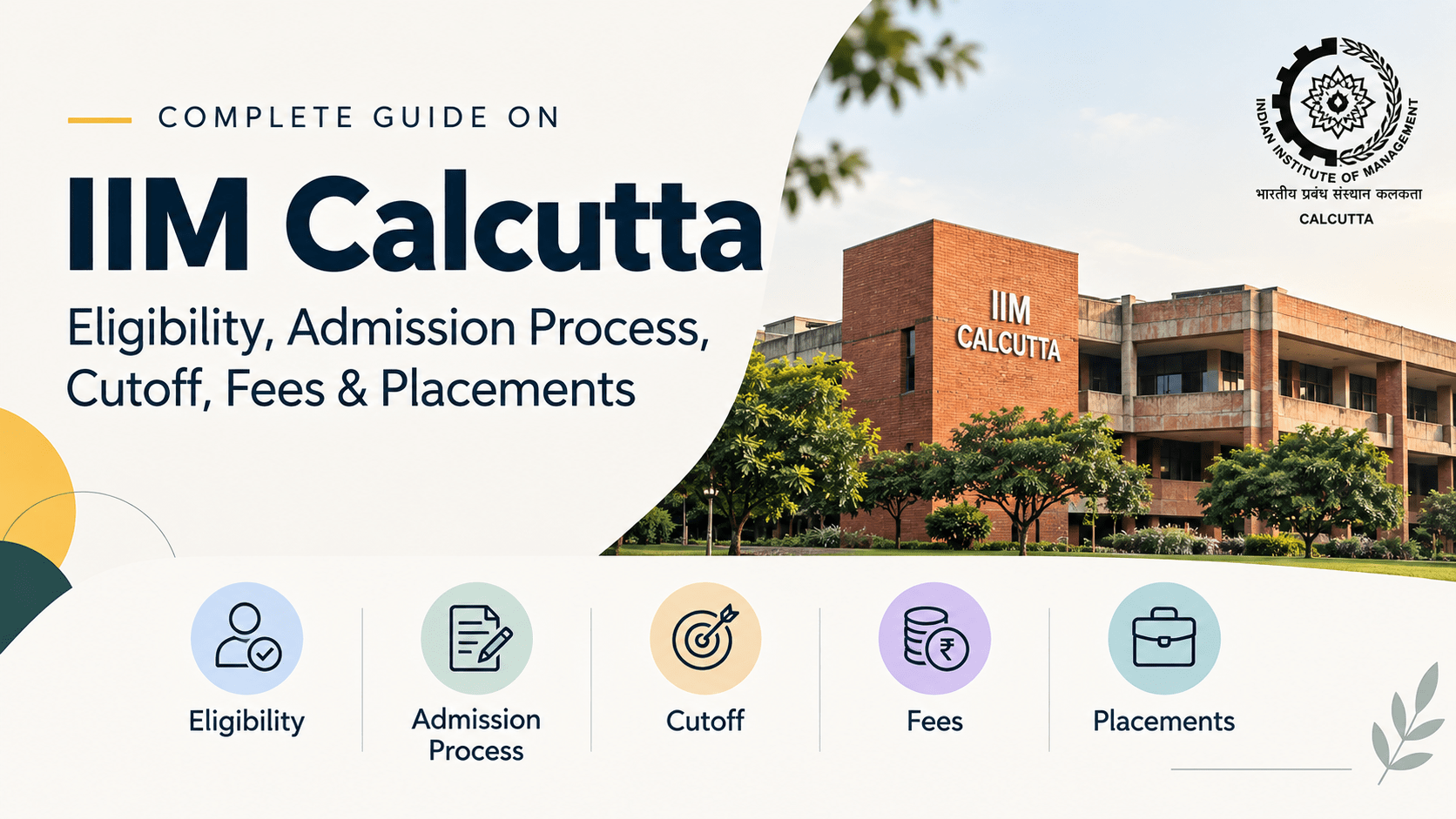
The Joka campus spans about 135 acres on Diamond Harbour Road in south-west Kolkata, roughly 25 km from the city centre. It is known for terracotta-brick buildings, exposed walkways and a chain of lakes, and has seven water bodies and even a miniature Howrah Bridge. The institute moved here in 1975 after the foundation stone was laid in 1968.
Facilities
Hostels
The Location Trade-Off
Students and alumni often describe Joka as a campus you either love or learn to live with. The lakes, greenery and residential environment create an intense, close-knit community, but the distance from the city centre means off-campus life takes planning, and the surrounding area has fewer options than a central location. Most students find that life largely revolves around campus, which suits some personalities far better than others.
Student Life
Life at IIMC is run largely by students through a network of councils, cells and clubs. The institute’s official pages list the following structure:
Student Bodies
Events and Publications
Beyond the formal structure, the culture is known for peer mentorship, case competitions, and strong finance and consulting interest groups that run interview preparation and workshops. Students typically balance a demanding academic schedule, preparation for internships and placements, and a full calendar of student-run events.
Global Exposure & Exchange
The MBA offers opportunities to spend a term at a partner institution abroad under memoranda of understanding, and a significant share of each batch takes part every year. The institute has partnered with business schools across Europe, Asia and other regions, and the list of partners expands over time.
IIM Calcutta is also part of the CEMS alliance, which gives selected students access to the CEMS Master in International Management track and its network of leading business schools and corporate partners. Foreign students can also come to Kolkata on exchange through the institute’s international office.
Faculty & Research
The institute has a substantial core faculty, and its doctoral programme, running since 1971, trains researchers across management disciplines. Its early faculty included scholars such as Jagdish Sheth and J. K. Sengupta. The institute is organised into academic groups such as finance, marketing, operations, organisational behaviour, information systems, economics, public policy and strategy, and runs centres of excellence and regular conferences and seminars. Historically, the institute has been especially strong in finance and economics.
Notable Alumni
IIM Calcutta’s alumni have led companies, institutions and public life. Widely cited names include:
| Alumnus | Known For |
|---|---|
| Indra Nooyi | Led PepsiCo as Chairman and CEO |
| Gopal Vittal | Telecom leadership, associated with Bharti Airtel |
| Ajit Balakrishnan | Founder of Rediff.com |
| Sunil Duggal | Led Dabur India as CEO |
| Shyam Srinivasan | Banking leadership, associated with Federal Bank |
| Ramachandra Guha | Historian and author |
| Amish Tripathi | Author and diplomat |
| Swami Mukundananda | Spiritual teacher and author |
The institute recognises alumni contributions through its Distinguished Alumni Award and maintains an active alumni network that many students describe as a major long-term benefit of the programme.
IIM Calcutta vs Other Top IIMs
Aspirants who clear CAT with a high percentile often get calls from several top IIMs, most often IIM Ahmedabad, IIM Bangalore and IIM Calcutta. Because rankings and placement numbers change each year, here is a framework for comparing them that stays valid.
| What to Compare | IIM Calcutta | How to Compare |
|---|---|---|
| Sector strength | Finance and consulting | Match each institute’s recruiter mix to your target career |
| Selection design | Heavy weight on interview and WAT, with school-marks-based shortlisting and diversity credits | Read each institute’s admission policy to see how it rewards your profile |
| Campus and location | Large lakeside campus on the outskirts of Kolkata | Consider proximity to industry, city life and your own preference |
| Class size and culture | Several hundred students, strong mentorship culture | Talk to current students and alumni |
| Outcomes | Consistently strong placements | Compare median CTC, sector mix and internship conversion from each institute’s latest report |
| Global exposure | Exchange programmes, CEMS membership, triple accreditation | Compare partner networks and accreditations |
There is no universally correct answer. Outcomes at the top IIMs are close, so the deciding factors are usually your target sector, how much you value location and campus, and how each institute’s admission formula rewards your profile.
Is IIM Calcutta Right for You?
It suits you if…
You want a career in finance, consulting, or general management and value a school with a strong finance identity; you like a residential, campus-centred, lakeside environment; and your profile plays well to IIMC’s approach, for example strong school marks and a strong interview.
Think twice if…
You want to be in the middle of a big city during your MBA, you’d prefer a more technology-centred ecosystem on your doorstep, or your profile is heavy on CAT but light on school marks, which the shortlisting stage takes into account.
Consider the alternatives if…
You are a working professional with several years of experience (look at MBAEx or other executive programmes), you’re strongly analytics-oriented (consider PGDBA), or you want a one-year programme.
Where to Verify Live Data
Numbers that change every year should always come from the source. Use these official pages for the current figures:
| What You Need | Where to Find It |
|---|---|
| Admission policy, weightages and cutoffs | Admissions section of iimcal.ac.in (MBA programme page) |
| Fees and payment schedule | Programme fees page on iimcal.ac.in |
| Placement report | Career Development and Placement pages on iimcal.ac.in |
| Current rankings | NIRF website and each ranking publisher’s latest edition |
| CAT dates and eligibility | Official CAT website |
| Executive, analytics and doctoral programmes | Individual programme pages on iimcal.ac.in |
Get a Free IIM Admission Strategy Session
Connect on WhatsApp: 7697517555
Your CAT score gets you the call. Your preparation gets you the seat.
IIM Calcutta gives more weight to the interview than to CAT. Let’s build a plan that covers all three: CAT, WAT and PI.
Book My Free Strategy SessionYou know your target percentile. Now you need to hit it.
Same faculty, same mock test series, same mentorship — across every format below. Pick the one that fits how you actually study.
Choose Your Course Format
Classroom CAT Coaching
Daily doubt-solving and face-to-face mentorship at our Indore center, with a fixed structure to keep you on track.
LIVE Online CAT Coaching
Real-time classes from anywhere in India, with the same faculty, schedule, and mock benchmarks as our classroom batches.
Self-Paced Online CAT Course
Recorded lectures you revisit on your own schedule, at the pace that actually fits your week.
Pair It With
CAT Preparation Books
Structured print material across QA, VARC and DILR, written to match the current exam pattern. Pairs with any course above, or independent study.
Explore Prep Books →CAT Test Series
Full-length, sectional and topic-wise mocks, benchmarked against the real all-India percentile curve. Pairs with any course above.
Explore Test Series →Frequently Asked Questions
Is IIM Calcutta the same as IIM Kolkata?
Yes. The institute’s official name is the Indian Institute of Management Calcutta, and many people call it IIM Kolkata or IIM-C. It is located in Joka, Kolkata.
Was IIM Calcutta the first IIM?
Yes. It was established on 14 November 1961 as the first IIM, a few weeks before IIM Ahmedabad.
What is the selection process for the IIM Calcutta MBA?
CAT score, followed by a shortlist based on CAT and school marks (plus a gender diversity credit), then a Written Ability Test and Personal Interview. The final score combines PI, CAT, WAT, work experience and academic diversity, with the interview carrying the largest share.
What CAT percentile is needed for IIM Calcutta?
The institute sets minimum overall and sectional percentiles, but these are only entry thresholds. Candidates who actually receive interview calls in the general category have historically clustered in the high-90s percentile, so aim well above the minimum. The exact thresholds are in each year’s admission policy.
Does the interview matter more than CAT at IIM Calcutta?
For final selection, yes. The Personal Interview has historically been the largest single component, and the interview and Written Ability Test together carry more weight than CAT. CAT matters most for getting shortlisted.
Do school marks matter for IIM Calcutta?
Yes. Class 10 and Class 12 marks are part of the shortlisting score, so weak school marks can reduce your chances of getting an interview call even with a strong CAT percentile.
Can freshers apply to the IIM Calcutta MBA?
Yes. Work experience is not required. Freshers are eligible, though work experience earns additional points in the final selection score, up to a cap.
When does the IIM Calcutta admission process happen?
CAT is typically held in November, results come in December or January, the WAT-PI shortlist follows in January, interviews run around February and March, offers typically arrive in April, and the programme begins around June or July. Exact dates change every year.
How much are the IIM Calcutta MBA fees?
The flagship MBA is among the more expensive government-backed MBA programmes, and fees are revised between batches. Check the programme fees page on iimcal.ac.in for the current amount and what it includes.
What are the placements like at IIM Calcutta?
The institute has a long record of placing essentially its entire flagship batch, with consulting, finance and general management among the major recruiting areas. The current average, median and highest packages are published in the annual placement report on the official website.
What is the triple crown accreditation?
It refers to holding all three top global business-school accreditations: AACSB (United States), AMBA (United Kingdom) and EQUIS (Europe). IIM Calcutta is accredited by all three, a distinction few business schools in the world hold.
Does IIM Calcutta offer scholarships?
The institute has offered need-based financial assistance for MBA students who demonstrate financial hardship, applied for after receiving the offer. Some external scholarships and education loans are also available. Check the current financial aid policy on the official website.
Which programmes does IIM Calcutta offer besides the MBA?
The MBA for Executives (MBAEx), PGPEX-VLM for manufacturing professionals, the PGDBA in business analytics (jointly with IIT Kharagpur and ISI Kolkata), the CEMS Master in International Management track, the PhD and Executive PhD programmes, and a range of executive education programmes.
What is the MBAEx admission process?
The MBAEx is for experienced professionals and has typically required a bachelor’s degree and several years of full-time work experience. Admission has been based on a valid GMAT score plus profile evaluation and interview, and CAT is not required. Confirm current requirements on the programme page.
Is IIM Calcutta better than IIM Ahmedabad or IIM Bangalore?
There is no single answer. Outcomes at the top IIMs are close, and IIM Calcutta is especially strong in finance and consulting. The best choice depends on your target sector, location preference and how each institute’s admission formula suits your profile.
Where is the IIM Calcutta campus?
The campus is in Joka, on Diamond Harbour Road in south-west Kolkata, about 25 km from the city centre. It spans roughly 135 acres and features lakes and terracotta-brick buildings.