CAT Exam Syllabus & Important Topics for CAT Exam
CAT Exam Syllabus: Section-Wise Important Topics for CAT & Weightage
IIMs never publish an official CAT syllabus — everything below is reconstructed from years of actual question papers, so you know exactly where the marks are, not just what's theoretically possible to be asked.
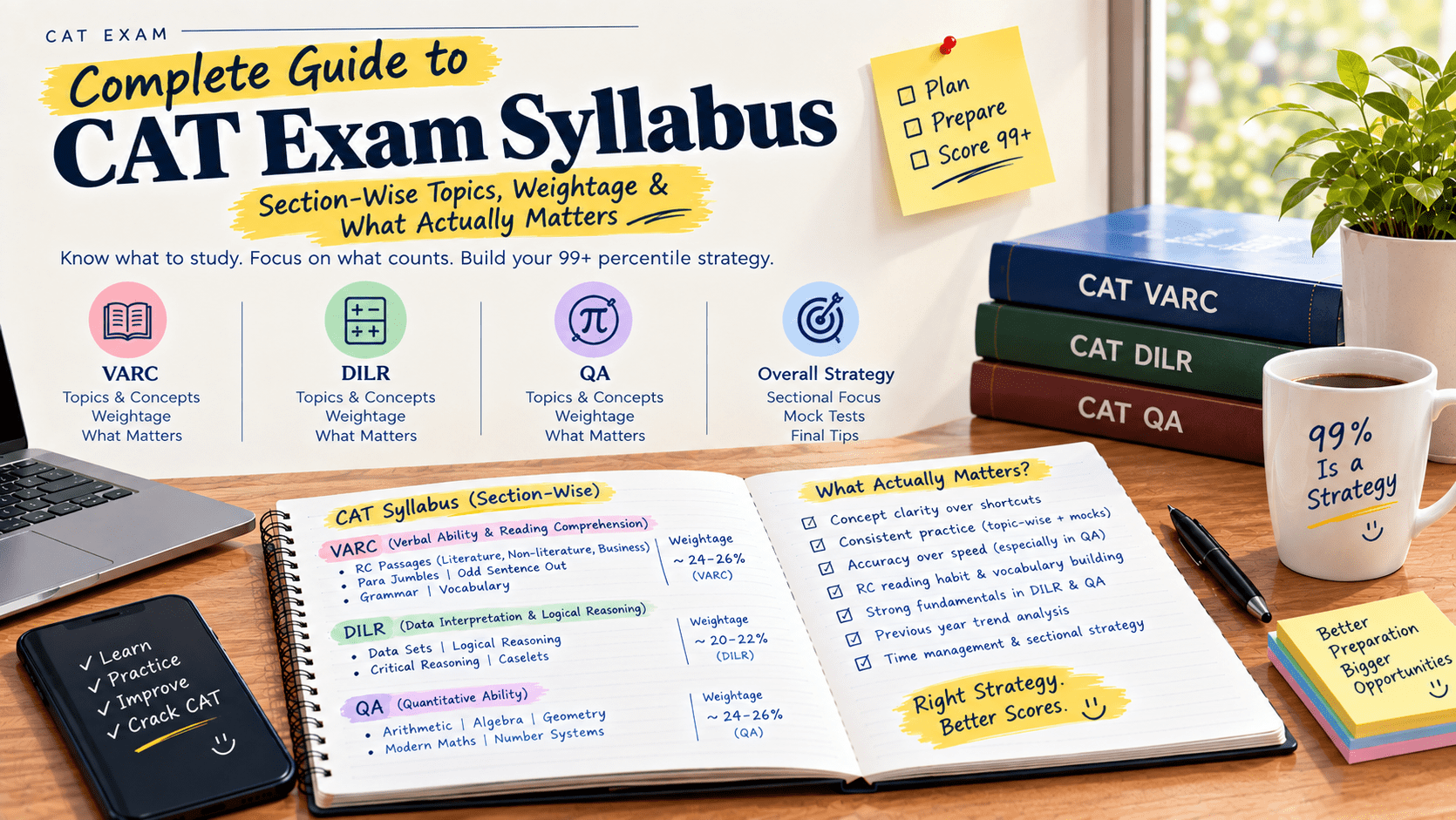
Here's the thing almost every CAT syllabus page skips: the IIMs have never released an official topic list. Every "CAT syllabus" you'll find online — including this one — is reverse-engineered from actual past papers. That matters, because it means the real question isn't "what could theoretically appear," it's "what has actually shown up, how often, and how heavily it's weighted." This page is your map of the full syllabus across all three sections, in one place — for a deep, cluster-by-cluster QA study plan or a full percentile-building strategy, we've linked out to dedicated guides for each further down.
Want a syllabus-mapped study plan instead of a PDF?
Get a free diagnostic session — where you actually stand across VARC, DILR and QA, and what to prioritise first.
CAT Exam Pattern at a Glance
| Section | Approx. Weightage | Time |
|---|---|---|
| Verbal Ability & Reading Comprehension (VARC) | ~36% | 40 min |
| Data Interpretation & Logical Reasoning (DILR) | ~32% | 40 min |
| Quantitative Ability (QA) | ~32% | 40 min |
Format: Computer-based, English medium, a mix of MCQs and TITA (Type-In-The-Answer) questions. Marking is +3 for a correct MCQ, −1 for a wrong one; TITA questions carry the same +3 for a correct answer but no penalty at all for a wrong or blank one. Sections run under a strict lock — you cannot move to another section early, and you cannot go back once time's up.
VARC Syllabus & Weightage
Reading Comprehension isn't just the biggest chunk of VARC — it's most of it, consistently making up roughly two-thirds of the section's questions across recent papers. If you're rationing prep time, this is the section where under-investing in RC specifically, rather than "verbal" generally, is the costliest mistake.
| Topic | Recent-Trend Frequency |
|---|---|
| Reading Comprehension (multiple passages) | Very High — roughly two-thirds of VARC questions |
| Para-jumbles | High — appears most years |
| Para-summary | High — appears most years |
| Odd-sentence-out | Moderate — appears in most slots |
| Sentence Correction / Vocabulary-based | Lower in recent years, still worth basic coverage |
DILR Syllabus & Weightage
DILR is the section where "important topics" is genuinely the wrong framework — many who track this closely argue against ranking DI/LR topics at all, since sets rotate heavily and any given set can combine two or three sub-skills at once. What's more useful is knowing the recurring set-types so nothing on exam day is a total surprise.
| Recurring Set-Type | Notes |
|---|---|
| Tables & Data Charts | Classic DI, often paired with basic arithmetic under time pressure |
| Caselets | Longer data-dense passages requiring careful reading before calculation |
| Seating Arrangements (Linear/Circular) | Recurs almost every year in some form |
| Games & Tournaments | Increasingly common in recent slots |
| Venn Diagrams | Appears periodically, usually as a standalone set |
| Blood Relations / Coding-Decoding | Less frequent as full sets, more common as standalone questions |
DILR typically presents several sets of 4-5 questions each. A widely used benchmark: getting 2-3 questions correct within each set, done consistently across all sets, is usually enough to cross a strong percentile in this section — full accuracy on fewer sets beats partial attempts across all of them.
QA Syllabus & Weightage
This is the section where "important topics" has the clearest, most data-backed answer of the three. Arithmetic and Algebra together have accounted for roughly 70% of QA's weightage across recent papers — by a wide margin, the highest-leverage place to spend prep time in the entire exam.
| Topic Group | Approx. Share of QA |
|---|---|
| Arithmetic | ~35-40% |
| Algebra | ~30-35% |
| Geometry & Mensuration | ~15-20% |
| Number Systems | ~5-10% |
| Modern Maths | ~5-10% |
Want the full QA breakdown?
Cluster-by-cluster syllabus, worked practice questions, a complete study plan, and sectional cutoff benchmarks — all in our dedicated Quant guide.
Prioritise by Your Academic Background
Weightage tells you what CAT emphasises overall — it doesn't tell you where you personally need to spend the next month. That depends heavily on what you studied before this. Here's how the three sections tend to map against common academic backgrounds, and where each group typically gets the fastest returns.
| Background | Usual Strength | Usual Gap | Where to Focus First |
|---|---|---|---|
| Engineering / Science | QA (especially Algebra, Number Systems) | VARC, particularly Reading Comprehension speed and inference-based questions | Build a daily reading habit early — this gap takes longer to close than QA revision does |
| Commerce | QA Arithmetic, basic DI (already familiar with ratios, percentages, tabular data) | Geometry, Modern Math, and LR puzzle-types outside standard accounting logic | Don't assume QA is "handled" — Commerce grads often plateau on Geometry and P&C specifically |
| Humanities / Arts | VARC, especially RC comprehension and inference | QA across the board, particularly Algebra and Geometry fluency | Start QA foundational work (Class 9-10 level) earliest of any group — it's the longest runway to close |
| Working Professionals (any background) | Varies by original background, often faster DILR pattern-recognition from workplace problem-solving | Time availability more than aptitude — skills often need refreshing, not rebuilding | Prioritise consistency over intensity; short daily sessions across all three sections beat occasional long ones |
MCQ vs. TITA: Why It Changes Your Strategy
A meaningful share of CAT's questions are non-MCQ (TITA), spread across all three sections. Since TITA carries zero penalty for a wrong or blank answer, it should be your default "attempt when even moderately confident" zone — the usual CAT caution around guessing applies specifically to MCQs, not TITA.
Common Myths About the CAT Exam Syllabus
"There's an official CAT syllabus PDF from the IIMs"
There isn't. Every syllabus resource, including this one, is built from analysing past papers — useful for prioritisation, but not an official document.
"DILR has a fixed set of 'important topics' like QA does"
Not really — DI/LR set-types rotate more than QA topics do, and many experts specifically caution against ranking DILR topics by importance. Broad set-type familiarity matters more than memorising a priority list here.
"Skipping vocabulary-heavy prep is safe since RC dominates VARC"
RC dominance means vocabulary-only questions are a smaller share of marks, not zero — a light, ongoing vocabulary habit still protects the remaining third of the section.
"Everyone should prepare the syllabus in the same order"
Not quite — the smartest starting sequence depends heavily on your academic background. An engineering graduate and a humanities graduate typically face very different gaps against this same syllabus, and should sequence their prep differently as a result.
Common CAT Syllabus Prep Mistakes
Treating this year's weightage as a guarantee for your year
Section and topic weightage shift from cycle to cycle. A topic that contributed only 1-2 questions in recent papers can just as easily contribute 4-5 in yours. Use weightage to sequence what you study first, not to decide what you skip entirely.
Preparing all three sections in isolation, with no sense of your own profile
Generic "cover everything equally" plans ignore that your starting point in VARC, DILR, and QA is probably uneven — usually tied to your academic background. Diagnose your own gaps early rather than assuming the textbook weightage applies equally to you.
Assuming DILR can be "syllabus-mastered" the way QA can
Because DI/LR set-types rotate more than QA topics, some aspirants keep hunting for a fixed topic list that doesn't really exist for this section — and lose time that would be better spent building broad set-type familiarity and set-selection judgement instead.
Confusing "I've covered the topic" with "I can execute it under a sectional lock"
Reading through a topic list or watching a lecture isn't the same as solving it inside a strict, non-switchable time window. Syllabus coverage is the starting line, not the finish line.
Ignoring vocabulary and grammar entirely because RC dominates VARC
RC being the largest chunk of VARC doesn't make the remaining question types worth zero — a small, consistent vocabulary and grammar habit protects marks that a pure RC-only focus leaves on the table.
Where to Go Next
This page maps the full syllabus. Two deeper guides pick up from here:
Mastering Quantitative Aptitude
Cluster-by-cluster QA breakdown, worked practice questions, a full study plan, and sectional cutoff benchmarks.
Read the QA Guide →CAT Preparation Strategy
The complete phase-by-phase plan for a top percentile — percentile math, VARC/DILR/QA tactics, mock-test cadence, and how to prepare with or without coaching.
Read the Strategy Guide →Get Your Free CAT Diagnostic & Study Plan
Connect on WhatsApp: 7697517555
Knowing the syllabus is step one. Building the speed is the actual work.
No room to borrow time across sections, no official CAT Exam syllabus to fall back on — let's turn this into a plan that fits how you actually study.
Book My Free Strategy SessionYou know the CAT syllabus. Here's how to turn it into a top percentile.
Same faculty, same mock test series, same mentorship — across every format below. Pick the one that fits how you actually study.
Choose Your Course Format
Classroom CAT Coaching
Daily doubt-solving and face-to-face mentorship at our Indore center, with a fixed structure to keep you on track across VARC, DILR and QA.
LIVE Online CAT Coaching
Real-time classes from anywhere in India, with the same faculty, schedule, and mock benchmarks as our classroom batches.
Self-Paced Online CAT Course
Recorded lectures you revisit on your own schedule, at the pace that actually fits your week — mapped topic-by-topic to this syllabus.
Pair It With
CAT Preparation Books
Structured print material across QA, VARC and DILR, written to match the current exam pattern — including the exact high-weightage topics for CAT covered above.
Explore Prep Books →CAT Test Series
Full-length, sectional, and set-specific mocks, benchmarked against the real all-India percentile curve, so you can test set-selection and section-time strategy under real pressure.
Explore Test Series →Frequently Asked Questions
Is there an official CAT syllabus published by the IIMs?
No. The IIMs have never released an official topic-wise syllabus. Every CAT syllabus resource, including this one, is built by analysing past question papers over multiple years.
What is the CAT exam pattern?
Three sections — VARC, DILR, and QA — each under its own strict time limit, with VARC carrying roughly 36% weightage and DILR and QA roughly 32% each. Exact question counts and total marks are set fresh by the conducting IIM every cycle, so confirm these against the current year's official notification.
What are the most important topics in CAT QA?
Arithmetic and Algebra together account for roughly 70% of the QA section's weightage in recent papers, making them the highest-priority topic groups, followed by Geometry & Mensuration, Number Systems, and Modern Maths. See our full QA guide for a complete cluster-by-cluster breakdown.
Is Reading Comprehension really that important in VARC?
Yes — RC has accounted for roughly two-thirds of VARC's questions in recent CAT papers, making it the single highest-leverage topic in the entire VARC section.
What is the CAT marking scheme?
+3 marks for every correct MCQ answer and −1 for every incorrect one. TITA (non-MCQ) questions also earn +3 for a correct answer but carry no penalty at all for a wrong or unattempted response.
Does DILR have specific "important topics" like QA does?
Not in the same clean way. DI/LR set-types rotate significantly year to year, and many CAT experts specifically advise against ranking DILR topics by importance — broad familiarity with recurring set-types (tables, caselets, arrangements, games & tournaments) matters more than a fixed priority list.
Should engineers and non-engineers prepare the CAT syllabus differently?
Yes, in sequencing if not in ultimate coverage. Engineering and science graduates typically start stronger in QA and weaker in VARC, while humanities graduates often show the reverse pattern — so the smartest first month of prep usually targets your specific gap rather than following a generic, one-size-fits-all order.