CAT Quantitative Aptitude · Complete Guide
Mastering Quantitative Aptitude for CAT: Syllabus, Weightage & 99 Percentile Strategy
QA is the one CAT section with an actual, learnable syllabus — no ambiguous reading comprehension, no unpredictable DILR sets, just Class 9-10 level maths asked at a higher level of application. That also makes it the most winnable section in the exam, if you prepare it in the right order. Here's the complete, weightage-accurate breakdown of what to study, in what sequence, and how to execute it under CAT's actual exam pattern.
Quantitative Aptitude is the section CAT aspirants either love or fear — and usually for the same reason: unlike VARC or DILR, QA has an actual, learnable syllabus. It's built almost entirely on Class 9 and 10 level mathematics, just asked with more layers of application and less time to think. That predictability is exactly why QA is often called the most "scoreable" section in CAT — if, and only if, you prepare it in the right order rather than trying to cover every topic with equal effort. This guide breaks down the current exam pattern, the real topic-wise weightage based on recent years' papers, a cluster-by-cluster syllabus with what actually matters inside each one, and a study plan built specifically around Quantitative Aptitude for CAT rather than the exam as a whole.
Want a QA-specific CAT preparation strategy?
Get a free diagnostic session — we'll map your current Quant level topic-by-topic and build a study plan around exactly where you're losing marks.
Quantitative Aptitude for CAT: Exam Pattern
Any QA-specific strategy has to start from the actual current structure of the section, not an outdated one — CAT's overall pattern has shifted more than once in recent years.
| Parameter | Detail |
|---|---|
| Total Questions | 22 |
| Total Marks | 66 (out of CAT's overall 204) |
| Time Allotted | 40 minutes, strictly sectional — no switching to VARC or DILR during this window |
| Question Type | Typically ~14 MCQs + ~8 TITA (Type In The Answer) |
| Marking Scheme | +3 for a correct answer, −1 for a wrong MCQ, no negative marking on TITA |
The MCQ/TITA split matters more than most aspirants realise: since TITA questions carry zero risk for a wrong answer, a confident attempt there is effectively free marks with no downside — worth factoring into how aggressively you attempt versus skip within the section.
CAT QA Topic-Wise Weightage
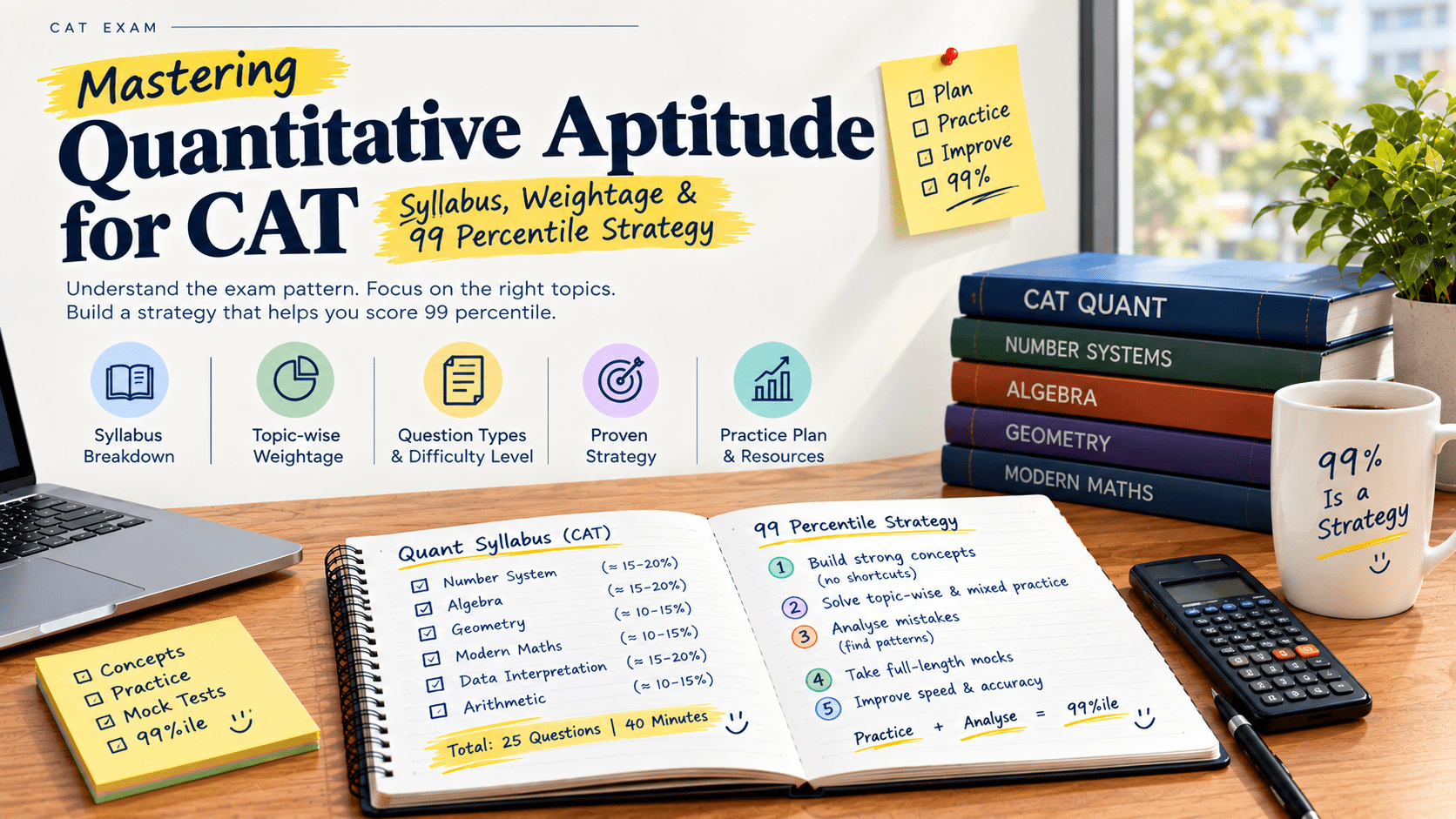
IIMs don't publish an official QA syllabus — everything below is derived from consistent patterns across the last several years of actual CAT papers, which is a far more reliable guide than any generic "syllabus list" copied from a textbook.
| Topic Cluster | Approx. Weightage | Typical Questions |
|---|---|---|
| Arithmetic | ~38-40% | 7-10 |
| Algebra | ~30-34% | 5-7 |
| Geometry & Mensuration | ~15% | 3-4 |
| Number System | ~8% | 1-2 |
| Modern Math | ~5% | 1-2 |
This weightage data is useful context, not a licence to skip anything. Arithmetic and Algebra have carried the largest share of QA marks in recent years, so it makes sense to build your foundation there first and get early wins and confidence. But CAT is deliberately unpredictable from year to year — a cluster that contributed 1-2 questions last year can just as easily contribute 4-5 this year, and IIMs change the paper's balance without warning. The study plan later in this guide uses weightage to sequence when you start each topic, not to decide whether you master it. Every cluster below deserves genuine mastery, not a token pass.
Full CAT Quantitative Aptitude Syllabus
Arithmetic
Algebra
Geometry & Mensuration
Number System
Modern Math
Arithmetic: The Highest-Leverage Cluster
With roughly 40% of QA's weightage, Arithmetic isn't optional prep — it's the foundation everything else sits on. Within Arithmetic, prioritise in this order:
- Percentages, Profit & Loss, and Simple/Compound Interest — these three are conceptually linked and together form the base for a large share of Arithmetic questions. Master percentage-to-fraction conversions until they're instant, not calculated.
- Time, Speed & Distance and Time & Work — these frequently combine with Ratio & Proportion in the same question, so treat all three as one connected unit rather than separate chapters.
- Averages and Mixtures & Alligations — smaller individually but fast to master, and alligation-based shortcuts save significant time across multiple question types.
Recent CAT papers have leaned toward conceptual, word-problem-based Arithmetic questions rather than direct formula application — meaning rote formula memorisation without genuinely understanding the underlying relationship between quantities will only get you partway.
Algebra: Where Inequalities Have Been Trending Up
Algebra sits just behind Arithmetic at roughly 30-34% of QA. Equations and Inequalities have consistently been among the highest-yield individual topics within this cluster — recent papers have specifically leaned harder on Inequalities and boundary-condition reasoning, so don't treat this as a minor sub-topic to skim.
- Linear & Quadratic Equations — get comfortable solving under time pressure without falling back on the general formula every time; pattern recognition is faster.
- Inequalities — practise both algebraic and graphical approaches, and pay specific attention to boundary conditions, which is where most marks are lost even by otherwise strong Algebra students.
- Logarithms and Progressions — smaller in volume but high-accuracy topics once the core identities are internalised; don't leave these for last.
Geometry & Mensuration: Consistent but Compact
Geometry has held fairly steady at around 3-4 questions per CAT paper in recent years — a smaller slice than Arithmetic or Algebra, but consistent enough to be worth dedicated preparation rather than leaving to chance. Triangles, Circles, and Mensuration (2D and 3D) form the bulk of this cluster; Coordinate Geometry appears less frequently but is usually high-accuracy once the basics are solid, since it rewards careful setup over quick calculation.
Number System: Small Volume, High Accuracy Potential
Number System typically contributes just 1-2 questions, but these tend to be solvable with clean logic rather than lengthy calculation — making this cluster a good candidate for near-100% accuracy once LCM/HCF, remainders, and divisibility rules are second nature. Don't over-invest prep time here relative to its weightage, but don't skip it either, since it's some of the fastest, most reliable marks available in the section.
Modern Math: Small Sample Size, Not a Reason to Skip It
Modern Math — Permutations & Combinations, Probability, Set Theory — has contributed fewer questions on average than Arithmetic or Algebra in recent CAT papers. But treat that as a reason to build genuine comfort here, not a reason to leave it half-prepared: CAT's question distribution shifts from year to year, and a cluster with a smaller recent footprint is exactly the kind of area that can catch an under-prepared aspirant off guard if that year's paper leans on it more than usual. A well-rounded CAT preparation strategy masters every cluster to a comparable standard — Modern Math included — rather than betting your score on a weightage pattern holding steady.
Practice Questions: One From Every Cluster
Below is one worked question from each of the five clusters covered above — original problems built to match current CAT difficulty and style, deliberately spread evenly across Arithmetic, Algebra, Geometry, Number System, and Modern Math rather than weighted toward any single topic, in keeping with the full-mastery approach this guide recommends. Try solving each one yourself before expanding the solution.
Arithmetic: A shopkeeper marks up an item 40% above cost price, then offers a 20% discount on the marked price. He still makes a profit of ₹60. Find the cost price.
Solution: Let the cost price be ₹x. Marked price = 1.4x. Selling price after a 20% discount = 0.8 × 1.4x = 1.12x. Profit = 1.12x − x = 0.12x. Given profit = ₹60, so 0.12x = 60, giving x = ₹500. Cost price = ₹500.
Algebra: For how many integer values of x is x² − 9x + 18 < 0 true?
Solution: Factorise: x² − 9x + 18 = (x − 3)(x − 6). The expression is negative when x lies strictly between the roots, i.e., 3 < x < 6. The integers satisfying this are 4 and 5. Answer: 2 integer values.
Geometry & Mensuration: A cylindrical tank of radius 7 cm and height 10 cm is full of water. This water is poured into a conical vessel of the same radius, filling it exactly. Find the height of the cone.
Solution: Volume of cylinder = πr²h = π(7²)(10) = 490π. Volume of cone = (1/3)πr²H. Setting them equal: (1/3)π(49)H = 490π, so H = 490 × 3 ÷ 49 = 30. Height of the cone = 30 cm.
Number System: What is the remainder when 7¹⁰⁰ is divided by 5?
Solution: 7 mod 5 = 2, so we need 2¹⁰⁰ mod 5. Powers of 2 mod 5 cycle as 2, 4, 3, 1 with period 4. Since 100 is exactly divisible by 4, 2¹⁰⁰ mod 5 = 2⁴ mod 5 = 16 mod 5 = 1. Remainder = 1.
Modern Math: A bag contains 5 red and 7 blue balls. Two balls are drawn at random without replacement. Find the probability that both are of the same colour.
Solution: Total ways to pick 2 from 12 = ¹²C₂ = 66. Ways both red = ⁵C₂ = 10. Ways both blue = ⁷C₂ = 21. Favourable outcomes = 10 + 21 = 31. Probability = 31/66.
Practice QA Under the Real 40-Minute Lock
Reading about weightage only gets you so far — the real gains come from solving under CAT's actual sectional-lock conditions, with topic-tagged analysis showing exactly where your Arithmetic, Algebra, and Geometry accuracy stand.
Topic-Tagged Mock Analysis — see your accuracy broken down by Arithmetic, Algebra, Geometry, Number System, and Modern Math separately.
Sectional-Lock Simulation — practise QA exactly as it appears on exam day, as the final 40-minute section after VARC and DILR fatigue.
30+ full-length mocks · QA sectional tests · Topic-wise drills · Updated for the current CAT exam pattern
👉 Explore the CAT Test SeriesQA Sectional Cutoff: What's "Good Enough"?
IIMs apply sectional percentile cutoffs alongside the overall CAT percentile, and QA is no exception — a strong overall score with a weak QA sectional percentile can still cost you a call at a top IIM. Sectional cutoffs vary by institute and by year, but as a general planning benchmark, most top IIMs have historically required somewhere in the 70-85+ sectional percentile range in QA for General category candidates, with the older, more selective IIMs trending toward the higher end. Because QA's total marks and question count have shifted across recent CAT cycles (198 marks through 2023, 204 marks from 2024 onward), always verify the specific year's sectional cutoff data once results are released rather than anchoring to a fixed score months in advance.
A 90-Day QA-Focused Study Plan
This plan assumes QA is being prepared alongside VARC and DILR as part of a broader CAT preparation strategy — treat it as your Quant-specific track within that larger timeline. Weightage decides the order you tackle clusters in, not how thoroughly you prepare each one — every cluster below gets a genuine mastery block, because CAT's actual paper can (and does) shift its balance from year to year.
Best Books & Resources for CAT Quant
Stalwart's own CAT Quant material is built cluster-by-cluster around the exact weightage and question style covered in this guide, so every topic — not just Arithmetic and Algebra — gets a properly structured workbook rather than a generic chapter dump.
| Resource | What It Covers |
|---|---|
| Stalwart CAT Preparation Books | Full QA workbook set across all five clusters — Arithmetic, Algebra, Geometry & Mensuration, Number System, and Modern Math — with graded difficulty and detailed solutions. |
| Stalwart CAT Test Series | 30+ full-length mocks and QA-specific sectional tests under the real 40-minute lock, with topic-tagged accuracy analysis across every cluster. |
Alongside these, make solving actual previous-year CAT papers — freely available from the conducting IIM's official channels — part of your routine. Real past papers are the single most reliable way to internalise current difficulty and question style, since recent QA papers have leaned more conceptual and application-based than a chapter-wise workbook alone can simulate.
Common CAT QA Preparation Mistakes
Treating weightage data as permission to skip a topic
Arithmetic and Algebra have carried more marks in recent years, but CAT's paper balance shifts unpredictably. Aspirants who deliberately under-prepare Geometry, Number System, or Modern Math because "it's usually only 1-2 questions" are the ones most exposed the year that pattern changes.
Over-attempting instead of selecting questions strategically
With 22 questions in 40 minutes, chasing every question rather than scanning first and picking off the easiest, most familiar ones first is one of the most common ways aspirants lose accuracy under time pressure.
Practising QA fresh and rested instead of after VARC and DILR fatigue
QA is always the final section on exam day. Practising it in isolation, without the mental fatigue of two prior sections already behind you, builds a false sense of your actual exam-day speed and accuracy.
Ignoring TITA's zero-risk structure
TITA questions carry no negative marking. Treating them with the same caution as MCQs — skipping when moderately unsure instead of attempting — leaves free marks on the table.
Relying on formula memorisation over conceptual understanding
Recent CAT QA papers have leaned toward word-problem-based, application-heavy questions. Pure formula recall without understanding the underlying relationship between quantities breaks down exactly when the question is phrased unfamiliarly — which recent papers do often.
Get a Personalised CAT Quant Study Plan
A CAT mentor will assess your current topic-wise Quant level and build a plan around where you're actually losing marks.
Connect on WhatsApp: 7697517555
QA Rewards Preparation More Than Any Other CAT Section.
Unlike VARC or DILR, Quant has a real, learnable syllabus with a known weightage pattern. The aspirants who master Arithmetic and Algebra first — not last — are the ones who turn QA into their highest-scoring section.
Book My Free Strategy SessionYou know the QA weightage. Here's how to build a study plan around it.
Same faculty, same mock test series, same mentorship — across every format below. Pick the one that fits how you actually study.
Choose Your Course Format
Classroom CAT Coaching
Daily doubt-solving and face-to-face mentorship at our Indore center, with dedicated Quant sessions sequenced by actual topic weightage.
LIVE Online CAT Coaching
Real-time classes from anywhere in India, with the same faculty, schedule, and topic-weighted Quant curriculum as our classroom batches.
Self-Paced Online CAT Course
Recorded lectures you revisit on your own schedule, structured around the 90-day Quant plan above.
Pair It With
CAT Preparation Books
Structured print material across Arithmetic, Algebra, Geometry, Number System and Modern Math, sequenced by the weightage covered above.
Explore Prep Books →CAT Test Series
Full-length and QA-sectional mocks benchmarked against the real all-India percentile curve, with topic-tagged accuracy analysis.
Explore Test Series →Frequently Asked Questions About CAT Quantitative Aptitude
What is the syllabus for Quantitative Aptitude in CAT?
CAT QA covers Arithmetic (percentages, profit & loss, TSD, time & work, ratios, averages), Algebra (equations, inequalities, logarithms, progressions), Geometry & Mensuration, Number System, and Modern Math (P&C, probability, set theory). IIMs don't publish an official syllabus — this list is based on consistent patterns across recent CAT papers.
Which topics have the highest weightage in CAT QA?
Arithmetic (~38-40%) and Algebra (~30-34%) together account for roughly 70% of the section. Geometry & Mensuration follows at around 15%, with Number System and Modern Math each contributing a smaller 5-8%.
How many questions are in the CAT QA section?
22 questions for 66 marks, to be solved in a strict 40-minute sectional window with no switching to other sections. The typical split is around 14 MCQs and 8 TITA (non-MCQ) questions.
Is Quant the easiest section in CAT?
Not necessarily easier, but more predictable — QA has a defined, learnable syllabus based on Class 9-10 mathematics, unlike VARC's open-ended reading comprehension or DILR's unpredictable set difficulty. That predictability makes it one of the more "prepare-able" sections if approached with the right topic priority.
Should I study Modern Math for CAT even though it has low weightage?
Yes — to the same standard as every other cluster. Modern Math has contributed fewer questions than Arithmetic or Algebra in recent papers, but CAT's topic balance shifts from year to year without warning, and a cluster you've under-prepared is exactly where that unpredictability costs you most. Treat weightage as a guide to sequencing, not a licence to prepare any topic superficially.
What score is needed in QA for a 99 percentile?
There's no fixed number — it shifts with paper difficulty and normalisation each year, and CAT's total marks have themselves changed in recent cycles. As a planning benchmark, most top IIMs have required a QA sectional percentile somewhere in the 70-85+ range for General category candidates; always verify the specific year's sectional cutoff data once results are released.