SNAP 2026 · New Section Alert
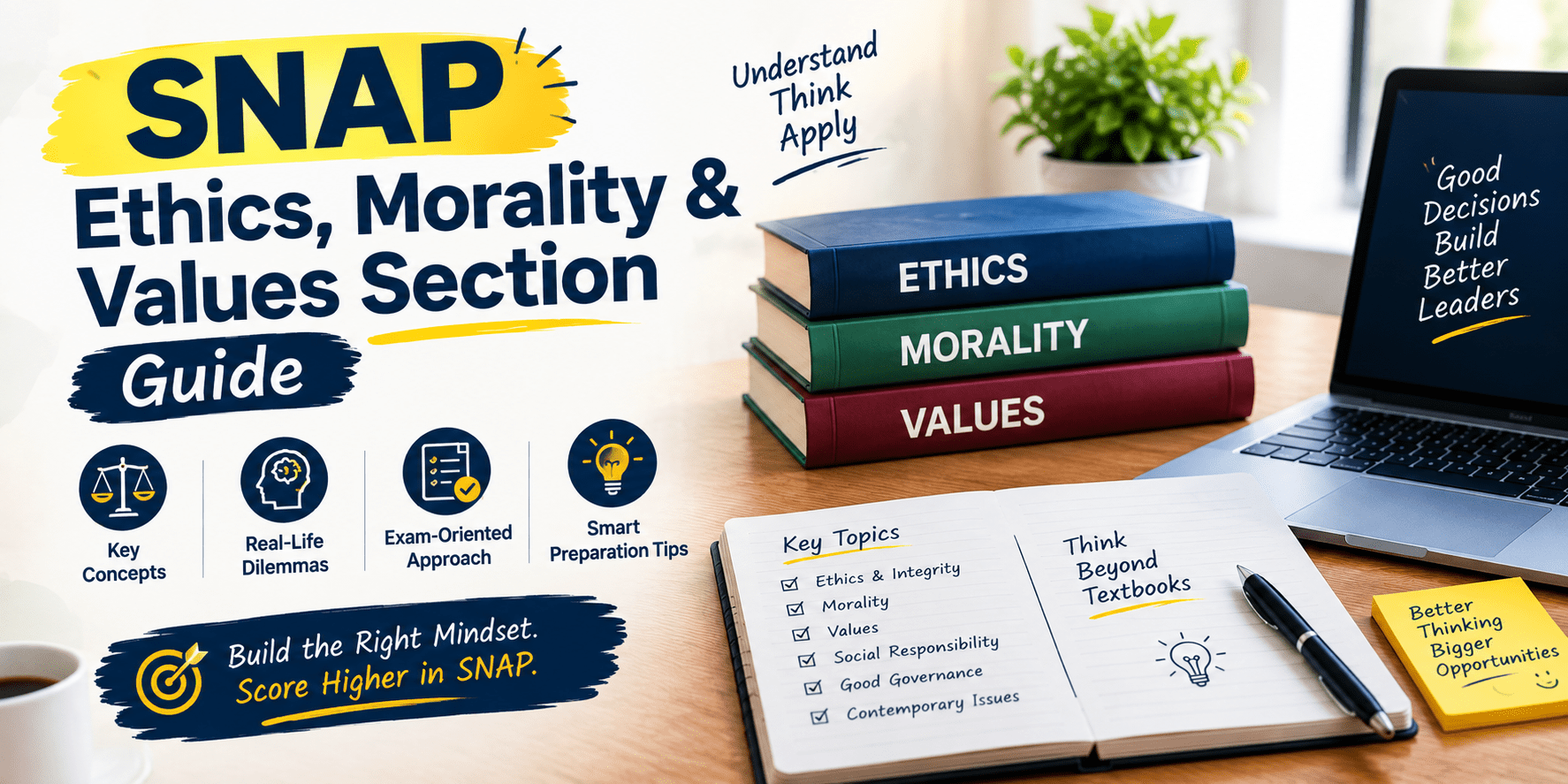
SNAP Ethics, Morality & Values Section: Full Guide, Syllabus & Prep Strategy
SNAP has added a brand-new fourth section for 2026 — Ethics, Morality and Values. Here’s everything currently known about what it tests, how it changes the exam pattern, and how to prepare for it, since there’s almost no detailed information about it anywhere else yet.
If you’ve been prepping for SNAP off last year’s pattern, stop — the exam changed under your feet this year. Symbiosis International (Deemed University) has added a completely new section to the SNAP 2026 test structure: Ethics, Morality and Values, worth 10 marks. It’s the first structural change to SNAP’s section line-up in years, and because the notification is barely a few weeks old, there’s very little detailed, practical guidance available on what it actually tests or how to prepare for it. This guide pulls together everything currently confirmed about the section — pattern, weightage, likely topics, question style, and a prep plan — so you’re not walking into December’s exam blind on a section nobody has taken before.
Preparing for SNAP 2026?
Get a free diagnostic session covering the new Ethics, Morality & Values section along with a full SNAP prep roadmap — Indore centre or online.
What Actually Changed in SNAP 2026
SNAP has run on the same three-section structure for years — General English, Analytical & Logical Reasoning, and Quantitative Ability with Data Interpretation & Data Sufficiency. The SNAP 2026 official notification (released August 2026) added a fourth: Ethics, Morality and Values. Importantly, the total paper size hasn’t grown — SIU carved out 10 questions from the existing sections rather than lengthening the test, so the overall 60-question, 60-minute, 60-mark format stays intact.
| Section | SNAP 2025 (Old Pattern) | SNAP 2026 (New Pattern) |
|---|---|---|
| General English | 15 questions | 10 questions |
| Analytical & Logical Reasoning | 25 questions | 20 questions |
| Quantitative, DI & DS | 20 questions | 20 questions |
| Ethics, Morality & Values | Did not exist | 10 questions NEW |
| Total | 60 | 60 |
General English absorbs the biggest cut (15→10) and Reasoning loses 5 questions (25→20); Quant, DI & DS is untouched at 20. Practically, this means your prep can no longer lean as heavily on English and Reasoning as it could last year — the paper now rewards a more even spread across all four areas.
What Is the Ethics, Morality & Values Section?
This is a brand-new 10-question, 10-mark section testing ethical reasoning, moral judgement, and values-based decision-making — a category SNAP has never tested before in a standalone section. Based on the official pattern released so far and how similar sections work in other MBA entrance exams, expect questions built around ethical dilemmas, business ethics scenarios, and situational judgement rather than pure factual recall of ethical theory.
Why Has SNAP Added an Ethics Section?
SIU hasn’t published an official explanation for the change, so anything here is informed reasoning rather than a confirmed rationale — worth stating plainly rather than guessing with false confidence. That said, the addition fits a pattern visible across other management entrance exams and B-school pedagogy more broadly:
- Ethics and governance have become a core part of MBA curricula at most B-schools, given increased scrutiny on corporate governance, ESG, and business accountability in the industry.
- Other flagship exams already test this territory — XAT’s long-standing Decision Making section evaluates similar judgement-under-ambiguity skills, and SNAP’s new section appears conceptually adjacent to it.
- It’s a differentiator for a test that competes directly with CAT and XAT for the same MBA applicant pool, and a distinct section gives SNAP its own identity beyond “CAT-lite.”
If and when SIU publishes an official statement on the rationale, this section should be updated to reflect it directly rather than relying on inference.
SNAP 2026 Full Exam Pattern (All 4 Sections)
| Parameter | Detail |
|---|---|
| Mode | Computer-Based Test (CBT) |
| Duration | 60 minutes, no sectional time limits |
| Total Questions / Marks | 60 questions for 60 marks |
| Sections | General English (10) · Analytical & Logical Reasoning (20) · Quantitative, DI & DS (20) · Ethics, Morality & Values (10) |
| Marking Scheme | +1 for every correct answer, −0.25 for every incorrect answer, 0 for unattempted |
| Sectional Cutoffs | None from SNAP itself — cutoffs are set independently by each Symbiosis institute |
| Number of Attempts | Up to 3 (Dec 13, Dec 19, Dec 26, 2026) — your highest score across attempts is used |
Because 0.25 marks are deducted per wrong answer with zero penalty for skips, blind guessing on the new Ethics section — where you have no past cutoffs or question banks to calibrate against — is riskier than guessing on a familiar section. Elimination-based attempts (ruling out 1–2 clearly wrong options) are safer than random guessing here.
Ethics, Morality & Values: Likely Syllabus & Topics
Since there’s no official topic-wise syllabus PDF yet, this list is built from the section’s stated scope in the pattern notification and the kind of themes management-ethics sections typically draw on:
Core Themes
Business-Context Themes
Reasoning Skills Tested
What Kind of Questions to Expect
Based on the section’s design and how comparable sections in other exams are structured, three broad question formats are likely. None of the examples below are official or leaked questions — they’re illustrative only, to show format and difficulty level.
Scenario-Based
A short workplace or business situation is described, followed by a question on the most appropriate or least appropriate course of action. Example style: “A team member reports a minor billing error that benefits the company. As the manager, what is the most appropriate first step?”
Concept-Based
Directly tests understanding of an ethical term or principle — definitions, distinctions between related concepts (e.g., ethics vs law, morality vs compliance), and applying a concept correctly to a short case.
Statement-Based
A set of statements or viewpoints is given, and the question asks which best reflects sound ethical reasoning, or asks you to rank statements by ethical soundness — similar in structure to critical reasoning questions.
How to Prepare for the Ethics, Morality & Values Section
1. Don’t leave it for the last week
Because it’s new, there’s a temptation to treat it as low-priority or “commonsense, no prep needed.” That’s a mistake — unfamiliar question formats cost time even when the underlying reasoning feels intuitive. Build it into your regular mock rotation from the start.
2. Build a working vocabulary of core ethical concepts
You don’t need a philosophy degree, but you do need working definitions of terms like integrity, conflict of interest, whistleblowing, CSR, corporate governance, and stakeholder responsibility — concept-based questions will assume you know these at a practical, business-applied level.
3. Practice reading speed on scenario questions
Scenario-based questions take longer to read than a standard quant or reasoning question. In mocks, track how long you’re spending per Ethics question specifically, since a 60-minute exam gives you no slack to overspend here.
4. Borrow practice material from XAT Decision Making
Until SNAP-specific question banks exist in volume, XAT’s Decision Making section is the closest available analogue in structure and difficulty — useful for practicing the “judge the best course of action” question style.
5. Set a time cap and stick to elimination, not guessing
With −0.25 negative marking and no sectional cutoff pressure, aim for roughly 8–10 minutes on this section in your first few mocks, then adjust based on accuracy. Eliminate clearly wrong options before attempting rather than guessing cold.
SNAP Ethics, Morality & Values vs XAT Decision Making
These two sections get compared often because they’re the only major national MBA entrance sections built around judgement rather than knowledge or calculation. They’re related, but not identical.
| Parameter | SNAP Ethics, Morality & Values | XAT Decision Making |
|---|---|---|
| Status | New for 2026 — first year | Long-established, well-documented section |
| Focus | Ethical reasoning, morality, values-based judgement | Broader managerial decision-making, often ethics-adjacent |
| Question Volume | 10 questions | Typically 21 questions |
| Study Material Available | Very limited — no past papers exist yet | Extensive — years of past papers and question banks |
If you’re preparing for both exams, XAT Decision Making practice is genuinely useful cross-training for the SNAP Ethics section — the judgement-under-ambiguity skill transfers even though the two sections aren’t identical in scope.
SNAP 2026: Quick Reference (Dates, Fees, Eligibility)
Since you’re here for the new section, here’s the rest of the SNAP 2026 cycle in one place so you don’t need a second tab open.
| Parameter | Detail |
|---|---|
| Registration Opens | August 21, 2026 |
| Registration Closes | November 25, 2026 |
| Exam Dates | December 13, 19 & 26, 2026 (attempt up to all three; best score counted) |
| Result Date | January 12, 2027 |
| Registration Fee | Approx. ₹2,250, plus separate programme-registration fees per Symbiosis institute selected |
| Eligibility | Graduation in any discipline from a recognised university with minimum 50% marks (45% for SC/ST candidates) |
| Scope | Gateway to MBA/MSc and other postgraduate programmes across 17 Symbiosis institutes |
Frequently Asked Questions
What is the new section added in SNAP 2026?
SNAP 2026 has added a fourth section called Ethics, Morality and Values, worth 10 marks out of the total 60. It tests ethical reasoning, moral judgement, and values-based decision-making through scenario-based and concept-based questions.
How many questions are in the SNAP Ethics, Morality & Values section?
10 questions, carrying 10 marks — about 16.7% of the total 60-mark paper.
Has the total SNAP exam duration or number of questions changed?
No. The exam is still 60 minutes long with 60 total questions. SIU redistributed 10 questions from the existing General English and Reasoning sections into the new Ethics section rather than lengthening the paper.
Is there negative marking in the new Ethics section?
Yes, the same scheme applies across the whole paper: −0.25 marks for every incorrect answer, and no penalty for questions left unattempted.
Is there an official syllabus for the Ethics, Morality & Values section?
SIU has not released a detailed, topic-wise syllabus document for this section as of now. Preparation guidance is currently based on the section’s stated scope and comparable sections in other exams, such as XAT’s Decision Making section — not an official SNAP syllabus PDF.
Is the SNAP Ethics section similar to XAT’s Decision Making section?
They’re conceptually related — both test judgement rather than pure knowledge or calculation — but they aren’t identical. XAT Decision Making is broader and covers more questions, while SNAP’s Ethics section is more narrowly focused on ethical and moral reasoning specifically.
Do I need a background in philosophy or ethics to do well in this section?
No. The section is designed to test practical, business-applied judgement rather than academic ethical theory. A working understanding of concepts like integrity, conflict of interest, and CSR, combined with practice on scenario-based reasoning, is a more effective preparation route than studying formal ethics.
Will SNAP institutes set a separate cutoff for the Ethics section?
SNAP itself does not set sectional cutoffs for any section — cutoffs are determined independently by each Symbiosis institute based on their own criteria. Whether individual institutes introduce a section-specific cutoff for Ethics this year hasn’t been confirmed; check each institute’s admission criteria once shortlists are released.
Get a Free SNAP 2026 Prep Session — Including the New Ethics Section
Connect on WhatsApp: 7697517555
The new section is everyone’s blind spot right now — use that.
Since almost no one has detailed prep material for Ethics, Morality & Values yet, early, structured practice is a genuine edge over aspirants who ignore it until November. Start building it into your mocks now.
Book My Free SNAP Prep Session