XAT · Decision Making Section
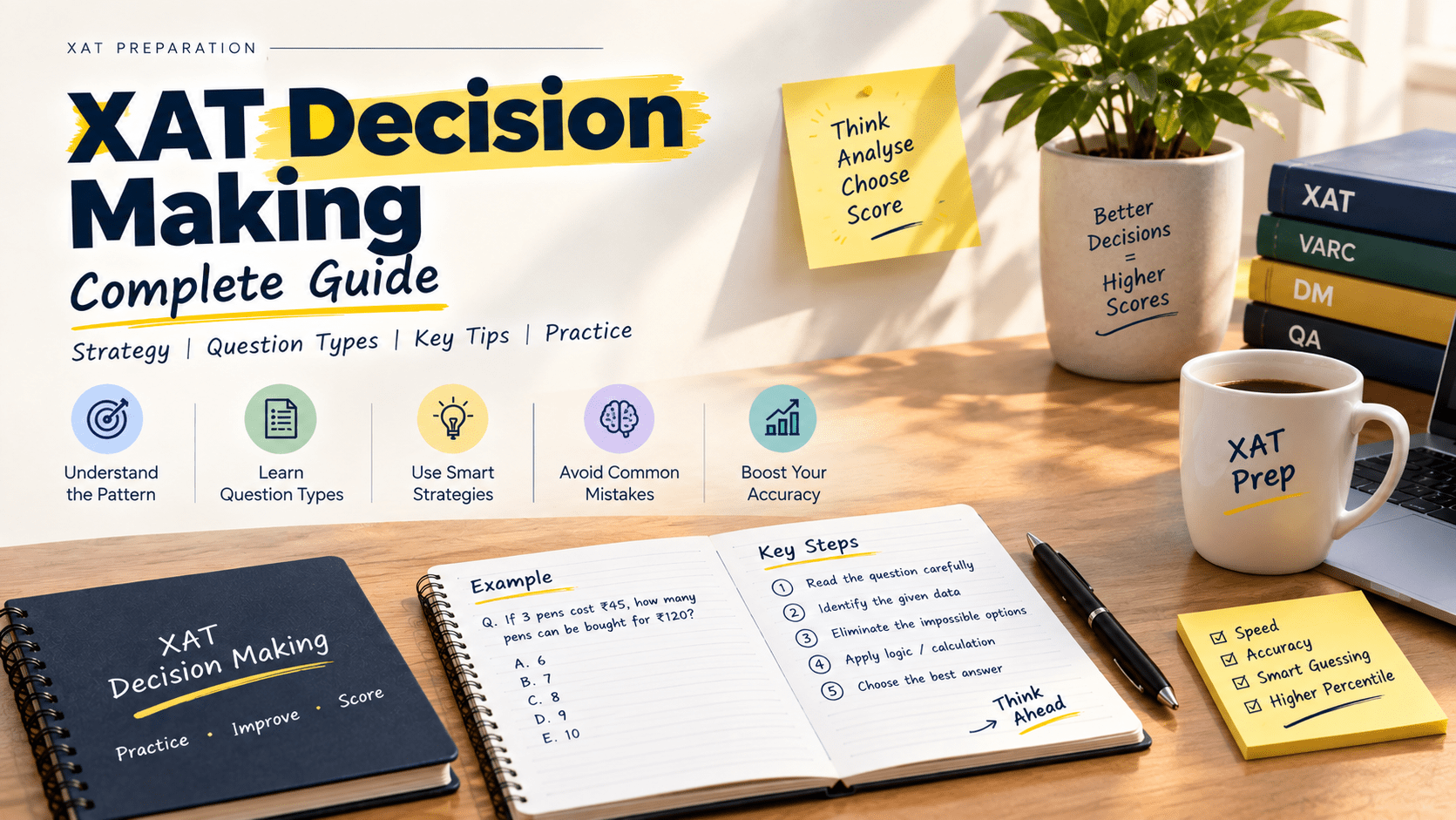
XAT Decision Making: The Complete Guide, Frameworks & Sample Questions
Unique to XAT, unpredictable by design, and the section most candidates prepare for the least. Full format, real ethical frameworks, why the "correct" answer often feels debatable, time-per-caselet guidance, and 10 fully worked sample questions.
The Xavier Aptitude Test (XAT) is known as one of India's toughest MBA entrances, and its Decision Making (DM) section is the single biggest reason why. Unlike Quant or Verbal, which test a specific, practicable skill, DM tests something harder to game: your judgment. There's no formula to memorise — just caselets describing real managerial dilemmas, where you pick the most reasonable course of action from five plausible-sounding options. This guide covers the exact format and scoring weight, practical ethical-reasoning frameworks, an honest discussion of why the "correct" answer often feels debatable, time management per caselet, and ten fully worked sample questions across ethical, business, and managerial scenarios.
Want more Decision Making practice?
Our free previous-year-papers portal has real, solved XAT Decision Making questions from past editions — with detailed reasoning for each answer.
What Is the XAT Decision Making Section?
Decision Making tests your ability to navigate real-life managerial dilemmas. Each caselet presents a scenario — an ethical conflict, a business problem, or a managerial challenge — and asks you to choose the most appropriate action from a list of alternatives. Unlike Quant or Verbal Ability, which test specific skills in isolation, DM assesses your overall thinking process: logical reasoning, ethical judgment, and business acumen combined. It's considered one of the most unique and unpredictable sections of any major MBA entrance exam.
Structure & Format
| Parameter | Detail |
|---|---|
| Total Questions | 21 to 23 |
| Number of Caselets | 7 to 8 |
| Questions per Caselet | 3 to 4 |
| Negative Marking (Wrong Answer) | 0.25 marks deducted, same as other XAT sections |
| Unattempted-Question Penalty | 0.10 marks deducted for each unattempted question beyond the first 8 (across the full test) |
| Sectional Time Limit | None for DM specifically — you can allocate time freely except for the separately-timed GK section |
Most caselets are multi-layered, combining ethical, operational, and financial dimensions in a single scenario — a genuinely good answer usually accounts for more than one of these at once. Confirm exact current-year figures against the official XAT notification.
How Much DM Actually Counts
DM questions contribute directly to your overall XAT percentile alongside Verbal & Logical Ability and Quantitative Ability & Data Interpretation — there's no separate DM-specific cutoff published by XLRI, but a weak DM performance drags down your composite score exactly like a weak Quant performance would. Because DM has no single objectively "correct" answer the way a math question does, XLRI's answer key for this section is typically finalised based on the option that reflects sound, balanced managerial judgment — which is precisely why understanding the reasoning frameworks below matters more than memorising rules.
Why This Section Matters
While QA, Verbal & Logical Ability, and GK are fairly standard across MBA entrances, DM gives examiners a direct window into your managerial temperament. In real business, decisions get made with incomplete information, under time pressure, and amid conflicting interests — leaders must weigh ethics against financial interest, act quickly without being reckless, and balance short-term wins against long-term consequences. A strong score here signals decision-making maturity — a quality XLRI weighs heavily given its historical strength in HR and general management.
Types of Questions
Morality vs Business Interest
Situations where the ethically correct decision conflicts with profit, convenience, or personal gain.
Strategy & Resource Allocation
Practical situations involving market dynamics, stakeholder interests, or resource constraints.
Team & Operational Challenges
Common workplace scenarios like team conflict or leadership challenges, requiring you to balance competing stakeholder expectations.
Ethical Frameworks You Can Actually Use
"Weigh ethics against business interest" is true but useless as practical advice. Here are three simplified reasoning lenses that genuinely help you evaluate options faster under time pressure:
Which Option Produces the Best Overall Outcome?
Weigh the total impact across all stakeholders — not just the company, but employees, customers, and the wider public. Options that create a small benefit for one group at a large cost to another usually score poorly under this lens.
What Are You Obligated to Do, Regardless of Outcome?
Some obligations hold even if breaking them produces a "better" short-term result — honesty with regulators, safety commitments, and legal compliance usually fall here. Options that violate a clear duty are rarely the right answer, however tempting the upside.
Does Any Group Bear an Unreasonable Share of the Cost?
Evaluate whether the burden of a decision falls disproportionately on a group with little power to object — employees, smaller vendors, or vulnerable customers. Options that quietly offload cost onto the least powerful stakeholder are usually wrong.
Run All Three, Fast
You won't have time for deep philosophical analysis. Instead, quickly ask all three questions in sequence — an option that holds up reasonably well across all three lenses is almost always the intended answer.
Why There's Rarely a "Clean" Right Answer
This is the single most common frustration aspirants voice about DM — and it's a fair one. Unlike a Quant question with one mathematically correct answer, DM options are deliberately written so that several sound reasonable at first glance. This isn't a flaw in the section; it's the actual point. XLRI is testing whether you can identify the most defensible option among several imperfect ones — not whether you can spot an objectively perfect solution, because in real management, perfect solutions rarely exist. The practical implication: stop searching for the option with zero downsides, and instead look for the option whose downsides are smallest, most manageable, and most honestly acknowledged.
Step-by-Step Approach
Step 1: Read the caselet thoroughly
Identify every stakeholder involved and their respective interests — note any conflicting objectives before you even glance at the answer options.
Step 2: Identify the core issue
Is it ethical, operational, financial, or interpersonal at its root? This determines which framework above is most relevant.
Step 3: Run the three-framework check
Quickly test the strongest 2-3 options against consequences, duty, and stakeholder fairness — the option holding up best across all three is usually correct.
Step 4: Eliminate extreme options first
Options that are too harsh, too passive, unethical, or illegal are almost always wrong — cut these immediately to narrow your real choice down to two or three.
Step 5: Choose the most defensible, not the most perfect, answer
Accept that your chosen option will have some downside — the goal is minimising and managing it, not eliminating it entirely.
Time Management per Caselet
With 7-8 caselets and no sectional time limit, budget roughly 2.5-3 minutes per caselet including all its questions (translating to a DM section total of around 20-24 minutes within your overall XAT time plan). Read the caselet once fully before touching any of its questions — re-reading the same caselet for each individual question wastes far more time than reading carefully once upfront.
Common Pitfalls to Avoid
- Overthinking the situation. Getting lost in hypothetical edge cases usually leads you away from the intended answer, not toward it.
- Ignoring ethical considerations in favour of the financially "smarter" option — DM consistently penalises this instinct.
- Choosing impulsive, short-term fixes without weighing their longer-term consequences.
- Searching for a perfect, downside-free answer. As covered above, this doesn't exist by design — look for the most defensible option instead.
- Re-reading the caselet for every question in its set. Read once, thoroughly, then work through all of that caselet's questions together.
10 Sample Questions & Solutions
Sample 1 — Ethical Dilemma
Scenario: You head a pharmaceutical company with a promising new drug for a life-threatening disease. It hasn't cleared all regulatory safety tests due to insufficient long-term data. Patient advocacy groups are pushing for immediate release.
Options: (1) Release immediately, bypassing regulation. (2) Wait for full testing. (3) Release under a compassionate-use programme with informed consent. (4) Sell in less-regulated markets. (5) Abandon the drug.
Answer: Option 3. Under the duty-based lens, it respects the obligation to regulatory honesty while still serving patients; under stakeholder-fairness, patients bear informed, consented risk rather than an imposed one.
Sample 2 — Business Scenario
Scenario: As regional sales manager, you find declining sales traced to understaffed, overworked service centres — but budget constraints block new hires.
Options: (1) Ignore complaints, push marketing. (2) Request more budget. (3) Retrain existing staff. (4) Outsource service. (5) Implement rotational shifts.
Answer: Option 5. Under the consequence-based lens, it's the only option that meaningfully redistributes existing workload without requiring additional budget — practical and immediately actionable.
Sample 3 — General Managerial Problem
Scenario: Your software project is behind schedule; the client wants the original deadline met, but your team is already working overtime and further pressure risks burnout and errors.
Options: (1) Push the team harder. (2) Inform the client, negotiate a new deadline. (3) Outsource part of the work. (4) Cut project scope. (5) Pull resources from other projects.
Answer: Option 2. Transparent communication preserves quality and the client relationship — the most defensible path under stakeholder-fairness, even though it isn't the most comfortable one.
Sample 4 — Ethical Dilemma
Scenario: Your manager asks you, a senior accountant, to adjust financial entries to look more attractive to investors — adjustments that violate accounting standards.
Options: (1) Comply. (2) Refuse and report upward immediately. (3) Discuss concerns with your manager and propose alternatives. (4) Ignore the request, submit unchanged statements. (5) Resign.
Answer: Option 3. Under the duty-based lens, it upholds your obligation to accurate reporting while still opening a constructive path before escalating further.
Sample 5 — Business Scenario
Scenario: Your company plans to automate processes that will improve efficiency but cause layoffs among long-term, loyal employees.
Options: (1) Automate immediately regardless of layoffs. (2) Cancel automation entirely. (3) Gradually automate while retraining staff for new roles. (4) Automate with generous severance. (5) Seek employee input first.
Answer: Option 3. It balances competitiveness with responsibility to existing employees — the strongest result across all three ethical lenses simultaneously.
Sample 6 — Ethical Dilemma
Scenario: You're a journalist with confidential proof that a public figure is involved in illegal activity. Publishing it would advance your career, but could endanger associates unaware of the wrongdoing.
Options: (1) Publish immediately. (2) Inform authorities and hold publication until action is taken. (3) Confront the figure for exclusive access in exchange for silence. (4) Ignore the information. (5) Leak it anonymously elsewhere.
Answer: Option 2. Under the duty-based lens, it honours your professional obligation to report wrongdoing while the stakeholder-fairness lens favours protecting uninvolved associates from harm first.
Sample 7 — General Managerial Problem
Scenario: Two team members from different cultural backgrounds are in conflict, hurting team morale and productivity. Both feel disrespected and refuse to collaborate.
Options: (1) Reprimand both. (2) Run a generic team-building activity. (3) Mediate a direct conversation between them. (4) Reassign one to a different team. (5) Ignore it, hoping it resolves itself.
Answer: Option 3. Direct mediation addresses the actual conflict rather than sidestepping it — the only option that resolves the root cause instead of masking or relocating it.
Sample 8 — Business Scenario
Scenario: Your company is close to launching a new product line, but market research shows significant risk from competition and uncertain demand. Your CEO wants to proceed regardless.
Options: (1) Support the CEO's decision unquestioningly. (2) Present your findings and recommend postponing. (3) Leak data to stakeholders to block the launch. (4) Proceed but prepare a contingency plan. (5) Resign over the disagreement.
Answer: Option 2. Under the duty-based lens, your professional obligation is to surface accurate data to leadership — the decision still ultimately rests with the CEO, but only after being properly informed.
Sample 9 — Ethical Dilemma
Scenario: You're close to your quarterly sales target. A client ready to make a large purchase asks you to provide false documentation to secure internal approval within their company.
Options: (1) Provide the false documentation. (2) Decline and risk losing the sale. (3) Report the client's request to your supervisor. (4) Try to convince the client to proceed without false documents. (5) Close the deal without documentation, hoping they secure approval independently.
Answer: Option 4. It attempts to preserve the sale ethically, satisfying the duty-based lens (no fraud) while still pursuing the consequence-based goal (closing the deal) where possible.
Sample 10 — General Managerial Problem
Scenario: As head of customer service, you find declining satisfaction traced to a new policy limiting representatives' authority to resolve issues without managerial approval, causing delays.
Options: (1) Remove the policy entirely. (2) Keep it unchanged. (3) Create a tiered system giving experienced reps more autonomy. (4) Add more managerial staff for faster approvals. (5) Ignore the ratings.
Answer: Option 3. It's the strongest option under the consequence-based lens — restoring speed for most cases while retaining oversight where it's genuinely needed, rather than an all-or-nothing fix.
Get a Free XAT Decision Making Strategy Session
Connect on WhatsApp: 7697517555
Decision Making rewards judgment you can actually train.
It's not random — there's a real method, and it gets sharper with real practice. Let's build your XAT strategy, DM included.
Book My Free Strategy SessionYou've got the DM framework. Here's how to turn it into a 90s percentile.
Same faculty, same mock test series, same mentorship — across every format below. Pick the one that fits how you actually study.
Choose Your Course Format
Classroom XAT Coaching
Daily doubt-solving and face-to-face mentorship at our Indore center, with a fixed structure to keep you on track.
LIVE Online XAT Coaching
Real-time classes from anywhere in India, with the same faculty, schedule, and mock benchmarks as our classroom batches.
Self-Paced Online XAT Course
Recorded lectures you revisit on your own schedule, at the pace that actually fits your week.
Pair It With
XAT Preparation Books
Structured print material across QA, VARC, DILR, and DM, written to match the current exam pattern.
Explore Prep Books →XAT Test Series
Full-length, sectional, and DM-only mocks, benchmarked against the real all-India percentile curve, so you can test your time-management under real pressure.
Explore Test Series →Frequently Asked Questions
How many questions are in the XAT Decision Making section?
Typically 21 to 23 questions, spread across 7 to 8 caselets with 3 to 4 questions each.
Is there negative marking in the Decision Making section?
Yes — 0.25 marks are deducted per incorrect answer, the same as other XAT sections. Additionally, 0.10 marks are deducted for each unattempted question beyond the first 8, across the full test.
Why do DM questions often feel like they have no clean right answer?
Because that's intentional — XLRI is testing your ability to identify the most defensible option among several imperfect ones, mirroring how real managerial decisions rarely have a perfect, downside-free solution.
What ethical framework should I use to evaluate options?
Three practical lenses help: consequence-based (best overall outcome), duty-based (obligations that hold regardless of outcome), and stakeholder-fairness (whether any group bears an unreasonable share of the cost). Options that hold up across all three are usually correct.
How much time should I spend on the DM section overall?
Roughly 2.5-3 minutes per caselet, including all its questions — around 20-24 minutes total for the full section, though there's no fixed sectional time limit.
Is Decision Making unique to XAT?
Yes. It's one of the features that most distinctly separates XAT from CAT and other major MBA entrance exams, which don't have a comparable standalone section.