CAT 2023 - Slot 1 Dilr Question 17
This is a detailed step-by-step solution for CAT 2023 - Slot 1 Dilr Question 17. Understand the concept, common mistakes, and expert tips to solve similar questions in CAT exam.
CAT 2023 Slot 1 - DILR
Some of the houses are occupied. The remaining ones are vacant and are the only ones available for sale.
The road adjacency value of a house is the number of its sides adjacent to a road. For example, the road adjacency values of C2, F2, and B1 are 2, 1, and 0, respectively. The neighbour count of a house is the number of sides of that house adjacent to occupied houses in the same block. For example, E1 and C1 can have the maximum possible neighbour counts of 3 and 2, respectively.
The base price of a vacant house is Rs. 10 lakhs if the house does not have a parking space, and Rs. 12 lakhs if it does. The quoted price (in lakhs of Rs.) of a vacant house is calculated as (base price) + 5 × (road adjacency value) + 3 × (neighbour count).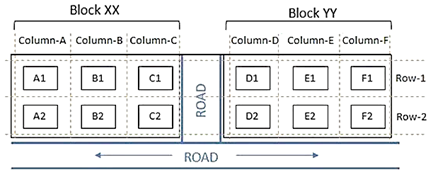
Some of the houses are occupied. The remaining ones are vacant and are the only ones available for sale.
We have entered the road adjacency numbers inside the boxes in purple.
The neighbour count of a house is the number of sides of that house adjacent to occupied houses in the same block. For example, E1 and C1 can have the maximum possible neighbour counts of 3 and 2, respectively.
The base price of a vacant house is Rs. 10 lakhs if the house does not have a parking space, and Rs. 12 lakhs if it does. The quoted price (in lakhs of Rs.) of a vacant house is calculated as (base price) + 5 × (road adjacency value) + 3 × (neighbour count).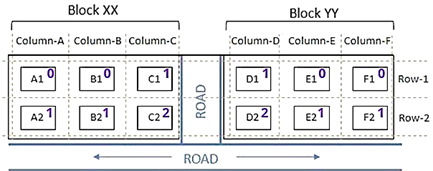
Some of the houses are occupied. The remaining ones are vacant and are the only ones available for sale.
We have entered the road adjacency numbers inside the boxes in purple.
We have entered the maximum possible neighbour count outside the box in red. Note that this is the max possibly neighbour count and not actual neighbour count.
Quoted Price = 10L/12L + 5 × (Road Adjacency) + 3 × (Neighbour Count)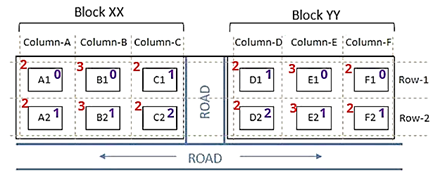
1. The maximum quoted price of a house in Block XX is Rs. 24 lakhs.
2. The minimum quoted price of a house in block YY is Rs. 15 lakhs, and one such house is in Column-E.
3. Row-1 has two occupied houses, one in each block.
4. Both houses in Column-E are vacant. Each of Column-D and Column-F has at least one occupied house.
5. There is only one house with parking space in Block YY.
Quoted Price = 10L/12L + 5 × (Road Adjacency) + 3 × (Neighbour Count)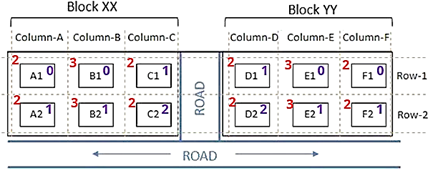
1. The maximum quoted price of a house in Block XX is Rs. 24 lakhs. The minimum quoted price of a house in block YY is Rs. 15 lakhs, and one such house is in Column-E.
2. Row-1 has two occupied houses, one in each block.
3. Both houses in Column-E are vacant. Each of Column-D and Column-F has at least one occupied house.
4. There is only one house with parking space in Block YY.
Quoted Price = 10L/12L + 5 × (Road Adjacency) + 3 × (Neighbour Count)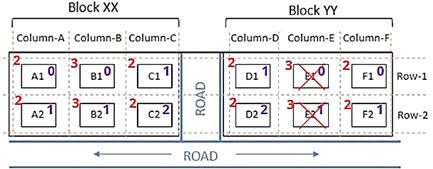
1. The maximum quoted price of a house in Block XX is Rs. 24 lakhs. - Which house could this be?
2. The minimum quoted price of a house in block YY is Rs. 15 lakhs, and one such house is in Column-E.
3. Row-1 has two occupied houses, one in each block.
4. Both houses in Column-E are vacant. Each of Column-D and Column-F has at least one occupied house.
5. 4. There is only one house with parking space in Block YY.
Quoted Price = 10L/12L + 5 × (Road Adjacency) + 3 × (Neighbour Count)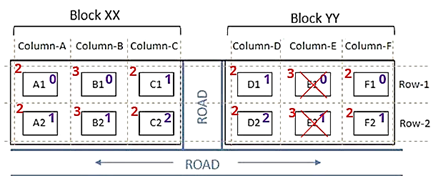
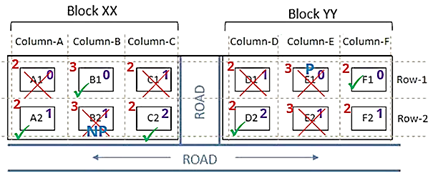
1. The maximum quoted price of a house in Block XX is Rs. 24 lakhs. - Which house could this be? A1, B1 cannot reach up to Rs. 24 lakhs. Nor can C1 or A2. C2 price should be 10/12 + 10 + 3 × (Neighbour count). This can be 20/22 or 23/25 or 26/28. So, B2 should be the one that costs Rs. 24 lakhs.
2. The minimum quoted price of a house in block YY is Rs. 15 lakhs, and one such house is in Column-E.
3. Row-1 has two occupied houses, one in each block.
4. Both houses in Column-E are vacant. Each of Column-D and Column-F has at least one occupied house.
5. 4. There is only one house with parking space in Block YY.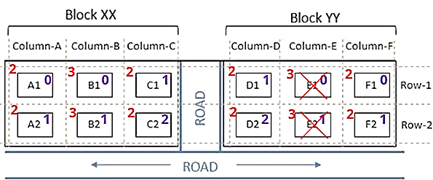
1. The maximum quoted price of a house in Block XX is Rs. 24 lakhs. - Which house could this be? A1, B1 cannot reach up to Rs. 24 lakhs. Nor can C1 or A2. C2 price should be 10/12 + 10 + 3 × (Neighbour count). This can be 20/22 or 23/25 or 26/28. So, B2 should be the one that costs Rs. 24 lakhs. So, B2 comes with no parking lot and 3 neighbours.
2. The minimum quoted price of a house in block YY is Rs. 15 lakhs, and one such house is in Column-E.
3. Row-1 has two occupied houses, one in each block.
4. Both houses in Column-E are vacant. Each of Column-D and Column-F has at least one occupied house.
5. 4. There is only one house with parking space in Block YY.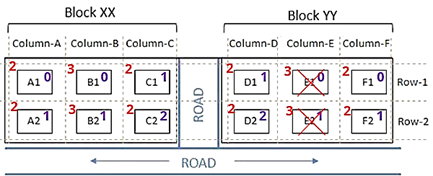
1. The maximum quoted price of a house in Block XX is Rs. 24 lakhs. - Which house could this be? A1, B1 cannot reach up to Rs. 24 lakhs. Nor can C1 or A2. C2 price should be 10/12 + 10 + 3 × (Neighbour count). This can be 20/22 or 23/25 or 26/28. So, B2 should be the one that costs Rs. 24 lakhs. So, B2 comes with no parking lot and 3 neighbours.
2. The minimum quoted price of a house in block YY is Rs. 15 lakhs, and one such house is in Column-E.
3. Row-1 has two occupied houses, one in each block.
4. Both houses in Column-E are vacant. Each of Column-D and Column-F has at least one occupied house.
5. 4. There is only one house with parking space in Block YY.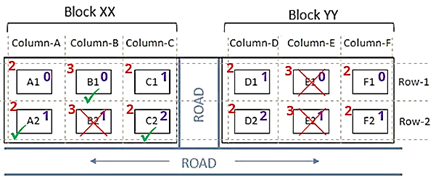
1. The maximum quoted price of a house in Block XX is Rs. 24 lakhs. So, B2 comes with no parking lot and 3 neighbours.
2. The minimum quoted price of a house in block YY is Rs. 15 lakhs, and one such house is in Column-E.
3. Row-1 has two occupied houses, one in each block.
4. Both houses in Column-E are vacant. Each of Column-D and Column-F has at least one occupied house.
5. There is only one house with parking space in Block YY.
Quoted Price = 10L/12L + 5 × (Road Adjacency) + 3 × (Neighbour Count)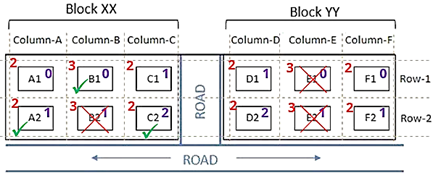
1. The maximum quoted price of a house in Block XX is Rs. 24 lakhs. So, B2 comes with no parking lot and 3 neighbours.
2. The minimum quoted price of a house in block YY is Rs. 15 lakhs, and one such house is in Column-E.
3. Row-1 has two occupied houses, one in each block.
4. Both houses in Column-E are vacant. Each of Column-D and Column-F has at least one occupied house.
5. There is only one house with parking space in Block YY.
Quoted Price = 10L/12L + 5 × (Road Adjacency) + 3 × (Neighbour Count)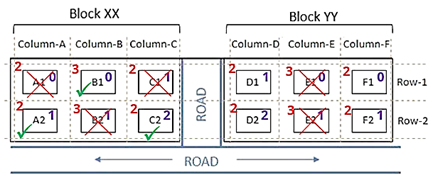
1. The maximum quoted price of a house in Block XX is Rs. 24 lakhs. So, B2 comes with no parking lot and 3 neighbours.
2. The minimum quoted price of a house in block YY is Rs. 15 lakhs, and one such house is in Column-E. Either E1 with base price 12 and one neighbour or E2 with base price 10 and zero neighbours
3. Row-1 has two occupied houses, one in each block.
4. Both houses in Column-E are vacant. Each of Column-D and Column-F has at least one occupied house.
5. There is only one house with parking space in Block YY.
Quoted Price = 10L/12L + 5 × (Road Adjacency) + 3 × (Neighbour Count)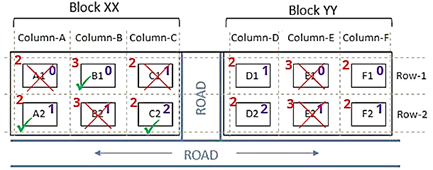
1. The maximum quoted price of a house in Block XX is Rs. 24 lakhs. So, B2 comes with no parking lot and 3 neighbours.
2. The minimum quoted price of a house in block YY is Rs. 15 lakhs, and one such house is in Column-E. Either E1 with base price 12 and one neighbour or E2 with base price 10 and zero neighbours.
1. If it were E2 with zero neighbours, then D2 and F2 should be empty. This means D1 and F1 should be occupied (constraint 4). This is not possible as Row 1 has only one occupied house in block YY.
3. Row-1 has two occupied houses, one in each block.
4. Both houses in Column-E are vacant. Each of Column-D and Column-F has at least one occupied house.
5. There is only one house with parking space in Block YY.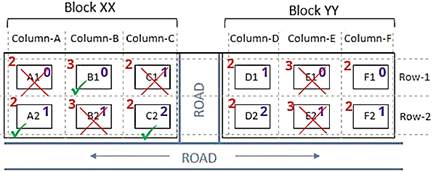
1. The maximum quoted price of a house in Block XX is Rs. 24 lakhs. So, B2 comes with no parking lot and 3 neighbours.
2. The minimum quoted price of a house in block YY is Rs. 15 lakhs, and one such house is in Column-E. E1 should have base price 12 and one neighbour.
3. Row-1 has two occupied houses, one in each block.
4. Both houses in Column-E are vacant. Each of Column-D and Column-F has at least one occupied house.
5. There is only one house with parking space in Block YY.
Quoted Price = 10L/12L + 5 × (Road Adjacency) + 3 × (Neighbour Count)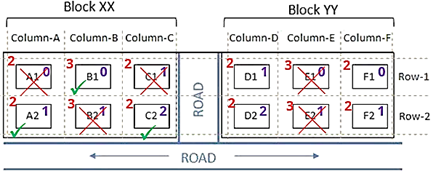
1. The maximum quoted price of a house in Block XX is Rs. 24 lakhs. So, B2 comes with no parking lot and 3 neighbours.
2. The minimum quoted price of a house in block YY is Rs. 15 lakhs, and one such house is in Column-E. E1 should have base price 12 and one neighbour. Either F1 or D1 should be vacant. If F1 were vacant, it would have a maximum quoted price of 10 + 3 = 13. This is not possible.
3. Row-1 has two occupied houses, one in each block.
4. Both houses in Column-E are vacant. Each of Column-D and Column-F has at least one occupied house.
5. There is only one house with parking space in Block YY.
Quoted Price = 10L/12L + 5 × (Road Adjacency) + 3 × (Neighbour Count)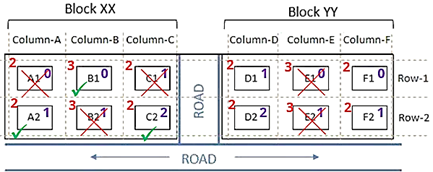
1. The maximum quoted price of a house in Block XX is Rs. 24 lakhs. So, B2 comes with no parking lot and 3 neighbours.
2. The minimum quoted price of a house in block YY is Rs. 15 lakhs, and one such house is in Column-E. E1 should have base price 12 and one neighbour. D1 is vacant, F1 is occupied.
3. Row-1 has two occupied houses, one in each block.
4. Both houses in Column-E are vacant. Each of Column-D and Column-F has at least one occupied house.
5. There is only one house with parking space in Block YY.
Quoted Price = 10L/12L + 5 × (Road Adjacency ) + 3 × (Neighbour Count)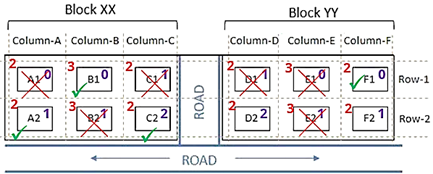
1. The maximum quoted price of a house in Block XX is Rs. 24 lakhs. So, B2 comes with no parking lot and 3 neighbours.
2. The minimum quoted price of a house in block YY is Rs. 15 lakhs, and one such house is in Column-E. E1 should have base price 12 and one neighbour. D1 is vacant, F1 is occupied.
3. Row-1 has two occupied houses, one in each block.
4. Both houses in Column-E are vacant. Each of Column-D and Column-F has at least one occupied house.
5. There is only one house with parking space in Block YY.
Quoted Price = 10L/12L + 5 × (Road Adjacency) + 3 × (Neighbour Count)