
IPM · Exit Options Explained
IPM Exit Options Explained: What You Actually Get If You Leave After 3 Years
Every IIM's 5-year IPM lets you exit early — but "exit with a degree" means something different at every single institute. Here's the complete, institute-by-institute breakdown of exit degrees, CGPA cutoffs, and whether leaving early is actually a good idea.
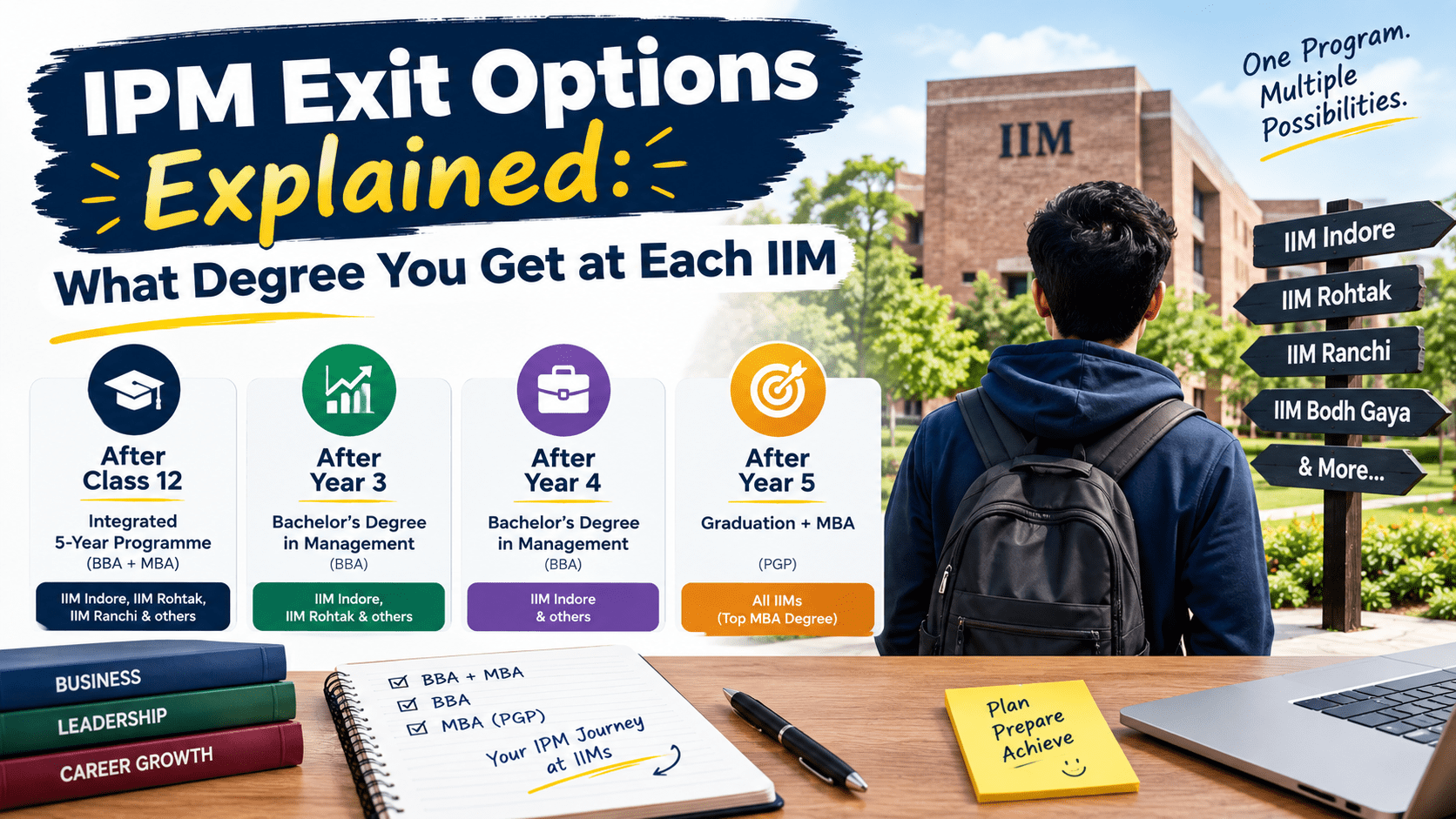
IPM has an exit option after 3 years" is one of the most repeated lines in every IPM brochure — and one of the least explained. Exit with what, exactly? The answer turns out to be surprisingly different depending on which IIM you're at: a BA at Indore, a BBA at Rohtak and Ranchi, a stack of certificates building up to a BBA at Jammu, and — most unexpectedly — a specialised finance-and-economics degree at Amritsar that most aspirants have never heard of. This guide breaks down exactly what each IIM's IPM exit actually gives you, the CGPA thresholds that decide whether you continue or leave, and a straight answer on whether exiting early is ever the right call.
*Based on industry estimates from IPM alumni/coaching sources rather than official institute-published data — treat as indicative, not exact.
Weighing IPM vs a straight IPMAT/CAT path?
Get a free counselling session to map out your IPM strategy — including exit-option planning — before you commit five years of your life to one institute.
Why Does IPM Even Have an Exit Option?
The exit structure isn't an institute-specific favour — it's built into how India's higher education framework now works. The National Education Policy (NEP) 2020 mandates multiple exit points in undergraduate education, so a student's years of study are never "wasted" if they choose not to complete a full degree. IIMs running 5-year IPM programmes have built this in from the start: since the programme is legally structured as a 3-year undergraduate phase followed by a 2-year MBA-equivalent phase, a student who completes the first phase has, by definition, completed a full bachelor's degree — and is entitled to be awarded one, whether or not they continue to the MBA phase.
This matters more than it sounds: it means exiting after 3 years isn't a consolation prize or a "dropout" credential. It's a real, complete degree that the institute is obligated to confer once you clear the requirements — you're simply choosing to stop there instead of continuing.
Full Comparison: IPM Exit Options Across All IIMs
| Institute | Total Duration | Exit Point | Exit Degree Awarded | Entrance Test |
|---|---|---|---|---|
| IIM Indore | 5 years | After Year 3 | BA (Foundations of Management) | IPMAT Indore |
| IIM Rohtak | 5 years | After Year 3 | BBA (subject to CGPA — see below) | IPMAT Rohtak |
| IIM Ranchi | 5 years | After Year 3 | BBA | IPMAT Indore |
| IIM Bodh Gaya | 5 years | After Year 3 (NEP multi-exit) | BBA | JIPMAT |
| IIM Jammu | 5 years | Year 1 / Year 2 / Year 3 | Certificate → Diploma → BBA | JIPMAT |
| IIM Shillong | 5 years | Year 1 / 2 / 3 / 4 | Certificate → Diploma → Degree → BBA (Hons) | IPMAT Indore |
| IIM Amritsar | 5 years | After Year 3 | BSQFE (B.Sc. in Quantitative Finance & Economics) | IPMAT Indore |
| IIM Sirmaur | 4 years (BMS, not a 5-yr IPM) | Every year | Certificate → Diploma → Degree → BMS (Hons) | IPMAT / DBE / BMS-AT / JEE Mains / CUET |
Institute-Wise Exit Details
BA (Foundations of Management)
India's original IPM (launched 2011) awards a Bachelor of Arts (Foundations of Management) to students exiting after Year 3. Uniquely, Indore also offers a sabbatical option of up to 2 years between Year 3 and Year 4 — letting students pause (for an internship, a startup attempt, or personal reasons) without formally exiting, then resume the MBA phase later, subject to institute approval.
BBA, CGPA-Gated
Rohtak's exit isn't automatic — it's a CGPA-based fork. Students with a CGPA between 4.0 and below 5.0 at the end of Year 3 exit with a BBA. Students who clear 5.0 or above continue directly into the MBA phase. Fall below 4.0, and continuation options narrow further — making Rohtak's system more of a graded ladder than a single go/no-go choice.
BBA
Students completing all Year 1–3 requirements exit with a Bachelor of Business Administration. A capstone assessment at the end of Year 3 determines promotion into the MBA phase, which requires a minimum CGPA of 4.5.
BBA
Exit is available after Year 3 in line with NEP 2020's multi-exit framework, awarding a BBA degree. Continuation into the MBA phase requires a minimum CGPA of 5.50 — notably higher than several peer institutes.
Multi-Year Exit Tracks: Jammu, Shillong & Sirmaur
Three institutes go beyond a single "exit after Year 3" checkpoint and offer a genuine NEP-style ladder — meaning you can walk away with something even if you leave after just one year.
IIM Jammu: Certificate → Diploma → BBA
Exit after Year 1 gets you a Certificate in Basics of Management. Exit after Year 2 gets you an Advanced Certificate/Diploma in Management. Exit after Year 3, with a minimum CGPA of 6.00, gets you the full BBA — and the same 6.00 CGPA threshold is what's required to continue directly into the MBA phase instead.
IIM Shillong: The longest exit ladder
Shillong extends the ladder furthest — Year 1, 2, and 3 exits mirror the certificate/diploma/degree progression seen at Jammu, but Shillong also allows an exit after Year 4, awarding a BBA (Hons) degree — a credential most other IPM tracks simply don't offer, since everywhere else the choice is binary at Year 3 (leave now, or commit to the full MBA phase).
IIM Sirmaur: A 4-year BMS, not a 5-year IPM
IIM Sirmaur's undergraduate track is structured differently from the start — it's a standalone 4-year Bachelor of Management Studies (BMS), not a 5-year IPM. It still follows NEP's exit ladder (certificate → diploma → degree → BMS Hons across the four years), and students completing the BMS with a CGPA of 8.0 or above can transition directly into IIM Sirmaur's MBA without appearing for CAT.
CGPA Cutoffs: Exit vs Continue, at a Glance
| Institute | Min. CGPA to Continue to MBA Phase |
|---|---|
| IIM Rohtak | 5.0 (below 5.0 down to 4.0 → BBA exit) |
| IIM Ranchi | 4.5 |
| IIM Bodh Gaya | 5.50 |
| IIM Jammu | 6.00 |
| IIM Sirmaur (BMS → MBA) | 8.0 |
Institutes without a clearly published minimum CGPA for continuation (Indore, Amritsar) generally require students to have cleared all academic requirements of the first phase in good standing — check the current academic regulations directly with the institute, since these thresholds are revised periodically.
Should You Exit After 3 Years, or Continue?
This is the question that actually matters, and the honest answer is: it depends heavily on what your Year 3 looks like compared to when you enrolled.
You Have a Better Option Lined Up
The single most common reason students exit is to attempt CAT/GMAT/XAT in Year 3 and move to a higher-ranked IIM or B-school for their MBA. If you clear a better call, the 3-year foundation you've built (quant, econ, communication) makes you well-prepared for that MBA — and the exit degree validates the years already spent.
You're Changing Direction Entirely
Some students exit to pursue entrepreneurship, a different academic field (law, other postgrad routes), or study abroad — where an IIM-affiliated bachelor's degree plus 3 years of rigorous coursework is a credible launchpad, even without the MBA attached.
You Don't Have a Concrete Alternative
An MBA from your current IIM is, in almost every case, more valuable in the placement market than a standalone exit-phase Bachelor's degree from the same institute. Exiting "just to be done early" without a specific next step (a better admit, a business plan, a clear reason) generally isn't the stronger financial or career decision.
You Lose Automatic MBA Entry
IPM's biggest structural advantage — skipping CAT entirely for your own institute's MBA — disappears the moment you exit. If you leave, you go back into the general applicant pool for any future MBA, competing on the same terms as everyone else.
What Happens If You Exit — Re-Entry & Next Steps
Once you exit, there's no fast-track re-entry into the same institute's MBA phase later — you're treated as a fresh applicant. Concretely, this means:
- You must clear CAT, GMAT, or another accepted entrance test to pursue an MBA anywhere, including at your own former institute.
- You go through the full admissions process — application, entrance score, personal interview, WAT/GD where applicable — with no automatic weightage for your prior IPM years.
- Your IPM years still count for something real: the quantitative and analytical foundation, plus the credibility of an IIM-affiliated bachelor's degree on your resume, both carry weight in later applications and interviews.
- Some students use the exit specifically as a launchpad year — exiting, working or interning for a year or two, then applying to MBA programmes with both the IPM foundation and fresh work experience on their profile.
Is the IPM Exit Degree Actually Valuable in the Job Market?
This is the question families are usually most anxious about, and it deserves an honest, non-inflated answer.
In practice, very few students use the exit degree as a terminal, standalone credential to enter the job market directly. It's far more commonly used as a stepping stone — either into a different, higher-ranked MBA, into further studies abroad, or into an entrepreneurial path where the "IIM-affiliated bachelor's + 3 years of rigorous coursework" story matters more than the degree title itself.
Frequently Asked Questions
Can I exit IPM after 3 years at any IIM?
Yes — every IIM offering the 5-year IPM (Indore, Rohtak, Ranchi, Bodh Gaya, Jammu, Shillong, Amritsar) provides an exit option after Year 3, in line with NEP 2020's multiple-exit framework. IIM Sirmaur's programme is structured differently as a 4-year BMS with exits available every year.
What degree do I get if I exit IPM after 3 years?
It varies by institute: a BA (Foundations of Management) at IIM Indore, a BBA at IIM Rohtak, Ranchi, Bodh Gaya, Jammu, and Shillong, and a distinctive BSQFE (Bachelor of Science in Quantitative Finance & Economics) at IIM Amritsar.
Is there a minimum CGPA required to exit IPM?
Generally, you need to have cleared all academic requirements of the first 3 years in good standing to be awarded the exit degree. Several institutes also use CGPA as a fork between exiting and continuing — for example, Rohtak requires a CGPA of at least 5.0 to continue into the MBA phase (students between 4.0–5.0 exit with a BBA), Ranchi requires 4.5, Bodh Gaya requires 5.50, and Jammu requires 6.00.
Can I exit IPM before completing 3 years?
At most institutes, no — the standard exit checkpoint is after Year 3. However, IIM Jammu, IIM Shillong, and IIM Sirmaur's BMS offer earlier exit points (Year 1 and Year 2) with a Certificate or Diploma, following NEP 2020's full multi-exit ladder.
If I exit IPM, can I rejoin the same IIM's MBA later?
Not automatically. Once you exit, you must apply afresh through CAT, GMAT, or another accepted entrance test and go through the complete admissions process like any other applicant — your prior IPM years do not guarantee re-entry or give you a scoring advantage.
What is the BSQFE degree at IIM Amritsar?
BSQFE stands for Bachelor of Science in Quantitative Finance and Economics — the exit degree IIM Amritsar's IPM awards after Year 3. It's distinct from the BA/BBA exit degrees at other IIMs, with a specific focus on quantitative techniques applied to finance and economics.
Is an IPM exit degree the same as a regular BBA from another college?
Not really, in substance — though the degree name (BBA) may be identical. IPM's first-phase coursework, IIM-level pedagogy, and institute affiliation typically differ meaningfully from a standalone 3-year BBA elsewhere. That said, it also isn't equivalent to a full IIM MBA in placement outcomes, since IPM placements happen at the end of the full 5-year programme alongside the MBA batch.
Why would someone exit IPM instead of completing the full 5 years?
The most common reason is securing admission to a higher-ranked IIM or B-school via CAT/GMAT during Year 3 and choosing to pursue that MBA instead. Other reasons include entrepreneurship plans, a shift to a different academic field, or studying abroad.
Confused Between IPM Options? Get a Free Counselling Session
Connect on WhatsApp: 7697517555
Choosing an IIM for IPM is a 5-year decision — plan the exit before you plan the entry.
Understanding each institute's exit ladder and CGPA thresholds now can save you a difficult decision three years in. Talk to a mentor before you finalise your IPMAT/JIPMAT college preferences.
Book My Free Counselling Session