SNAP · Symbiosis National Aptitude Test
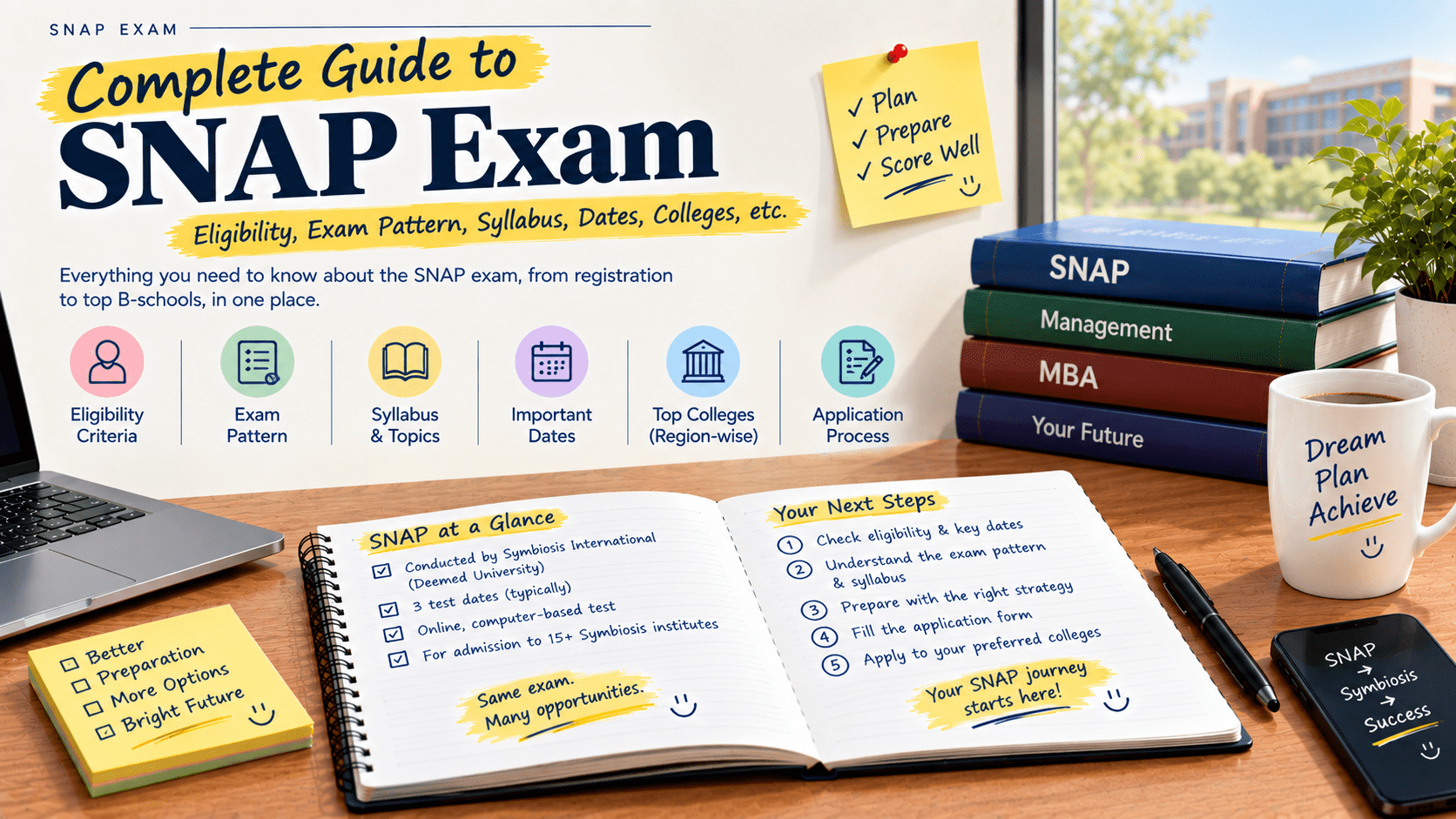
SNAP Exam: Eligibility, Pattern, Syllabus, Selection Process & Participating Institutes
One 60-minute test decides your shortlist for every Symbiosis MBA programme you apply to — and you get up to three attempts, with your best score counted. Here’s a complete breakdown of SNAP’s eligibility, the four-section pattern including its new Ethics section, marking scheme, fees, results, GE-PI-WAT selection, and how SNAP compares to CAT and CMAT.
If your target B-school is one of the Symbiosis institutes — SIBM Pune, SCMHRD, SIBM Bengaluru, SIIB, or any of the other SIU-affiliated colleges — SNAP is the exam standing between you and a shortlist. Unlike CAT, it’s a short, sharp 60-minute test, and unlike most entrance exams, you get up to three attempts in the same admission cycle with your best score counted. This guide covers SNAP end to end: what it actually tests, who’s eligible, the real exam pattern, the newly added Ethics section, how percentile works, what GE-PI-WAT actually involves, which institutes accept your score, and how SNAP stacks up against CAT and CMAT.
Want a SNAP prep plan built around your target institute?
Get a free session — we’ll map a study plan to the cutoff percentile your target SIU institute actually needs.
What Is SNAP?
SNAP (Symbiosis National Aptitude Test) is the entrance test for MBA and PGDM admission at institutes affiliated with Symbiosis International (Deemed University). It’s a short, single-sitting computer-based test — no sectional time limits, no separate essay paper the way some exams have — designed to be finished inside an hour. Clearing SNAP with a competitive percentile doesn’t itself get you a seat: it gets you shortlisted for each institute’s own Group Exercise, Personal Interview, and Writing Ability Test (GE-PI-WAT) round, which is where the final admission decision actually happens.
Why Take SNAP
Done in 60 minutes
No 2-3 hour marathon. One focused sitting, and you know your percentile within weeks, not months.
Three chances, best score counted
A rough first session doesn’t sink you. Register for a retake and your improved score is what institutes see.
Mild negative marking
−0.25 on a +1 question is a far gentler ratio than CAT’s −1 on +3, so calculated guessing pays off more often here.
17 institutes, 29 programmes
One score, one application cycle, and a genuine choice of Symbiosis campuses and specialisations to apply across.
No sectional time limit
You choose your own section order and pacing inside the 60 minutes — a real strategic lever most exams don’t give you.
Overlaps with CAT prep
Quant and reasoning fundamentals carry over almost entirely, so SNAP is a low-cost addition if you’re already deep into CAT prep.
SNAP Eligibility
| Criterion | Requirement |
|---|---|
| Educational Qualification | A bachelor’s degree (10+2+3 or equivalent) from any recognised university, in any discipline |
| Minimum Marks — General category | At least 50% aggregate marks or equivalent grade in the bachelor’s degree |
| Minimum Marks — SC/ST/PwBD categories | Relaxed to at least 45% aggregate marks |
| Final-Year Students | Eligible to apply, provided the degree is completed before the institute’s specified deadline, usually at admission confirmation |
| NRI / International Candidates | Eligible with an equivalence certificate from the Association of Indian Universities (AIU) for degrees from foreign universities |
| Age Limit | No upper age limit specified |
Important SNAP Dates (Tentative)
SIU sets the exact schedule fresh every cycle, so specific dates aren’t worth memorising months out. The month-wise sequence below has stayed fairly consistent, though, and is useful for planning your prep timeline before the current year’s bulletin is out.
SNAP Exam Pattern
SNAP’s pattern was recently revised to add a fourth section, so make sure you’re studying the current structure rather than an older three-section version still floating around online.
| Section | Questions | What It Covers |
|---|---|---|
| General English | 10 | Reading comprehension, verbal reasoning, and verbal ability |
| Analytical & Logical Reasoning | 20 | Analytical puzzles, logical sequences, and reasoning-based questions |
| Quantitative, Data Interpretation & Data Sufficiency | 20 | Arithmetic, algebra, geometry, data interpretation, and data sufficiency |
| Ethics, Morality & Values | 10 | A newly added section testing judgment on ethical and values-based scenarios |
Format: Computer-based test, 60 objective-type MCQs (four options each, all carrying one mark), no non-MCQ or typed-answer questions, completed in a single 60-minute sitting with no sectional time limit — candidates can move between sections freely and attempt questions in any order.
SNAP Marking Scheme
Every correct answer earns +1 mark, every wrong answer costs −0.25 marks, and an unattempted question costs nothing. That penalty is comparatively mild: you lose a quarter of what you’d gain, which is a lighter ratio than CAT’s −1 on +3. Mathematically, a guess breaks even when you have a 1-in-5 (20%) chance of being right, so a blind guess among four options has a small positive expected value. In practice, the smart rule is to guess when you can eliminate at least one option, and to skip questions you can’t make any progress on.
SNAP Syllabus
General English
Reading comprehension passages, para-jumbles and completion, vocabulary (synonyms/antonyms, fill-in-the-blanks), and grammar-based error-spotting questions.
Analytical & Logical Reasoning
Seating arrangements, blood relations, syllogisms, coding-decoding, series completion, statement-and-assumption questions, and puzzle-based reasoning. Recent papers have mixed verbal and non-verbal reasoning questions.
Quantitative, Data Interpretation & Data Sufficiency
Arithmetic (percentages, ratios, profit-loss, time-speed-distance), algebra, geometry and mensuration, plus data interpretation built around tables, graphs, and charts, along with data sufficiency questions.
Ethics, Morality & Values
Scenario-based questions testing ethical judgment, workplace values, and decision-making in situations with no single “correct” technical answer — closer to a values-assessment than a knowledge test.
Ethics, Morality & Values: The New Section
Ten questions and ten marks — one-sixth of the paper — now come from a section that didn’t exist in earlier SNAP papers, added for the first time in years. This is the biggest change to the exam recently, and it’s where most candidates are least prepared, since there are no past-year papers to practise from.
How to Prepare It
Practise scenario-based judgment questions
Expect short business or workplace situations followed by a question about the most appropriate action. Some prep experts compare the format to the decision-making sections of other MBA exams, so scenario practice from those sources is a reasonable starting point.
Learn to identify stakeholders and principles
For each scenario, ask who is affected, what principle is at stake (honesty, fairness, accountability, confidentiality), and which option resolves the situation without causing avoidable harm.
Be wary of extreme options
Answers that are drastic, punitive or that ignore a stakeholder are often weaker than measured options that address the problem and respect the people involved.
Time it early in your mocks
Because there is no sectional timer, decide in advance how long you’ll spend here. Reading dense scenarios can quietly eat time you need for Quant, so include this section in full mocks from the start.
How to Split Your 60 Minutes
With no sectional time limit, your section order and time split are entirely your call. The table below is a sensible starting template based on the number of questions and typical difficulty — refine it after a few full-length mocks, since your strengths matter more than any generic split.
| Section | Suggested Time (Starting Point) | Approach |
|---|---|---|
| General English | ~10 min | Take the quick vocabulary and grammar questions first, then read RC selectively |
| Analytical & Logical Reasoning | ~18 min | Solve the puzzles you can crack quickly, skip time-heavy arrangements |
| Quant, DI & Data Sufficiency | ~20 min | Start with arithmetic you’re confident in, leave lengthy calculations for last |
| Ethics, Morality & Values | ~8 min | Read the scenario once carefully, eliminate extreme options |
| Review buffer | ~4 min | Revisit marked questions and confirm every answer is saved |
SNAP Application Process
1. Registration on snaptest.org
Create an account on the official SNAP portal with your basic details, a valid mobile number, and a unique email ID — use details you’ll check regularly, since all communication goes there. Registration generates your SNAP ID, used through test booking, result, and admissions.
2. Filling the application form
Enter academic and personal details (keep your Class 10, 12 and graduation marksheets handy for exact scores), and choose up to three preferred test cities. Centre allotment depends on availability.
3. Uploading documents
Upload a recent photograph and a signature on a plain white background in the specified formats, plus category certificates where applicable.
4. Selecting test dates and paying the SNAP fee
Choose which of the three sessions you’ll sit and pay the fee for each test. Once locked, a test date generally can’t be changed, and not every city hosts every session, so pick carefully.
5. Programme-wise registration
Register separately, with a separate fee, for each SIU institute and programme you intend to apply to. Your SNAP score alone does not automatically apply you to every institute.
SNAP Application Fee
The SNAP fee has two parts: a test registration fee per attempt and a programme registration fee per programme. Recent cycles have priced the test fee at around ₹2,550 per session and each programme registration at around ₹1,000, both plus applicable taxes.
| Scenario | Approx. Cost (Before Taxes) |
|---|---|
| 1 test + 1 programme | ~₹3,550 |
| 1 test + 5 programmes | ~₹7,550 |
| 3 tests + 5 programmes | ~₹12,650 |
SNAP Admit Card
The admit card (hall ticket) is released on the official SNAP portal ahead of each test session and confirms your allotted test centre, date, session timing, and reporting instructions. Download it as soon as it’s released and verify your name, photograph, and category details immediately against your application.
Exam Day Guidelines
A few avoidable mistakes cause more last-minute stress on SNAP exam day than the test itself. Keep this checklist handy the night before:
- Printed copy of the admit card, matching the details on your application exactly
- A valid original photo ID (the same one referenced during registration)
- Arrive at the centre well before the reporting time stated on the admit card — late entry is generally not permitted once the session begins
- Check your allotted session time carefully if you’ve registered for multiple attempts on different dates
- Carry a passport-size photograph if specified in your admit card instructions
- Avoid carrying prohibited items (electronic devices, bags, notes) into the exam hall — centres typically provide secure storage outside the hall
SNAP Result, Scorecard & Percentile
SNAP results are declared as a percentile score, since scores need to be comparable across candidates. Scorecards for all the attempts you took are typically released on the same day, and the download window stays open for a limited time, so save your copy as soon as it’s out.
How Your Final Score Is Decided
If you appear for more than one session, your best score counts for the final percentile. SIU does not apply any normalisation across sessions, so each attempt is judged on its own raw performance — you are not adjusted up or down for getting a harder or easier paper. Your percentile reflects the share of candidates you outperformed, so it can shift from year to year with paper difficulty and the size of the applicant pool.
Score Validity
A SNAP score is valid only for the admission cycle it belongs to. It can’t be carried forward to the next year, so if you reappear later, treat it as a fresh attempt.
Your scorecard doesn’t confirm admission anywhere — it’s the document each SIU institute uses independently to decide its own shortlist for GE-PI-WAT.
Which SNAP Attempts Should You Take?
Three attempts with the best score counted sounds like a free safety net, but each additional attempt costs both money and prep bandwidth. A sensible approach:
Use your first attempt as a live diagnostic
A real test experience teaches you more about timing and nerves than another mock. It also gives you a benchmark to improve on before the next session.
Only take a later session if you expect to improve
Since only your best score counts, a weaker attempt costs you nothing but the fee. Register for additional sessions when you have specific weak areas you can fix in the gap between tests.
Plan your cities and dates in advance
Test dates are locked once chosen, and not every city hosts every session. Choose a first-attempt city close to home and a backup nearer to you for later sessions.
SNAP Cutoff Trends by Institute Tier
Institute-wise cutoff percentiles are announced separately by each SIU institute after the result, and they vary considerably depending on the applicant pool, seat count, and programme popularity in that specific cycle. As a rough, illustrative guide based on how cutoffs have historically trended across institute tiers:
| Institute Tier | Illustrative Examples | Historically Observed Cutoff Range |
|---|---|---|
| Flagship | SIBM Pune, SCMHRD | Upper 90s percentile and above |
| Well-established | SIBM Bengaluru, SIBM Hyderabad, SIBM Nagpur, SIIB | Roughly 85–95 percentile |
| Other SIU institutes | Remaining SIU-affiliated colleges | Roughly 70–90 percentile |
Selection Process: GE-PI-WAT
SNAP itself only gets you shortlisted — final admission is decided through each institute’s own next-stage process, commonly referred to as GE-PI-WAT (Group Exercise, Personal Interview, and Writing Ability Test), though the exact combination and naming can vary slightly by institute and year, and the relative weightage of each component differs.
| Stage | What It Assesses |
|---|---|
| Group Exercise (GE) | Collaborative problem-solving and communication in a group setting, sometimes run in phases |
| Personal Interview (PI) | An interview-style round assessing background, motivation, and fit for the programme (some institutes call it Personal Interaction) |
| Writing Ability Test (WAT) | A short written response to a given topic, testing structured thinking and written communication |
Institutes then prepare a final merit list combining a scaled-down SNAP score with marks from GE, PI, and WAT — the exact weightage split has varied across cycles and institutes, so check your specific target institute’s current weightage rather than assuming a fixed formula. Attending every component of GE-PI-WAT for a programme is typically mandatory; missing even one usually makes that application ineligible for the merit list.
How to Prepare for Each Round
Group Exercise
Focus on listening, building on others’ points, and staying composed. Volume doesn’t win these rounds; clear structure and constructive contributions do.
Personal Interview
Prepare honest, specific answers on your academics, internships, projects and career goals, and a clear reason for choosing that particular Symbiosis institute and programme. Be ready to discuss anything on your resume in depth.
Writing Ability Test
Practise short, well-organised essays on business, economic and social topics within the time limit. Structure, clarity and relevance matter more than length.
Participating Institutes
SNAP scores are accepted only by institutes affiliated with Symbiosis International (Deemed University). The current cycle covers 29 MBA programmes across 17 institutes, including well-known names such as Symbiosis Institute of Business Management (SIBM), which runs campuses in Pune, Bengaluru, Hyderabad, Nagpur and Noida, Symbiosis Centre for Management and Human Resource Development (SCMHRD), Symbiosis Institute of International Business (SIIB), Symbiosis Centre for Information Technology (SCIT), and Symbiosis Institute of Digital and Telecom Management (SIDTM), among others. Unlike CAT or CMAT, a good SNAP score is not usable outside the SIU ecosystem — always confirm your specific target institute’s current participation, programme list, and cutoff directly on snaptest.org, since the list and each institute’s specific requirements can change slightly each cycle.
SNAP vs CAT vs CMAT
| Parameter | SNAP | CAT | CMAT |
|---|---|---|---|
| Conducted by | Symbiosis International (Deemed University) | IIMs (rotational) | National Testing Agency (NTA) |
| Duration | 60 minutes | 120 minutes | 180 minutes |
| Questions | 60 | About 66–68 (varies by year) | 100 |
| Marking Scheme | +1 / −0.25 | +3 / −1 (MCQs); no negative marking on TITA | +4 / −1 |
| Sectional Time Limit | None | Yes, per section | None |
| Accepted By | SIU-affiliated institutes only | IIMs and hundreds of other B-schools | AICTE-approved institutes across India |
| Attempts Allowed | Up to 3, best score counted | 1 per year | 1 per year |
In practice, most serious MBA aspirants prepare for more than one of these exams in parallel, since the quantitative and reasoning fundamentals overlap heavily even though the format, timing pressure, and accepting institutes differ. SNAP’s shorter duration and multiple-attempt structure make it comparatively more forgiving than CAT’s single-shot, sectionally-timed format. Its −0.25 penalty is the same mild ratio as CMAT’s, so well-judged guessing pays off.
SNAP: Pros & Cons
| Strengths | Trade-offs |
|---|---|
| Short, single 60-minute sitting — done faster than almost any other MBA entrance exam | Score is usable only within the SIU ecosystem, not at CAT- or CMAT-accepting institutes |
| Up to three attempts, with your best score counted | Each additional attempt costs its own fee, and only the best score matters — the rest is sunk cost |
| Mild −0.25 negative marking makes educated guessing genuinely worthwhile | No sectional time limit sounds forgiving, but poor time discipline across sections isn’t self-correcting |
| No separate essay or WAT built into the test itself — that comes later, only if shortlisted | A strong SNAP percentile still only earns a GE-PI-WAT shortlist, not a seat |
| Heavy syllabus overlap with CAT, so prep isn’t wasted if you’re also targeting CAT | The new Ethics section has no past papers to practise from yet |
How to Prepare for SNAP
Build speed for a 60-minute sprint, not a marathon
With no sectional time limit but only 60 minutes total, practising full papers under strict time pressure matters more than section-by-section untimed practice — decide your section order and stick to it in mocks.
Don’t skip the Ethics, Morality & Values section
Being newly added, this section is exactly where under-preparation is most common. It rewards familiarity with typical scenario formats more than memorised facts, so a handful of practice sets goes a long way.
Guess smartly, not blindly
The −0.25 penalty is mild, so an educated guess after eliminating even one option is usually worth taking. Skip only when you have no real handle on the question, and don’t let one hard question drain minutes you need elsewhere.
Practise GE-PI-WAT skills alongside the test, not after it
Since GE-PI-WAT often carries as much or more weight than the SNAP score itself in the final merit list, starting group discussion practice, mock interviews, and timed writing well before results are out avoids a scramble once shortlists are announced.
A 10-Week SNAP Study Plan
If you’re starting from scratch with your first test roughly ten weeks away, here’s a realistic structure. Count backward from your first test date and adjust for your own strengths.
Common SNAP Myths
“A high SNAP percentile guarantees a seat”
No — SNAP only gets you shortlisted for GE-PI-WAT at your chosen institutes. The final merit list combines your SNAP score with GE, PI, and WAT performance, and the exact weightage varies by institute.
“You should always attempt all three SNAP sessions”
Not necessarily — since only your best score counts, appearing multiple times helps mainly if you genuinely expect to improve. Each extra test also adds to your fee bill.
“Negative marking in SNAP is harsh, so never guess”
The −0.25 penalty is mild, and a guess breaks even at just a 20% chance of being right. Skipping every uncertain question usually costs more marks than it saves.
“A SNAP score is usable outside Symbiosis institutes”
No — SNAP is accepted only by institutes affiliated with Symbiosis International (Deemed University). For a wider set of B-schools, candidates typically also need to sit CAT, CMAT, or other national-level exams separately.
“The exam pattern is the same every year”
Not always — SNAP’s section structure has changed before, most recently with the addition of the Ethics, Morality & Values section. Always confirm the current cycle’s pattern before finalising your prep plan.
Get a Free SNAP Strategy Session
Connect on WhatsApp: 7697517555
You know the SNAP pattern. Here’s how to prepare for it.
Same faculty, same mock benchmarking, same mentorship — across every format below. Pick the one that fits how you actually study.
Choose Your Course Format
Classroom SNAP Coaching
Daily doubt-solving and face-to-face mentorship at our Indore center, covering the quant, reasoning, English, and GE-PI-WAT skills SNAP tests.
LIVE Online SNAP Coaching
Real-time classes from anywhere in India, with the same faculty and structured schedule as our classroom batches.
Self-Paced Online SNAP Course
Recorded lectures you revisit on your own schedule — useful if you’re balancing SNAP prep with a job or final-year coursework.
Pair It With
SNAP Preparation Books
Structured print material across English, reasoning, quant, and the Ethics section, written to match the current SNAP pattern.
Explore Prep Books →SNAP Mock Tests
Full-length and section-wise mocks benchmarked against the real SNAP pattern, including timed practice for the 60-minute format.
Explore Mock Tests →Know exactly what SNAP is testing you on.
Let’s build a prep plan around the percentile your target SIU institute actually needs.
Book My Free Strategy SessionFrequently Asked Questions
What is SNAP?
SNAP (Symbiosis National Aptitude Test) is a national-level entrance exam conducted by Symbiosis International (Deemed University) for admission to MBA and PGDM programmes at its affiliated institutes.
When is SNAP usually held?
SNAP is typically conducted across three sessions in December, with results declared in early-to-mid January. Exact dates are announced fresh each cycle on snaptest.org.
How many sections does SNAP have?
Four in the current pattern: General English, Analytical & Logical Reasoning, Quantitative-DI-DS, and Ethics, Morality & Values, totalling 60 questions in 60 minutes.
Is there negative marking in SNAP?
Yes. Every correct answer earns +1 mark and every wrong answer deducts 0.25 marks, with no penalty for an unattempted question.
Should I guess in SNAP?
Usually yes, when you can eliminate at least one option. A guess breaks even at a 20% chance of being right, so an educated guess is generally worth taking, while blind guesses on questions you can’t approach add little.
How many times can I attempt SNAP?
Up to three times in the same admission cycle. If you appear more than once, your best score is used for the final percentile — there is no normalisation across sessions.
What is the SNAP application fee?
Recent cycles have priced the test fee at around ₹2,550 per session plus around ₹1,000 per programme, both plus applicable taxes. Fees are non-refundable and can be revised each cycle, so confirm the current amounts on snaptest.org.
Does a good SNAP score guarantee admission?
No. SNAP only shortlists you for each institute’s GE-PI-WAT (Group Exercise, Personal Interview, Writing Ability Test) round. The final merit list combines your SNAP score with GE-PI-WAT performance, and the exact weightage varies by institute.
What is the minimum eligibility for SNAP?
A bachelor’s degree in any discipline with at least 50% aggregate marks (45% for SC/ST/PwBD candidates). Final-year students can also apply, subject to completing their degree by the institute’s specified deadline.
How long is a SNAP score valid?
A SNAP score is valid only for the admission cycle it was earned in. It can’t be carried forward to the next year.
How is the SNAP percentile calculated when I take more than one test?
Your best score across attempts is used for the final percentile, with no normalisation applied between sessions.
Which institutes accept SNAP scores?
Only institutes affiliated with Symbiosis International (Deemed University) — currently 29 MBA programmes across 17 institutes, including SIBM (Pune, Bengaluru, Hyderabad, Nagpur, Noida), SCMHRD, SIIB, SCIT and SIDTM.
What does the SNAP scorecard show?
Your scores and overall SNAP percentile for each attempt. It doesn’t confirm admission — each SIU institute uses it independently to decide its own shortlist for GE-PI-WAT.
How is SNAP different from CAT and CMAT?
SNAP is a shorter, 60-minute test with no sectional time limits and up to three attempts, accepted only by SIU institutes. CAT is a longer, sectionally-timed, single-attempt exam accepted by IIMs and many other B-schools. CMAT, conducted by NTA, is a 180-minute exam with no sectional time limits, accepted across AICTE-approved institutes nationwide.