NMAT by GMAC · MBA Entrance Exam
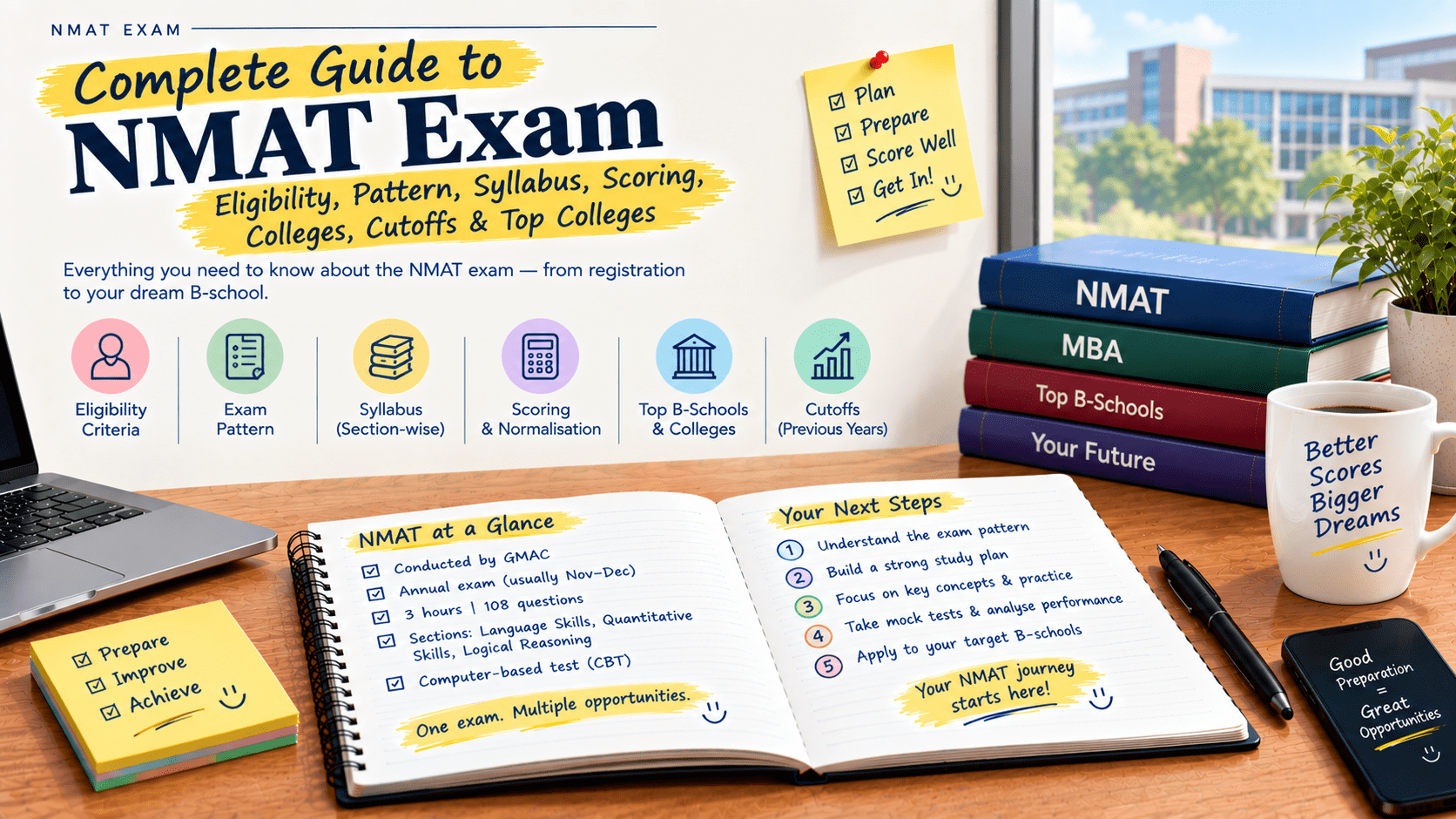
NMAT Exam: Eligibility, Pattern, Syllabus, Scoring, Colleges & Cutoffs
No negative marking, three attempts a season, and questions that change difficulty as you answer them. NMAT plays by different rules than CAT or XAT, and most guides don't explain the rules well enough to actually use them. This one does.
GMAC runs NMAT the way it runs the GMAT, not the way NTA runs CAT — and that distinction matters more than most NMAT guides bother explaining. There's no negative marking. You get three attempts in a season instead of one shot. You choose your own section order. And the test itself is adaptive: your third question depends on how you answered your first two. Put together, these rules change the actual optimal strategy for this exam in ways that don't carry over from CAT prep. This page covers the mechanics properly, plus real cutoffs by college, retake policy quirks that trip people up, and where NMAT fits if you're also prepping for CAT or XAT.
Want an NMAT strategy built around your target score?
Get a free session — we'll map a realistic score target to your shortlist of colleges and build a section-order strategy around your strengths.
What Is NMAT?
NMAT by GMAC started life as NMIMS's own entrance test before GMAC took over running it, and NMIMS is still where the majority of test-takers end up applying. But it stopped being an NMIMS-only exam years ago — more than 50 business schools across India now accept the score, along with a small number of institutes abroad. GMAC's fingerprints are all over how the test is built: it's the same organisation behind the GMAT, and NMAT borrows the GMAT's adaptive-testing engine and scaled scoring model rather than using the fixed-paper format CAT and most other Indian entrance exams use.
Why Take NMAT
Zero penalty for a wrong guess
Unlike CAT or XAT, a wrong answer costs nothing. You can attempt every question with genuine confidence rather than second-guessing whether to skip.
Three shots, not one
A bad exam day doesn't end your season. Retake within the same window and let your better attempt count, subject to each institute's own policy.
You choose the section order
Almost no other Indian MBA entrance exam lets you decide this. Start with your strongest section and carry that momentum forward.
Result in 48 hours
Compare that to the weeks most NTA-conducted exams take. You'll know where you stand well before most other results are even out.
50+ institutes, one score
Beyond NMIMS, a single NMAT attempt opens doors at XIMB, TAPMI, K J Somaiya, ICFAI, and dozens of other B-schools.
A genuine complement to CAT prep
The syllabus overlap with CAT is heavy enough that NMAT prep barely adds extra load if you're already deep into CAT.
NMAT Eligibility
| Criterion | Requirement |
|---|---|
| Educational Qualification | A Bachelor's degree from a recognised university, or currently in the final year of one |
| Minimum Marks | None set by GMAC — individual institutes may set their own minimum percentage requirement |
| Age Limit | None |
| Work Experience | Not required by GMAC, though some institutes may weigh it as part of their own selection process |
NMAT Exam Pattern
Three sections, 108 questions, 120 minutes. You pick the order you attempt them in — that part is genuinely unusual among Indian MBA entrance exams.
| Section | Questions | Time |
|---|---|---|
| Language Skills | 36 | 28 minutes |
| Quantitative Skills | 36 | 52 minutes |
| Logical Reasoning | 36 | 40 minutes |
| Total | 108 | 120 minutes |
Quant gets nearly double Language's time for the same number of questions — a fair signal that GMAC expects those questions to take longer to solve, and something worth weighing when you pick your own section order.
The Adaptive Format — and the One Rule Most Guides Skip
NMAT is a computer-adaptive test, the same principle the GMAT uses: answer a question correctly, and the next one tends to get harder. Answer it wrong, and the next one eases up. Your final score reflects not just how many questions you got right, but how difficult the questions you were shown actually were — a candidate who lands harder questions and gets half of them right can end up scoring higher than someone who only ever saw easy questions and got most of them right.
That mechanic comes with a rule that changes exam-day strategy directly: you cannot skip a question, and you cannot go back to change an answer once you've submitted it. The adaptive engine needs your answer to select the next question, so it won't let you move forward without one. There's no "mark for review and return later" — that habit, drilled into most CAT and XAT preparation, simply doesn't work here.
How NMAT Scoring Works
Each section's raw performance converts into a scaled score between 12 and 120, and the three add up to a total between 36 and 360. GMAC does this conversion — rather than just totaling correct answers — because an adaptive test hands different candidates a different mix of question difficulty, and a raw score alone wouldn't be comparable across two people who saw entirely different question sets.
| Score Type | Range |
|---|---|
| Per Section (Scaled) | 12-120 |
| Total (All 3 Sections) | 36-360 |
In practice, this means two candidates who answered a different number of questions correctly can land the same scaled score, and it also means chasing "questions correct" as a mock-test metric is less useful for NMAT than for a fixed-paper exam. Track your scaled sectional score instead.
NMAT Syllabus
GMAC has never released an official topic list. What follows comes from years of test-takers' accounts of what actually shows up.
Language Skills
Quantitative Skills
Logical Reasoning
Multiple Attempts, Explained
You can sit NMAT up to three times in one season — one original attempt plus two retakes, spaced at least 15 days apart. That's the exam's biggest selling point over CAT, which gives you exactly one shot per year.
Important NMAT Dates (Tentative)
GMAC sets the exact schedule fresh each year, and specific dates aren't worth memorising months in advance. The month-wise rhythm below has stayed fairly consistent, though — useful for planning your prep timeline even before the official bulletin is out.
NMAT Application Process
1. Register on mba.com
NMAT registration runs through GMAC's mba.com portal — the same platform used for GMAT sign-ups. Set up your profile with your personal and academic details.
2. Pick a test city and slot
Choose from the available centres and a date inside the test window. Slots near either end of the window fill up first, so register early if you want scheduling flexibility.
3. Pay the registration fee
Paid online through the portal. This covers your first attempt only — retakes are booked and paid separately.
4. Select which colleges receive your score
A set number of institutes are included by default; you can add more later for an extra fee. Decide your shortlist ahead of time rather than scrambling after results.
5. Book retakes separately if you need them
Each retake is its own transaction, subject to the 15-day gap and the test window's closing date.
NMAT Registration Fees
You pay per attempt — the first registration and each retake carry their own charge — plus an extra fee if you want to send your score to more institutes than the number included by default, and a late fee if you register close to the window's closing date. GMAC changes the fee slab most cycles, so check mba.com for the current number rather than trusting a figure you've read elsewhere.
Admit Card
There's no separate admit-card release date to wait for. Once your registration and payment go through, your test authorisation is available for download from your mba.com account on your own timeline. Bring it along with a valid original photo ID that matches your registration.
Result & Scorecard
Your scorecard shows up in your mba.com profile within about 48 hours of finishing the test — faster than most NTA-run exams, which can take weeks. It shows your scaled score for each of the three sections and your total, on the 12-120 and 36-360 scales covered earlier.
| What | Detail |
|---|---|
| Turnaround | Scorecard available within ~48 hours of each attempt |
| Score validity | 1 year — noticeably shorter than the GMAT's 5-year validity |
| Sending scores to more institutes | A set number of institutes are included by default at registration; you can send your score to additional institutes later for an extra fee |
| Multiple attempts | Each attempt generates its own scorecard — which one an institute actually considers depends on that institute's policy (see the retake section above) |
Colleges Accepting NMAT — With Realistic Cutoffs
NMIMS gets most of the attention, but a decent NMAT score opens more doors than that. Here's roughly where different score bands land.
| NMAT Score Band | Colleges Realistically in Range |
|---|---|
| 210+ | NMIMS Mumbai (Core, HR, Business Analytics, Digital Transformation), NMIMS Bengaluru, NMIMS Hyderabad, NMIMS Navi Mumbai |
| 220-235+ | XIMB-HR, TAPMI Bangalore, K J Somaiya Institute of Management |
| 200-215 | IFMR GSB (Krea University), ISB-AMPBA, XIM University (Bhubaneswar) |
| 180-195 | SOIL Institute of Management, SDA Bocconi Asia Center |
| 150-180 | ICFAI Business School (multiple cities), Alliance University, Woxsen University, BML Munjal University, Shiv Nadar University, VIT Business School |
| Below 150 | Amity University, Thapar School of Management, UPES Dehradun, ITM Navi Mumbai, and several other participating institutes |
What Happens After NMAT: NMIMS's Selection Process
Clearing NMIMS's cutoff isn't the finish line. Candidates who clear both the overall and sectional cutoffs move to a Competency-Based Interview or Group Exercise followed by a Personal Interview, and final admission comes from a combination of your NMAT score and that second stage — not the score alone.
NMAT vs. CAT vs. XAT: Which Should You Prioritise?
| Parameter | NMAT | CAT | XAT |
|---|---|---|---|
| Negative Marking | None | Yes, on MCQs | Yes, on MCQs |
| Attempts per Season | Up to 3 | 1 | 1 |
| Question Format | Adaptive, one question at a time | Fixed paper | Fixed paper |
| Section Order | Candidate's choice | Fixed | Fixed |
| Primary Gateway Into | NMIMS and 50+ other institutes | IIMs and CAT-accepting institutes | XLRI and XAT-accepting institutes |
Most CAT aspirants find NMAT comparatively approachable — no punishing sectional cutoffs at the top IIMs, no penalty for a wrong guess, and three chances instead of one. That makes it a sensible exam to sit alongside CAT or XAT rather than treat as a fallback: a strong NMAT score into NMIMS or a similarly ranked school is a real outcome on its own, not a consolation prize for missing CAT.
NMAT: Pros & Cons
| Strengths | Trade-offs |
|---|---|
| Zero negative marking — every attempt either helps or does nothing | You can't skip a question or revisit one once answered, which punishes indecision differently than CAT does |
| Up to three attempts per season | Not every institute takes your best score — NMIMS counts your first valid attempt only |
| You choose your own section order | A weak start in your first section can anchor you to easier, lower-scoring questions for longer, given the adaptive format |
| Result within 48 hours | Score validity is just 1 year, so it isn't a score you can bank for future cycles |
| Accepted by 50+ institutes, not just NMIMS | Cutoffs and sectional requirements vary a lot institute to institute, so one score doesn't mean equal odds everywhere |
| Heavy syllabus overlap with CAT, so it's a low-cost add-on to CAT prep | Clearing NMIMS's NMAT cutoff still leaves a Competency-Based Interview or Group Exercise and a PI ahead |
How to Prepare for NMAT
Test your section order in mocks before test day
Try attempting Quant first in one mock, Language first in another, and compare your total scaled score across both. Don't guess at this on exam day — you should already know your best order.
Build real speed for Quant's pace specifically
52 minutes for 36 questions is roughly 87 seconds each — tighter than it sounds once you factor in reading time for word problems and DI sets. Time your Quant practice to this exact pace, not a generic one.
Practice with a "no skip, no going back" rule from day one
If your mock platform lets you skip and return, you're training a habit the real exam won't allow. Force yourself to commit to an answer before moving on, even in practice.
If you're already deep into CAT prep, don't restart from zero
NMAT's Quant and Logical Reasoning content overlaps heavily with CAT's. What's actually new is the adaptive mechanic and the section-order decision — spend your prep time there, not relearning topics you already know.
Attempt Strategy: Why Guessing Is Always Worth It
No negative marking plus a rule that forces you to answer every question anyway means the usual "should I guess" debate doesn't really apply here — you don't get a choice to leave something blank in the first place. The only real decision is how much time to spend before you commit to an answer and move on.
Answer fast when you're stuck — don't sit on a question
Since you can't return to it later, a stuck question is better answered with your best guess in 20 seconds than fought over for two minutes you can't get back.
Protect your early accuracy in each section
Because difficulty adapts to your answers, getting the first several questions right pushes you into a harder — and higher-scoring — question pool sooner. A rough start can anchor you to easier, lower-value questions for longer than a rough patch mid-section would.
Start with your strongest section
Early confidence carries into the sections that follow. Most candidates do better opening with what they're best at rather than "getting the hard one out of the way" first.
Common NMAT Myths
"NMAT is easy, so it barely needs preparation"
It's more moderate than CAT, not undemanding. The adaptive format, tight sectional timing, and the no-skip rule all punish an unpracticed candidate just as hard as any fixed-paper exam would.
"Every college takes your best score across all three attempts"
NMIMS doesn't — it counts your first valid attempt. Check each target institute's actual policy before assuming a retake will help.
"No negative marking means an unfinished section costs nothing"
There's no formal penalty for a wrong answer, but running out of time with questions unanswered still appears to affect your ability estimate. Finishing the section matters even without a marked deduction.
"A good NMAT score guarantees an NMIMS seat"
Clearing the cutoff only gets you to the interview stage — a Competency-Based Interview or Group Exercise and a Personal Interview still decide final admission.
Get a Free NMAT Strategy Session
Connect on WhatsApp: 7697517555
Three chances, an adaptive format, zero penalty for a guess.
NMAT rewards a different strategy than CAT or XAT. Let's build a section-order and pacing plan around your actual strengths.
Book My Free Strategy SessionYou know the NMAT pattern. Here's how to build the score you need.
Same faculty, same mock benchmarking, same mentorship — across every format below. Pick the one that fits how you actually study.
Choose Your Course Format
Classroom NMAT Coaching
Daily doubt-solving and face-to-face mentorship at our Indore center, covering Language Skills, Quantitative Skills and Logical Reasoning.
LIVE Online NMAT Coaching
Real-time classes covering Language Skills, Quantitative Skills and Logical Reasoning, with the same faculty and structured schedule as our classroom batches.
Self-Paced Online NMAT Course
Recorded lectures you revisit on your own schedule, at the pace that actually fits your week.
Pair It With
NMAT Preparation Books
Structured print material across Language Skills, Quantitative Skills and Logical Reasoning, written to match NMAT's current pattern.
Explore Prep Books →NMAT Mock Tests
Full-length and sectional mocks benchmarked against the real NMAT pattern, including the section-order and adaptive mechanics covered above.
Explore Mock Tests →Frequently Asked Questions
What is NMAT by GMAC?
NMAT is a national-level MBA entrance exam conducted by the Graduate Management Admission Council, used for admission into NMIMS and over 50 other business schools in India and select international institutes.
Is NMAT a computer-adaptive test?
Yes. NMAT uses the same adaptive-testing principle as the GMAT — the difficulty of each question depends on how you answered the previous one, and your score reflects both accuracy and the difficulty of the questions you were shown.
Can I skip a question in NMAT?
No. Because the test is adaptive, you must submit an answer to move to the next question, and you cannot return to change a previous answer once submitted.
Is there negative marking in NMAT?
No formal negative marking for a wrong answer. However, running out of time with questions unanswered still appears to affect your underlying ability estimate, so finishing each section within its time limit still matters.
How many times can I attempt NMAT?
Up to three times within a single test window — one original attempt plus two retakes — with a mandatory 15-day gap between each attempt.
Do all colleges consider the best of my three NMAT attempts?
No. This varies by institute — NMIMS specifically considers your first valid attempt rather than your best score across all three. Always confirm each target institute's specific policy.
What is a good NMAT score?
It depends on your target institute. NMIMS's campuses have generally required scores upward of 210, while several other well-regarded institutes accept scores in the 150-200 range. Check current-cycle cutoffs for your specific shortlist.
Is NMAT easier than CAT?
It's widely considered more moderate and speed-focused than CAT, without CAT's punishing sectional cutoffs at the top IIMs. That doesn't make it undemanding — its adaptive format and no-skip rule still require real, targeted practice.
How long is an NMAT score valid?
One year — noticeably shorter than the GMAT's five-year validity. NMAT should be planned around the specific admission cycle you're targeting rather than treated as a score to hold onto for later.