CUET Exam · NTA Common University Entrance Test
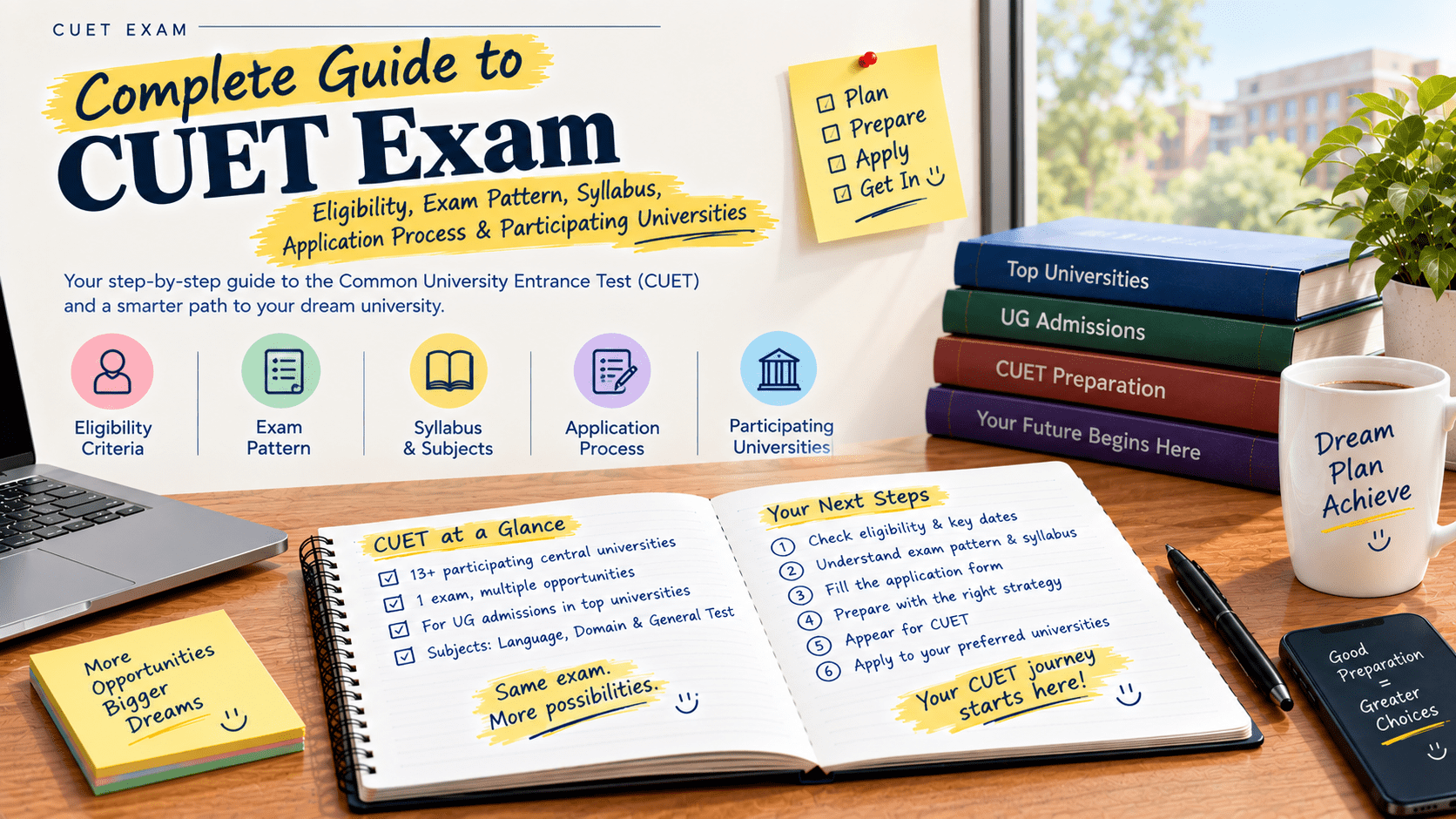
CUET Exam: Eligibility, Exam Pattern, Syllabus, Application Process & Participating Universities
One national exam, hundreds of universities, and your CUET score doing the heavy lifting instead of board-percentage cutoffs. Here’s everything on CUET Exam eligibility, pattern, syllabus, important CUET exam dates, application process, fees, admit card, result, cutoffs, counselling and participating institutions — plus how it all changes for postgraduate admission via CUET PG.
Before CUET Exam existed, getting into a central university meant either chasing a sky-high board-percentage cutoff or sitting a separate entrance exam for every single institution. The Common University Entrance Test, run by the National Testing Agency, replaced all of that with one standardised score universities actually use — sit it once, apply to hundreds of institutions with the same result. This guide covers CUET Exam end to end: what it actually tests, who’s eligible, the real exam pattern, the subject syllabus, the tentative calendar, how to apply, the fee structure, admit card, result and cutoff process, and which universities accept it. Near the end, we’ve also covered how things differ if you’re applying for a postgraduate programme rather than an undergraduate one, since NTA runs a related but separately structured exam — CUET PG — for that.
Want a CUET strategy built around your target university?
Get a free session — we’ll map your subject choices to your target course’s actual requirements.
What Is CUET?
CUET is the single entrance exam for undergraduate admission across Central Universities — Delhi University, JNU, BHU, Jamia Millia Islamia, and more — alongside a large and growing number of State, Deemed, and Private universities that have opted into the system. At most central universities, the CUET score is now the main basis for merit, while board marks are largely limited to meeting the minimum eligibility percentage. A few institutions still give board marks some weight, so always check your target university’s policy. One exam, taken once, can be used to apply across hundreds of institutions, replacing what used to be a separate application and entrance process for each one.
CUET Exam Eligibility
| Criterion | Requirement |
|---|---|
| Educational Qualification | Passed or appearing in Class 12 (or equivalent) from a recognised board |
| Minimum Marks — General category | Generally around 45–50% aggregate at most participating universities, though this is set by each university, not by NTA |
| Minimum Marks — Reserved categories (SC/ST/OBC/EWS/PwD) | Usually relaxed by roughly 5 percentage points versus the general-category requirement, again varying by university |
| Stream Restriction | None — candidates can choose CUET exam subjects independent of what they studied in Class 12, though some university programmes may require specific subject combinations |
| Age Limit | No upper age limit |
| Nationality | Indian citizens; NRI, OCI, and foreign national candidates can also apply |
CUET Exam Pattern
CUET isn’t one paper — it’s a set of independent subject-papers, and candidates choose their own combination based on the programmes they’re targeting.
| Section | What It Covers |
|---|---|
| Section 1: Language(s) | Reading comprehension, grammar, and vocabulary in the chosen language(s) — 13 major Indian languages plus a wider list of foreign and classical languages are offered |
| Section 2: Domain Subjects | Subject-specific papers (candidates typically choose up to several), based on Class 12 NCERT-level content for that subject |
| Section 3: General Test | Logical and analytical reasoning, general knowledge and current affairs, and basic quantitative aptitude — required for programmes that ask for it |
Format: Computer-based test, objective-type MCQs, with each subject paper run as its own timed unit (roughly 50 questions per paper in around an hour, or 40 questions in 45 minutes for shorter papers). Marking is +5 for a correct answer and −1 for a wrong one, with no marks lost for an unattempted question.
CUET Subjects & CUET Exam Syllabus
The domain-subject pool spans the sciences, commerce, and humanities — think Physics, Chemistry, Biology, Mathematics, Accountancy, Business Studies, Economics, History, Political Science, Psychology, Sociology, and more — alongside a wide set of language options. Domain subject syllabi are drawn directly from the Class 12 NCERT curriculum, so a strong grip on your board syllabus for that subject carries over directly into CUET preparation for it — this is one of the few entrance exams where board prep and entrance prep genuinely overlap rather than competing for time.
CUET Exam Mode & Languages
CUET is conducted as a Computer-Based Test (CBT) — candidates answer on-screen at a designated exam centre rather than on an OMR sheet, though NTA has in some cycles used a hybrid model for very high-demand papers, so it’s worth checking the mode confirmed for your specific subjects in the current bulletin. Question papers are available in a wide set of languages — English and Hindi are the default, with several regional languages (such as Marathi, Gujarati, Tamil, Telugu, Kannada, Bengali, Malayalam, Odia, Assamese, Punjabi, and Urdu) also offered depending on the subject and centre. Choosing a language you’re genuinely comfortable reading fast in matters more than defaulting to English, especially for the General Test’s comprehension-heavy questions.
Important CUET Dates (Tentative)
NTA announces the exact schedule every cycle, and CUET exam dates have shifted from year to year. The timeline below shows the usual month-wise rhythm so you can plan your year. Treat it as a planning guide, not a confirmed calendar.
CUET Application Process
The application itself follows a fairly predictable sequence each cycle, even though the exact opening and closing dates shift:
1. Registration
Create an account on the official NTA CUET portal with basic personal details, a valid mobile number, and an active email ID — this generates your application number, which you’ll need for every step afterward.
2. Filling the application form
Enter academic details, choose your exam city preferences, and select your language, domain subjects, and whether you’re opting for the General Test — this subject selection directly determines which university programmes you can later apply to, so cross-check it against your target course before submitting.
3. Uploading documents
Scanned photograph, signature, and category/PwD certificates where applicable, in the specified size and format — rejected uploads are one of the most common reasons applications get stuck.
4. Fee payment
Paid online via the portal (net banking, cards, UPI, or wallets). Keep the payment confirmation and application printout for your records.
5. Correction window
NTA typically opens a short correction window after the form closes, allowing limited edits to certain fields — this is not guaranteed for every field, so double-check entries before initial submission rather than relying on it.
Documents You Need Before You Apply
Application Stage
If Applicable
Category certificates should be current and in the format the bulletin specifies. An outdated OBC-NCL or EWS certificate is a common reason for problems during counselling, even when the exam itself went well.
CUET Application Fee
The application fee is charged per subject/paper chosen and typically scales with how many subjects a candidate selects, with the amount also varying by category (general, reserved, PwD) and, in some cycles, by whether the candidate is applying from within India or abroad. Because NTA revises the exact fee slab most cycles, treat any specific number you see online with caution and confirm the current fee structure directly on the official CUET information bulletin at the time of filling your form.
CUET Admit Card
The admit card is released on the official NTA CUET portal ahead of the exam date and is the single most important document for exam day — it confirms your exam city, centre, date, shift, and reporting time, none of which are otherwise communicated individually. Download it as soon as it’s released, check every detail (name, photograph, category, exam city) against your application form immediately, and carry a printed copy along with a valid original photo ID to the centre, since most centres will not admit a candidate without both.
CUET Result, Scorecard & CSAS Counselling
NTA releases the result on the official CUET portal. You log in with your application number and date of birth, and you can download a scorecard covering every subject you took.
How Scores Are Calculated
Because the same subject is held across several days and shifts, papers can differ slightly in difficulty. NTA therefore uses a normalisation method for subjects held in multiple sessions, so a candidate’s score is not affected by getting a tougher shift. That is why your result shows scaled, normalised scores rather than raw marks or a rank. Raw marks come from the +5 / −1 scheme, and the scaled score is what universities actually use.
CUET itself does not allocate seats. For Delhi University, seat allocation runs through the Common Seat Allocation System (CSAS), a centralised portal where candidates register preferences for colleges and programmes, which are then matched against CUET scores in multiple allocation rounds. Other universities run their own equivalent counselling processes.
What to Do After the Result
1. Download and save the scorecard
Keep several copies. You’ll need it for every university portal and again at document verification.
2. Check each target university’s admission policy
Confirm which subjects and what weightage each programme uses. A high score in the wrong subject combination may not count for your course.
3. Register on the university or CSAS portal
For Delhi University this is CSAS. Other universities run their own portals with their own deadlines. Missing a registration window costs you the seat, regardless of your score.
4. Fill preferences carefully and track allocation rounds
Arrange college and course preferences by real priority, not just by prestige. Understand freeze, float and upgrade options before each round closes.
5. Complete verification and fee payment on time
An allotted seat is only secured once documents are verified and the admission fee is paid within the stated deadline.
CUET Cutoff Explained
There is no single “CUET cutoff”, and understanding why will help you plan better. NTA sets no qualifying score. Cutoffs are decided by each university, for each course, and often for each college and category.
| What Drives the Cutoff | Why It Matters |
|---|---|
| Number of seats vs. applicants | Popular courses (Economics, Commerce, Psychology, English) get far more applicants per seat than niche subjects |
| College or institution reputation | The same course can have very different cutoffs across colleges of one university |
| Category and quota | Reserved-category cutoffs are lower, but the reserved seat pool is separate |
| Subject combination and weightage | Many programmes calculate merit from a specific set of subjects, not your total |
| Paper difficulty and normalisation | Score distributions change each year, so last year’s number is a guide, not a promise |
How to use cutoffs sensibly: look at the last two or three years of allocation lists for your target courses, find the trend rather than a single number, and shortlist across three tiers: a stretch choice, a realistic choice and a safe choice. Then aim to score with a buffer above your realistic tier, because year-to-year movement can be several points.
Participating Universities
All Central Universities require CUET scores for undergraduate admission, alongside a large and growing list of State, Deemed, and Private universities that have opted into the system. The specific list changes slightly each year as more institutions join — always confirm directly with your target university whether it’s currently a participant and what its specific cutoff and course requirements are, since CUET clears the entrance hurdle but each university still runs its own subsequent counselling and seat-allocation process.
Well-Known Central Universities
Choosing Your Subject Combination by Course
Your subject choices decide which programmes you can apply for, so choose them backward from the course you want. The table shows typical combinations, but every university sets its own rules.
| Target Course | Commonly Asked Domain Subjects | Also Consider |
|---|---|---|
| BA (Hons) Economics | Economics, Mathematics or Applied Mathematics | English, General Test |
| B.Com / B.Com (Hons) | Accountancy, Business Studies, Economics or Mathematics | English, General Test |
| BBA / BMS / management programmes | Mathematics, Business Studies or Economics | General Test (often required) |
| BA (Hons) History / Political Science / Sociology | The matching subject, plus two related humanities subjects | English, General Test |
| BA (Hons) Psychology | Psychology, plus subjects the university lists | English, General Test |
| BA (Hons) English / Hindi / other languages | The language as a subject | General Test, one humanities subject |
| BSc (Hons) Physics / Chemistry / Mathematics | Physics, Chemistry, Mathematics | English |
| BSc Life Sciences / Zoology / Botany | Biology, Chemistry, Physics | English |
CUET Exam vs State-Level Entrance Exams
CUET Exam is not compulsory for every college in India — it’s compulsory only for universities that have opted into the CUET system, which now includes all Central Universities and a large share of State, Deemed, and Private universities. Some state universities and most private/deemed institutions outside the CUET list continue to run their own state-level or institution-specific entrance exams and admission criteria (and a smaller number still admit directly on board-exam merit). Before assuming CUET is your only route, check whether your specific target university/course participates in CUET, runs a separate state-level exam, or uses direct merit-based admission — the three routes aren’t mutually exclusive, and many students end up preparing for more than one in parallel.
How to Prepare for CUET Exam
Treat your board prep and CUET prep as one track, not two
Since domain-subject syllabi mirror the NCERT Class 12 curriculum, solid board exam preparation directly builds your CUET readiness for that subject — don’t split your effort as if these were unrelated exams.
Don’t neglect the General Test if your target programme needs it
Many aspirants over-invest in domain subjects and under-prepare the General Test’s reasoning and current-affairs components, which some universities weight heavily for specific programmes.
Confirm your exact subject combination against your target course early
Different universities and programmes require different subject combinations. Locking in your subject choices without checking your target course’s specific requirement is one of the most common, avoidable mistakes.
Practise under real timing constraints
Each subject paper runs as its own strict timed unit, so practising full-length, timed mock papers matters more for CUET than for exams with a single continuous paper — pacing errors in one subject don’t get corrected by extra time in another.
CUET Attempt Strategy: Should You Guess?
With +5 for a correct answer, −1 for a wrong one and nothing for a skipped question, the maths favours attempting. You break even on a blind guess when your chance of being right is only 1 in 6 (about 17%). A pure random guess among four options has a 25% chance, which gives a small positive return on average. In practice:
Attempt every question you can eliminate at least one option on
Each eliminated option raises your odds well above the 17% break-even point.
Don’t chase accuracy at the cost of unattempted questions
Leaving several questions blank is usually worse than losing a few marks to wrong answers.
Treat each paper as its own clock
Do your surest questions first, mark the tricky ones, and return if time remains. A stuck question in one paper can’t borrow time from another.
Month-by-Month CUET Preparation Timeline
Board exams typically fall in the middle of this timeline, so plan a lighter CUET schedule around them and use board revision as CUET practice wherever the syllabus overlaps.
Exam-Day Checklist
Carry
Do
Avoid
Common CUET Myths
“A good CUET score guarantees admission”
CUET clears the entrance hurdle and gets you into a university’s applicant pool — each institution still runs its own counselling, seat-allocation, and specific programme cutoffs on top of that score.
“You can only choose subjects that match your Class 12 stream”
Not true in general — candidates can choose subjects independent of their Class 12 stream, though individual university programmes may still specify required subject combinations for admission.
“CUET is compulsory for every college in India”
No — it’s compulsory only for universities that have opted into the system. Some state, deemed, and private institutions still run their own separate entrance exams or admission criteria.
“CUET is the same exam whether you’re applying after Class 12 or after graduation”
No — NTA runs a related but separately structured exam, CUET PG, specifically for postgraduate admission, with its own eligibility, pattern, and marking scheme. See the section below.
Get a Free CUET Strategy Session
Connect on WhatsApp: 7697517555
You know the CUET exam pattern. Here’s how to prepare for it.
Same faculty, same mock benchmarking, same mentorship — across every format below. Pick the one that fits how you actually study.
Choose Your Course Format
Classroom CUET Coaching
Daily doubt-solving and face-to-face mentorship at our Indore center, covering your chosen domain subjects and the General Test.
LIVE Online CUET Coaching
Real-time classes from anywhere in India, with the same faculty and structured schedule as our classroom batches.
Self-Paced Online CUET Course
Recorded lectures you revisit on your own schedule, at the pace that actually fits your week alongside boards.
Pair It With
CUET Preparation Books
Structured print material across language, domain and general test sections, written to match the current CUET pattern.
Explore Prep Books →CUET Mock Tests
Full-length and subject-specific mocks benchmarked against the real CUET pattern.
Explore Mock Tests →Is CUET the Same for Postgraduate Admission?
No — if you’re a graduate applying for a Master’s programme rather than a Class 12 student applying for undergraduate admission, you’re looking at a related but distinctly different exam: CUET PG. It’s run by the same agency (NTA) for a similar purpose — one common entrance score accepted across many universities — but the eligibility, structure, and marking scheme are all different.
| Parameter | CUET (Undergraduate Admission) | CUET PG (Postgraduate Admission) |
|---|---|---|
| Eligibility | Class 12 pass or appearing | Bachelor’s degree, or in the final year of one |
| Admits Into | UG programmes (BA, BSc, BCom, etc.) | PG programmes (MA, MSc, MCom, MBA, MCA, and more) |
| Paper Structure | Language + Domain Subjects + General Test, in a combination you choose | A domain-specific paper per subject, often paired with a shorter general section |
| Marking Scheme | +5 correct / −1 wrong | +4 correct / −1 wrong |
| Universities Accepting Scores | 280+ | 200+ |
CUET PG Exam Pattern
CUET PG papers typically run around 75 MCQs in about 90 minutes, in a Computer-Based Test conducted in English and Hindi (barring literature/language-specific papers). Each subject paper generally combines a subject-specific section with a shorter general component covering reasoning, comprehension, and general awareness — the exact split varies by domain. Candidates can sit multiple subject papers if applying across more than one postgraduate programme or university.
CUET PG Syllabus
CUET PG’s subject pool is organised into broad domains — Humanities, Science, Commerce, Languages, Common/Interdisciplinary courses, and technical postgraduate streams — with dozens of individual subject papers inside each. Most papers also draw on a shared core of English language and comprehension, general knowledge and current affairs, and logical and analytical reasoning, worth preparing for regardless of your specific subject paper.
CUET PG Universities
CUET PG scores are accepted by a large number of Central universities — including Delhi University, JNU, BHU, and Jamia Millia Islamia — alongside a growing set of other participating institutions for postgraduate admission. As with undergraduate CUET, each university runs its own subsequent counselling and seat-allocation process, so clearing the exam gets you into the applicant pool, not an automatic seat.
Know which exam you’re actually sitting.
Whether it’s the undergraduate CUET or CUET PG, let’s build a plan around the specific paper you’re facing.
Book My Free Strategy SessionFrequently Asked Questions
What is CUET?
CUET (Common University Entrance Test) is a national-level exam conducted by the National Testing Agency for undergraduate admission across Central Universities and a large number of State, Deemed, and Private universities in India.
Does CUET replace board exam percentage for university admission?
At most central universities, CUET score is now the main basis for merit, and board marks are largely limited to meeting the minimum eligibility percentage. A few institutions still give board marks some weight, so check your target university’s policy.
When is the CUET exam usually held?
Applications usually open in the February–March window and the exam is typically held in May–June. Exact CUET Exam dates change every year, so check the official NTA bulletin.
Is there negative marking in CUET?
Yes. CUET uses a +5 for a correct answer and −1 for a wrong one, with zero penalty for an unattempted question.
Should I guess in CUET if I am unsure?
Usually yes, when you can eliminate at least one option. A guess breaks even at roughly a 1-in-6 chance of being right, and a four-option guess has a 1-in-4 chance.
Do I need to study only my Class 12 stream subjects for CUET?
No — CUET allows candidates to choose subjects independent of their Class 12 stream, though some university programmes may still specify required subject combinations for admission into that specific course.
Which subject combination is best for CUET?
There is no universal best. The right combination is the one your target course and university require, so work backwards from the programme and confirm it on the university’s eligibility page.
Is there a minimum qualifying score in CUET?
NTA does not set a single qualifying score. Each university sets its own cutoff by course, college and category.
Does clearing CUET guarantee a university seat?
No. CUET qualifies you for a university’s applicant pool — each institution still runs its own separate counselling, seat-allocation, and programme-specific cutoff process after results are declared.
Can I appear in CUET more than once?
Candidates who have passed Class 12 are generally free to reappear in later cycles, and there is no upper age limit. Confirm any attempt-related rules in the current bulletin.
Is CUET compulsory for all colleges in India?
No — only for universities that have opted into the CUET system, which includes all Central Universities and a large share of State, Deemed, and Private universities. Some institutions still run separate state-level exams or their own admission criteria.
How is the CUET application fee decided?
It’s charged per subject chosen and varies by category and number of subjects selected. The exact slab is revised most cycles, so check the current information bulletin when filling your form.
What does the CUET admit card show, and when is it released?
It’s released on the official NTA portal ahead of the exam and confirms your exam city, centre, date, shift, and reporting time. Download and verify it as soon as it’s out, and carry a printed copy plus a valid photo ID to the centre.
Is the CUET result a rank or a score?
A normalised, scaled score — not a raw mark or an all-India rank. Universities use this score independently in their own counselling processes, such as CSAS for Delhi University.
Is CUET the same exam for postgraduate admission?
No. Postgraduate admission uses a separate exam, CUET PG, with different eligibility (a bachelor’s degree instead of Class 12), a different paper structure, and a different marking scheme (+4/−1 instead of +5/−1).
What is the CUET PG marking scheme?
+4 for a correct answer and −1 for a wrong one, with no penalty for an unattempted question — different from undergraduate CUET’s +5/−1 scheme.