India’s Economic Resilience Through Crises:
Past Recoveries and the Search for the Next Growth Engine in the Indian Economy 2026
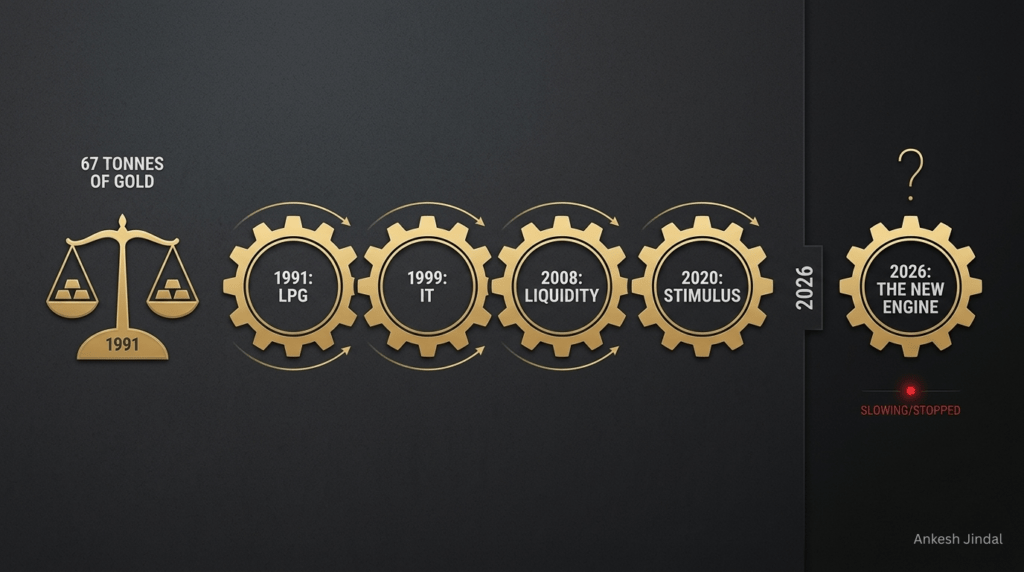
The Indian economy has repeatedly shown remarkable resilience, bouncing back from major shocks time and again. From the near-default crisis of 1991 to conflicts, global financial meltdowns, and the COVID-19 pandemic, India has recovered stronger each time. The familiar narrative – “the Indian economy always bounces back” – holds true historically. But every rebound has relied on a specific growth engine: bold reforms, sector booms, or external liquidity. As we enter 2026, traditional drivers are weakening, raising a key question for the Indian economy: what will power the next phase of growth?
The 1991 Balance of Payments Crisis: Liberalisation as the Engine for the Indian Economy
In early 1991, India’s foreign exchange reserves fell to about $1.2 billion – sufficient for just three weeks of imports. To avert default, the Reserve Bank of India pledged around 67 tonnes of gold as collateral for emergency loans. This included 20 tonnes to the Union Bank of Switzerland and 47 tonnes to the Bank of England and Bank of Japan, raising roughly $600-639 million. These were collateralised borrowings with repurchase clauses, not permanent sales, and the gold was later redeemed.
This crisis paved the way for Finance Minister Manmohan Singh’s landmark reforms: rupee devaluation, dismantling the License Raj, opening to foreign direct investment, and initiating privatisation. These changes unleashed private sector potential, boosted exports, and attracted capital inflows. The Indian economy shifted from a closed, socialist model to a liberalised, globally integrated one – the engine was comprehensive structural reform.
Post-Kargil Conflict (1999): IT Boom Fuels Recovery in the Indian Economy
The 1999 Kargil war imposed fiscal pressure amid lingering effects of the Asian financial crisis. Yet the Indian economy recovered rapidly, driven by the explosive growth in information technology and software services. Y2K-related global demand, combined with India’s skilled workforce, propelled software exports. Firms like Infosys and TCS expanded dramatically, generating foreign exchange and employment. The engine here was services-led exports, particularly IT-BPM, which built a resilient middle class and cushioned external shocks.
2008 Global Financial Crisis: Liquidity Inflows Support the Indian Economy
The 2008 Lehman Brothers collapse disrupted worldwide markets, but the Indian economy’s limited exposure to subprime assets limited direct damage. Recovery gained momentum as the US Federal Reserve and China injected trillions in stimulus, creating cheap global liquidity that flowed into emerging markets like India. Capital inflows, lower borrowing costs, and rebounding exports helped. Domestic fiscal packages added support. The engine: external monetary easing and countercyclical policies.
2020 COVID-19 Pandemic: Global Printing Powers Rebound in the Indian Economy
The pandemic caused India’s sharpest contraction (around -6-7% GDP in FY21) due to lockdowns. Post-vaccination recovery was swift, aided by unprecedented global central bank actions: over $9 trillion printed worldwide, with near-zero interest rates channeling funds into emerging markets. This boosted Indian markets, consumption, and investment. Government initiatives like Atmanirbhar Bharat and RBI liquidity measures reinforced demand. The engine: massive monetary expansion and domestic policy response.
The Indian Economy in 2026: Traditional Engines Stalling
The current environment differs significantly. Key supports are constrained:
- The US Fed faces persistent inflation pressures – partly from oil prices and geopolitics – limiting aggressive easing or printing.
- China, dealing with internal slowdowns and proxy conflict funding, is not launching large-scale stimulus.
- The IT sector, a longtime pillar of the Indian economy, encounters headwinds from AI automation displacing routine coding and outsourcing roles that once fueled middle-class growth.
- Domestic demand faces strain from high household debt and stretched consumers.
Despite these, projections for the Indian economy remain optimistic. Government estimates, IMF, World Bank, Goldman Sachs, and Deloitte forecast 6.6-7.3%+ GDP growth in FY26-FY27, driven by resilient domestic demand, infrastructure spending, and policy continuity.
Potential Growth Engines for the Indian Economy in 2026 and Beyond
Past recoveries succeeded because an engine emerged – often from policy shifts, technology, or global tailwinds. For the Indian economy today, promising drivers include:
- Manufacturing and Make in India – Supply-chain shifts from China, Production Linked Incentive (PLI) schemes across sectors, and focus on electronics, renewables, and defense could scale production and jobs.
- Renewable Energy and Green Transition – Targets of 500 GW non-fossil capacity by 2030, falling solar/wind costs, and investments in green hydrogen, storage, and EV batteries position this as a major engine for employment, exports, and energy security.
- Evolving Services and Digital Economy – While traditional IT slows, high-value areas like financial services, fintech, and AI adoption could add hundreds of billions to GDP (PwC estimates up to $550 billion from AI by 2035).
- Infrastructure and Public Capex – Continued high investment in roads, ports, railways, and green projects crowds in private capital and generates multiplier effects.
- Domestic Consumption Boost – Tax reforms, GST rationalisation, lower interest rates, and rising incomes in Tier-2/3 cities sustain spending.
The Indian economy’s strengths – young demographics, policy flexibility, and entrepreneurial drive – suggest it will identify a new engine. In a world without easy global liquidity, success hinges on productivity gains, innovation in emerging sectors, and deeper reforms.
Hope is not a strategy. Spotting and igniting the next engine is essential for sustained momentum in the Indian economy.