All Courses / CAT / CAT 2023 Slot 3 - DILR

CAT 2023 Slot 3 - DILR

Previous Year Questions with Detailed Solutions

20 Questions CAT Free Access

Practice CAT 2023 Slot 3 - DILR previous year questions with step-by-step solutions from the CAT exam. Every question includes the correct answer and a full worked explanation — no need to leave the page.

Q1

CAT 2023 Slot 3 - DILR

Directions for Qs. 1 – 5: Refer to the following information and answer the following questions.

There are only three female students – Amala, Koli and Rini – and only three male students - Biman, Mathew and Shyamal – in a course. The course has two evaluation components, a project and a test. The aggregate score in the course is a weighted average of the two components, with the weights being positive and adding to 1.
The projects are done in groups of two, with each group consisting of a female and a male student. Both the group members obtain the same score in the project.
The following additional facts are known about the scores in the project and the test.
1. The minimum, maximum and the average of both project and test scores were identical - 40, 80 and 60, respectively.
2. The test scores of the students were all multiples of 10; four of them were distinct and the remaining two were equal to the average test scores.
3. Amala's score in the project was double that of Koli in the same, but Koli scored 20 more than Amala in the test. Yet Amala had the highest aggregate score.
4. Shyamal scored the second highest in the test. He scored two more than Koli, but two less than Amala in the aggregate.
5. Biman scored the second lowest in the test and the lowest in the aggregate.
6. Mathew scored more than Rini in the project, but less than her in the test.

What was Rini's score in the project ?

Free Resources
Marking Scheme
Correct Answer

60

In a course, there are only three female students named Amala, Koli, and Rini, and only three male students named Biman, Mathew, and Shyamal.
It is known that the total score in the course is calculated as a weighted average of two components, with both weights being positive and summing up to 1.
Let's assume that the project score component be x, while the test score is represented by (1-x).Projects are completed in pairs, with each pair consisting of one female and one male student, totaling three pairs.Both members of each pair receive the same score for the project. So, the scores achieved in the project are 40, 60, and 80, respectively.
Hence, it can be concluded that each female student will belong to a unique group, and no two male or female students will be assigned to the same group.
Regarding the test scores, there are six scores provided for six students, with four being unique and the remaining two being average scores, both of which are 60. Additionally, it is understood that the highest possible score is 80, while the lowest is 40.
Therefore, the unique scores are 80, 70, 50, and 40 (as all test scores are multiples of 10), while the remaining two scores are both 60.
Based on point 3, we deduce that Amala's project score was twice that of Koli's, while Koli scored 20 points higher than Amala in the test. Therefore, Amala's project score is 80, and Koli's is 40, resulting in Rini's project score being 60. Koli's test score, being 20 points higher than Amala's, could be either 80, 70, or 60.
So, the score obtained by them is as follows:
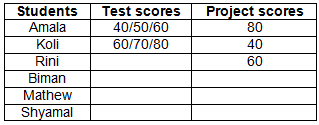
It is given that Amala attained the highest overall score, while Shyamal achieved the second highest on the test. His score surpassed Koli's by two points, yet fell short of Amala's aggregate by two points.
Therefore, Shyamal's test score is 70, which means Koli cannot score 70 in the test, leading to the inference that Amala cannot score 50 in the test.
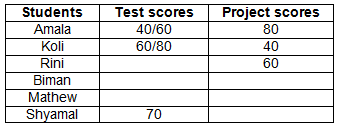
As stated, Shyamal's aggregate score surpassed Koli's by two points but fell short of Amala's by two points. Consequently, Amala's aggregate score is four points higher than Koli's, and she holds the highest aggregate score.
Case (i): The test of Amala is 40
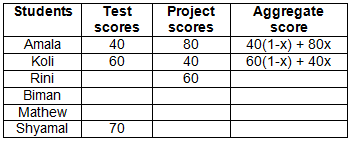
Hence, 40(1 – x) + 80x = 60(1 – x) + 40x + 4
60x = 24
x = 0.4
Therefore, Amala's aggregate score is calculated as:
= 40(1 – 0.4) + 80 × 0.4
24 + 32 = 56
Shyamal's minimum aggregate score, calculated as 70(1 – 0.4) + 40 × 0.4, equals 58, which surpasses Amala's.
Therefore, Case 1 is not possible.
So, the below table is as follows:
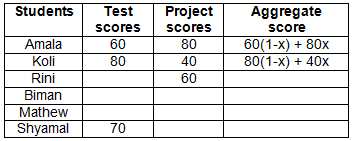
Hence, 60(1 – x) + 80x = 80(1 – x) + 40x + 4
60 + 20x = 84 – 40x
60x = 24
x = 0.24
Therefore, Amala's aggregate score, calculated as 60(1-0.4) + 80 × 0.4, amounts to 68, indicating that Shyamal's aggregate score is (68 – 2) = 66
Thus, Shyamal's project score is calculated as
(66-70×0.6)/0.4 = 60
It is further understood that Biman achieved the second lowest score in the test, indicating his test score to be 50, and he attained the lowest aggregate score. Additionally, Mathew's project score exceeded Rini's but fell short of her test score. Consequently, Mathew's project score is 80 (as Rini scored 60 in the project), while Biman's project score is 40.
Likewise, Rini outperformed Mathew on the test, indicating Rini's score to be 60 and Mathew's to be 40.
Therefore, the final table will be as follows:
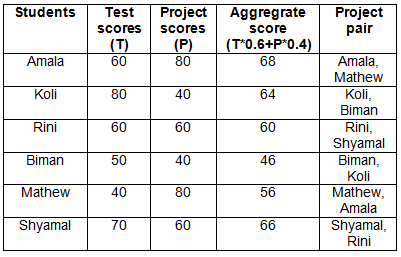
From the table, we can see that the score obtained by Rini in the project is 60.
So, the correct answer is 60.
Q2

CAT 2023 Slot 3 - DILR

Directions for Qs. 1 – 5: Refer to the following information and answer the following questions.

There are only three female students – Amala, Koli and Rini – and only three male students - Biman, Mathew and Shyamal – in a course. The course has two evaluation components, a project and a test. The aggregate score in the course is a weighted average of the two components, with the weights being positive and adding to 1.
The projects are done in groups of two, with each group consisting of a female and a male student. Both the group members obtain the same score in the project.
The following additional facts are known about the scores in the project and the test.
1. The minimum, maximum and the average of both project and test scores were identical - 40, 80 and 60, respectively.
2. The test scores of the students were all multiples of 10; four of them were distinct and the remaining two were equal to the average test scores.
3. Amala's score in the project was double that of Koli in the same, but Koli scored 20 more than Amala in the test. Yet Amala had the highest aggregate score.
4. Shyamal scored the second highest in the test. He scored two more than Koli, but two less than Amala in the aggregate.
5. Biman scored the second lowest in the test and the lowest in the aggregate.
6. Mathew scored more than Rini in the project, but less than her in the test.

What was the weight of the test component ?

A

0.75

B

0.50

C

0.60

D

0.40

Free Resources
Marking Scheme
Correct Answer

0.60

In a course, there are only three female students named Amala, Koli, and Rini, and only three male students named Biman, Mathew, and Shyamal.
It is known that the total score in the course is calculated as a weighted average of two components, with both weights being positive and summing up to 1.
Let's assume that the project score component be x, while the test score is represented by (1-x).Projects are completed in pairs, with each pair consisting of one female and one male student, totaling three pairs.Both members of each pair receive the same score for the project. So, the scores achieved in the project are 40, 60, and 80, respectively.
Hence, it can be concluded that each female student will belong to a unique group, and no two male or female students will be assigned to the same group.
Regarding the test scores, there are six scores provided for six students, with four being unique and the remaining two being average scores, both of which are 60. Additionally, it is understood that the highest possible score is 80, while the lowest is 40.
Therefore, the unique scores are 80, 70, 50, and 40 (as all test scores are multiples of 10), while the remaining two scores are both 60.
Based on point 3, we deduce that Amala's project score was twice that of Koli's, while Koli scored 20 points higher than Amala in the test. Therefore, Amala's project score is 80, and Koli's is 40, resulting in Rini's project score being 60. Koli's test score, being 20 points higher than Amala's, could be either 80, 70, or 60.
So, the score obtained by them is as follows:

It is given that Amala attained the highest overall score, while Shyamal achieved the second highest on the test. His score surpassed Koli's by two points, yet fell short of Amala's aggregate by two points.
Therefore, Shyamal's test score is 70, which means Koli cannot score 70 in the test, leading to the inference that Amala cannot score 50 in the test.

As stated, Shyamal's aggregate score surpassed Koli's by two points but fell short of Amala's by two points. Consequently, Amala's aggregate score is four points higher than Koli's, and she holds the highest aggregate score.
Case (i): The test of Amala is 40

Hence, 40(1 – x) + 80x = 60(1 – x) + 40x + 4
60x = 24
x = 0.4
Therefore, Amala's aggregate score is calculated as:
= 40(1 – 0.4) + 80 × 0.4
24 + 32 = 56
Shyamal's minimum aggregate score, calculated as 70(1 – 0.4) + 40 × 0.4, equals 58, which surpasses Amala's.
Therefore, Case 1 is not possible.
So, the below table is as follows:

Hence, 60(1 – x) + 80x = 80(1 – x) + 40x + 4
60 + 20x = 84 – 40x
60x = 24
x = 0.24
Therefore, Amala's aggregate score, calculated as 60(1-0.4) + 80 × 0.4, amounts to 68, indicating that Shyamal's aggregate score is (68 – 2) = 66
Thus, Shyamal's project score is calculated as
(66-70×0.6)/0.4 = 60
It is further understood that Biman achieved the second lowest score in the test, indicating his test score to be 50, and he attained the lowest aggregate score. Additionally, Mathew's project score exceeded Rini's but fell short of her test score. Consequently, Mathew's project score is 80 (as Rini scored 60 in the project), while Biman's project score is 40.
Likewise, Rini outperformed Mathew on the test, indicating Rini's score to be 60 and Mathew's to be 40.
Therefore, the final table will be as follows:

From the solution, we get that the weight of the test component is 0.6
So, the correct answer is 0.60

Q3

CAT 2023 Slot 3 - DILR

Directions for Qs. 1 – 5: Refer to the following information and answer the following questions.

There are only three female students – Amala, Koli and Rini – and only three male students - Biman, Mathew and Shyamal – in a course. The course has two evaluation components, a project and a test. The aggregate score in the course is a weighted average of the two components, with the weights being positive and adding to 1.
The projects are done in groups of two, with each group consisting of a female and a male student. Both the group members obtain the same score in the project.
The following additional facts are known about the scores in the project and the test.
1. The minimum, maximum and the average of both project and test scores were identical - 40, 80 and 60, respectively.
2. The test scores of the students were all multiples of 10; four of them were distinct and the remaining two were equal to the average test scores.
3. Amala's score in the project was double that of Koli in the same, but Koli scored 20 more than Amala in the test. Yet Amala had the highest aggregate score.
4. Shyamal scored the second highest in the test. He scored two more than Koli, but two less than Amala in the aggregate.
5. Biman scored the second lowest in the test and the lowest in the aggregate.
6. Mathew scored more than Rini in the project, but less than her in the test.

What was the maximum aggregate score obtained by the students ?

A

66

B

68

C

80

D

62

Free Resources
Marking Scheme
Correct Answer

68

In a course, there are only three female students named Amala, Koli, and Rini, and only three male students named Biman, Mathew, and Shyamal.
It is known that the total score in the course is calculated as a weighted average of two components, with both weights being positive and summing up to 1.
Let's assume that the project score component be x, while the test score is represented by (1-x).Projects are completed in pairs, with each pair consisting of one female and one male student, totaling three pairs.Both members of each pair receive the same score for the project. So, the scores achieved in the project are 40, 60, and 80, respectively.
Hence, it can be concluded that each female student will belong to a unique group, and no two male or female students will be assigned to the same group.
Regarding the test scores, there are six scores provided for six students, with four being unique and the remaining two being average scores, both of which are 60. Additionally, it is understood that the highest possible score is 80, while the lowest is 40.
Therefore, the unique scores are 80, 70, 50, and 40 (as all test scores are multiples of 10), while the remaining two scores are both 60.
Based on point 3, we deduce that Amala's project score was twice that of Koli's, while Koli scored 20 points higher than Amala in the test. Therefore, Amala's project score is 80, and Koli's is 40, resulting in Rini's project score being 60. Koli's test score, being 20 points higher than Amala's, could be either 80, 70, or 60.
So, the score obtained by them is as follows:

It is given that Amala attained the highest overall score, while Shyamal achieved the second highest on the test. His score surpassed Koli's by two points, yet fell short of Amala's aggregate by two points.
Therefore, Shyamal's test score is 70, which means Koli cannot score 70 in the test, leading to the inference that Amala cannot score 50 in the test.

As stated, Shyamal's aggregate score surpassed Koli's by two points but fell short of Amala's by two points. Consequently, Amala's aggregate score is four points higher than Koli's, and she holds the highest aggregate score.
Case (i): The test of Amala is 40

Hence, 40(1 – x) + 80x = 60(1 – x) + 40x + 4
60x = 24
x = 0.4
Therefore, Amala's aggregate score is calculated as:
= 40(1 – 0.4) + 80 × 0.4
24 + 32 = 56
Shyamal's minimum aggregate score, calculated as 70(1 – 0.4) + 40 × 0.4, equals 58, which surpasses Amala's.
Therefore, Case 1 is not possible.
So, the below table is as follows:

Hence, 60(1 – x) + 80x = 80(1 – x) + 40x + 4
60 + 20x = 84 – 40x
60x = 24
x = 0.24
Therefore, Amala's aggregate score, calculated as 60(1-0.4) + 80 × 0.4, amounts to 68, indicating that Shyamal's aggregate score is (68 – 2) = 66
Thus, Shyamal's project score is calculated as
(66-70×0.6)/0.4 = 60
It is further understood that Biman achieved the second lowest score in the test, indicating his test score to be 50, and he attained the lowest aggregate score. Additionally, Mathew's project score exceeded Rini's but fell short of her test score. Consequently, Mathew's project score is 80 (as Rini scored 60 in the project), while Biman's project score is 40.
Likewise, Rini outperformed Mathew on the test, indicating Rini's score to be 60 and Mathew's to be 40.
Therefore, the final table will be as follows:

From the table, we can see that 68 is the maximum aggregrate score.
So, the correct answer is 68.

Q4

CAT 2023 Slot 3 - DILR

Directions for Qs. 1 – 5: Refer to the following information and answer the following questions.

There are only three female students – Amala, Koli and Rini – and only three male students - Biman, Mathew and Shyamal – in a course. The course has two evaluation components, a project and a test. The aggregate score in the course is a weighted average of the two components, with the weights being positive and adding to 1.
The projects are done in groups of two, with each group consisting of a female and a male student. Both the group members obtain the same score in the project.
The following additional facts are known about the scores in the project and the test.
1. The minimum, maximum and the average of both project and test scores were identical - 40, 80 and 60, respectively.
2. The test scores of the students were all multiples of 10; four of them were distinct and the remaining two were equal to the average test scores.
3. Amala's score in the project was double that of Koli in the same, but Koli scored 20 more than Amala in the test. Yet Amala had the highest aggregate score.
4. Shyamal scored the second highest in the test. He scored two more than Koli, but two less than Amala in the aggregate.
5. Biman scored the second lowest in the test and the lowest in the aggregate.
6. Mathew scored more than Rini in the project, but less than her in the test.

What was Mathew's score in the test ?

Free Resources
Marking Scheme
Correct Answer

40

In a course, there are only three female students named Amala, Koli, and Rini, and only three male students named Biman, Mathew, and Shyamal.
It is known that the total score in the course is calculated as a weighted average of two components, with both weights being positive and summing up to 1.
Let's assume that the project score component be x, while the test score is represented by (1-x).Projects are completed in pairs, with each pair consisting of one female and one male student, totaling three pairs.Both members of each pair receive the same score for the project. So, the scores achieved in the project are 40, 60, and 80, respectively.
Hence, it can be concluded that each female student will belong to a unique group, and no two male or female students will be assigned to the same group.
Regarding the test scores, there are six scores provided for six students, with four being unique and the remaining two being average scores, both of which are 60. Additionally, it is understood that the highest possible score is 80, while the lowest is 40.
Therefore, the unique scores are 80, 70, 50, and 40 (as all test scores are multiples of 10), while the remaining two scores are both 60.
Based on point 3, we deduce that Amala's project score was twice that of Koli's, while Koli scored 20 points higher than Amala in the test. Therefore, Amala's project score is 80, and Koli's is 40, resulting in Rini's project score being 60. Koli's test score, being 20 points higher than Amala's, could be either 80, 70, or 60.
So, the score obtained by them is as follows:

It is given that Amala attained the highest overall score, while Shyamal achieved the second highest on the test. His score surpassed Koli's by two points, yet fell short of Amala's aggregate by two points.
Therefore, Shyamal's test score is 70, which means Koli cannot score 70 in the test, leading to the inference that Amala cannot score 50 in the test.

As stated, Shyamal's aggregate score surpassed Koli's by two points but fell short of Amala's by two points. Consequently, Amala's aggregate score is four points higher than Koli's, and she holds the highest aggregate score.
Case (i): The test of Amala is 40

Hence, 40(1 – x) + 80x = 60(1 – x) + 40x + 4
60x = 24
x = 0.4
Therefore, Amala's aggregate score is calculated as:
= 40(1 – 0.4) + 80 × 0.4
24 + 32 = 56
Shyamal's minimum aggregate score, calculated as 70(1 – 0.4) + 40 × 0.4, equals 58, which surpasses Amala's.
Therefore, Case 1 is not possible.
So, the below table is as follows:

Hence, 60(1 – x) + 80x = 80(1 – x) + 40x + 4
60 + 20x = 84 – 40x
60x = 24
x = 0.24
Therefore, Amala's aggregate score, calculated as 60(1-0.4) + 80 × 0.4, amounts to 68, indicating that Shyamal's aggregate score is (68 – 2) = 66
Thus, Shyamal's project score is calculated as
(66-70×0.6)/0.4 = 60
It is further understood that Biman achieved the second lowest score in the test, indicating his test score to be 50, and he attained the lowest aggregate score. Additionally, Mathew's project score exceeded Rini's but fell short of her test score. Consequently, Mathew's project score is 80 (as Rini scored 60 in the project), while Biman's project score is 40.
Likewise, Rini outperformed Mathew on the test, indicating Rini's score to be 60 and Mathew's to be 40.
Therefore, the final table will be as follows:

From the table, we can see that Mathew has got a score of 40 in the test.
So, the correct answer is 40.

Q5

CAT 2023 Slot 3 - DILR

Directions for Qs. 1 – 5: Refer to the following information and answer the following questions.

There are only three female students – Amala, Koli and Rini – and only three male students - Biman, Mathew and Shyamal – in a course. The course has two evaluation components, a project and a test. The aggregate score in the course is a weighted average of the two components, with the weights being positive and adding to 1.
The projects are done in groups of two, with each group consisting of a female and a male student. Both the group members obtain the same score in the project.
The following additional facts are known about the scores in the project and the test.
1. The minimum, maximum and the average of both project and test scores were identical - 40, 80 and 60, respectively.
2. The test scores of the students were all multiples of 10; four of them were distinct and the remaining two were equal to the average test scores.
3. Amala's score in the project was double that of Koli in the same, but Koli scored 20 more than Amala in the test. Yet Amala had the highest aggregate score.
4. Shyamal scored the second highest in the test. He scored two more than Koli, but two less than Amala in the aggregate.
5. Biman scored the second lowest in the test and the lowest in the aggregate.
6. Mathew scored more than Rini in the project, but less than her in the test.

Which of the following pairs of students were part of the same project team ?
i) Amala and Biman
ii) Koli and Mathew

A

Neither i nor ii

B

Both i and ii

C

Only i

D

Only ii

Free Resources
Marking Scheme
Correct Answer

Neither i nor ii

In a course, there are only three female students named Amala, Koli, and Rini, and only three male students named Biman, Mathew, and Shyamal.
It is known that the total score in the course is calculated as a weighted average of two components, with both weights being positive and summing up to 1.
Let's assume that the project score component be x, while the test score is represented by (1-x).Projects are completed in pairs, with each pair consisting of one female and one male student, totaling three pairs.Both members of each pair receive the same score for the project. So, the scores achieved in the project are 40, 60, and 80, respectively.
Hence, it can be concluded that each female student will belong to a unique group, and no two male or female students will be assigned to the same group.
Regarding the test scores, there are six scores provided for six students, with four being unique and the remaining two being average scores, both of which are 60. Additionally, it is understood that the highest possible score is 80, while the lowest is 40.
Therefore, the unique scores are 80, 70, 50, and 40 (as all test scores are multiples of 10), while the remaining two scores are both 60.
Based on point 3, we deduce that Amala's project score was twice that of Koli's, while Koli scored 20 points higher than Amala in the test. Therefore, Amala's project score is 80, and Koli's is 40, resulting in Rini's project score being 60. Koli's test score, being 20 points higher than Amala's, could be either 80, 70, or 60.
So, the score obtained by them is as follows:

It is given that Amala attained the highest overall score, while Shyamal achieved the second highest on the test. His score surpassed Koli's by two points, yet fell short of Amala's aggregate by two points.
Therefore, Shyamal's test score is 70, which means Koli cannot score 70 in the test, leading to the inference that Amala cannot score 50 in the test.

As stated, Shyamal's aggregate score surpassed Koli's by two points but fell short of Amala's by two points. Consequently, Amala's aggregate score is four points higher than Koli's, and she holds the highest aggregate score.
Case (i): The test of Amala is 40

Hence, 40(1 – x) + 80x = 60(1 – x) + 40x + 4
60x = 24
x = 0.4
Therefore, Amala's aggregate score is calculated as:
= 40(1 – 0.4) + 80 × 0.4
24 + 32 = 56
Shyamal's minimum aggregate score, calculated as 70(1 – 0.4) + 40 × 0.4, equals 58, which surpasses Amala's.
Therefore, Case 1 is not possible.
So, the below table is as follows:

Hence, 60(1 – x) + 80x = 80(1 – x) + 40x + 4
60 + 20x = 84 – 40x
60x = 24
x = 0.24
Therefore, Amala's aggregate score, calculated as 60(1-0.4) + 80 × 0.4, amounts to 68, indicating that Shyamal's aggregate score is (68 – 2) = 66
Thus, Shyamal's project score is calculated as
(66-70×0.6)/0.4 = 60
It is further understood that Biman achieved the second lowest score in the test, indicating his test score to be 50, and he attained the lowest aggregate score. Additionally, Mathew's project score exceeded Rini's but fell short of her test score. Consequently, Mathew's project score is 80 (as Rini scored 60 in the project), while Biman's project score is 40.
Likewise, Rini outperformed Mathew on the test, indicating Rini's score to be 60 and Mathew's to be 40.
Therefore, the final table will be as follows:

From the table, we can see that both the pairs Amala is with Mathew, Koli is with Biman and Shyamal is with Rini. So, the pairs given in the questions are not there.
So, the correct answer is Neither (i) nor (ii).

Q6

CAT 2023 Slot 3 - DILR

Directions for Qs. 6 – 10: Refer to the following information and answer the following questions.

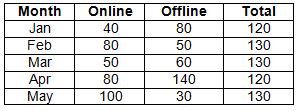
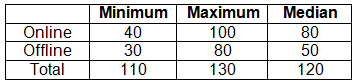
In a coaching class, some students register online, and some others register offline. No student registers both online and offline; hence the total registration number is the sum of online and offline registrations. The following facts and table pertain to these registration numbers for the five months – January to May of 2023. The table shows the minimum, maximum, median registration numbers of these five months, separately for online, offline and total number of registrations. The following additional facts are known.
1. In every month, both online and offline registration numbers were multiples of 10.
2. In January, the number of offline registrations was twice that of online registrations.
3. In April, the number of online registrations was twice that of offline registrations.
4. The number of online registrations in March was the same as the number of offline registrations in February.
5. The number of online registrations was the largest in May.


What was the total number of registrations in April ?

Free Resources
Marking Scheme
Correct Answer

120

In every month, both online and offline registration numbers were multiples of 10.
From (2), in Jan, the number of offline registrations was double that of online registrations.
Let x be the number of online registrations
2x be the number of offline registrations
Total number of registrations be x + 2x = 3x
According to the table data:
3x should lie between the minimum and maximum total number of registrations.
x = 40 (as x should also be a multiple of 10)
In January, 40 and 80 are the online and offline registrations respectively.
From 5, we can say that the number of online registrations is highest in may.
In may, there are total 100 online registrations.
Maximum possible total registrations is 130
Lowest possible number of offline registrations is 30
Let x be the number of offline registrations in May which is equal to number of online registrations in March.
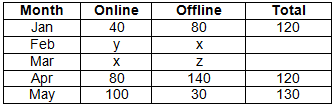
Let's arrange the data in table:

From the table mentioned in question, 50 is the median for Offline data
Now x should lie between 50 and 80
For 80 to be the median for the online data
y should lie between 80 and 100
Now, let's consider the following:
Feb ⇒ Minimum value of y + x
= 80 + 50 = 130
Therefore, x = 50 and y = 80
Since, 110 is the minimum number of total registrations, the only possibility is in March:
50 + z = 110
z = 60
Let's complete the table:

So, total number of April's registrations is 120.

Q7

CAT 2023 Slot 3 - DILR

Directions for Qs. 6 – 10: Refer to the following information and answer the following questions.

In a coaching class, some students register online, and some others register offline. No student registers both online and offline; hence the total registration number is the sum of online and offline registrations. The following facts and table pertain to these registration numbers for the five months – January to May of 2023. The table shows the minimum, maximum, median registration numbers of these five months, separately for online, offline and total number of registrations. The following additional facts are known.
1. In every month, both online and offline registration numbers were multiples of 10.
2. In January, the number of offline registrations was twice that of online registrations.
3. In April, the number of online registrations was twice that of offline registrations.
4. The number of online registrations in March was the same as the number of offline registrations in February.
5. The number of online registrations was the largest in May.


What was the number of online registrations in January ?

Free Resources
Marking Scheme
Correct Answer

40

In every month, both online and offline registration numbers were multiples of 10.
From (2), in Jan, the number of offline registrations was double that of online registrations.
Let x be the number of online registrations
2x be the number of offline registrations
Total number of registrations be x + 2x = 3x
According to the table data:
3x should lie between the minimum and maximum total number of registrations.
x = 40 (as x should also be a multiple of 10)
In January, 40 and 80 are the online and offline registrations respectively.
From 5, we can say that the number of online registrations is highest in may.
In may, there are total 100 online registrations.
Maximum possible total registrations is 130
Lowest possible number of offline registrations is 30
Let x be the number of offline registrations in May which is equal to number of online registrations in March.
Let's arrange the data in table:

From the table mentioned in question, 50 is the median for Offline data
Now x should lie between 50 and 80
For 80 to be the median for the online data
y should lie between 80 and 100
Now, let's consider the following:
Feb ⇒ Minimum value of y + x
= 80 + 50 = 130
Therefore, x = 50 and y = 80
Since, 110 is the minimum number of total registrations, the only possibility is in March:
50 + z = 110
z = 60
Let's complete the table:

The correct answer is 40.

Q8

CAT 2023 Slot 3 - DILR

Directions for Qs. 6 – 10: Refer to the following information and answer the following questions.

In a coaching class, some students register online, and some others register offline. No student registers both online and offline; hence the total registration number is the sum of online and offline registrations. The following facts and table pertain to these registration numbers for the five months – January to May of 2023. The table shows the minimum, maximum, median registration numbers of these five months, separately for online, offline and total number of registrations. The following additional facts are known.
1. In every month, both online and offline registration numbers were multiples of 10.
2. In January, the number of offline registrations was twice that of online registrations.
3. In April, the number of online registrations was twice that of offline registrations.
4. The number of online registrations in March was the same as the number of offline registrations in February.
5. The number of online registrations was the largest in May.


Which of the following statements can be true ?
I. The number of offline registrations was the smallest in May.
II. The total number of registrations was the smallest in February.

A

Only I

B

Only II

C

Both I and II

D

Neither I nor II

Free Resources
Marking Scheme
Correct Answer

Only I

In every month, both online and offline registration numbers were multiples of 10.
From (2), in Jan, the number of offline registrations was double that of online registrations.
Let x be the number of online registrations
2x be the number of offline registrations
Total number of registrations be x + 2x = 3x
According to the table data:
3x should lie between the minimum and maximum total number of registrations.
x = 40 (as x should also be a multiple of 10)
In January, 40 and 80 are the online and offline registrations respectively.
From 5, we can say that the number of online registrations is highest in may.
In may, there are total 100 online registrations.
Maximum possible total registrations is 130
Lowest possible number of offline registrations is 30
Let x be the number of offline registrations in May which is equal to number of online registrations in March.
Let's arrange the data in table:

From the table mentioned in question, 50 is the median for Offline data
Now x should lie between 50 and 80
For 80 to be the median for the online data
y should lie between 80 and 100
Now, let's consider the following:
Feb ⇒ Minimum value of y + x
= 80 + 50 = 130
Therefore, x = 50 and y = 80
Since, 110 is the minimum number of total registrations, the only possibility is in March:
50 + z = 110
z = 60
Let's complete the table:

The correct answer is Only I.

Q9

CAT 2023 Slot 3 - DILR

Directions for Qs. 6 – 10: Refer to the following information and answer the following questions.

In a coaching class, some students register online, and some others register offline. No student registers both online and offline; hence the total registration number is the sum of online and offline registrations. The following facts and table pertain to these registration numbers for the five months – January to May of 2023. The table shows the minimum, maximum, median registration numbers of these five months, separately for online, offline and total number of registrations. The following additional facts are known.
1. In every month, both online and offline registration numbers were multiples of 10.
2. In January, the number of offline registrations was twice that of online registrations.
3. In April, the number of online registrations was twice that of offline registrations.
4. The number of online registrations in March was the same as the number of offline registrations in February.
5. The number of online registrations was the largest in May.


What best can be concluded about the number of offline registrations in February ?

A

30 or 50 or 80

B

80

C

50 or 80

D

50

Free Resources
Marking Scheme
Correct Answer

50

In every month, both online and offline registration numbers were multiples of 10.
From (2), in Jan, the number of offline registrations was double that of online registrations.
Let x be the number of online registrations
2x be the number of offline registrations
Total number of registrations be x + 2x = 3x
According to the table data:
3x should lie between the minimum and maximum total number of registrations.
x = 40 (as x should also be a multiple of 10)
In January, 40 and 80 are the online and offline registrations respectively.
From 5, we can say that the number of online registrations is highest in may.
In may, there are total 100 online registrations.
Maximum possible total registrations is 130
Lowest possible number of offline registrations is 30
Let x be the number of offline registrations in May which is equal to number of online registrations in March.
Let's arrange the data in table:

From the table mentioned in question, 50 is the median for Offline data
Now x should lie between 50 and 80
For 80 to be the median for the online data
y should lie between 80 and 100
Now, let's consider the following:
Feb ⇒ Minimum value of y + x
= 80 + 50 = 130
Therefore, x = 50 and y = 80
Since, 110 is the minimum number of total registrations, the only possibility is in March:
50 + z = 110
z = 60
Let's complete the table:

The correct answer is 50

Q10

CAT 2023 Slot 3 - DILR

Directions for Qs. 6 – 10: Refer to the following information and answer the following questions.

In a coaching class, some students register online, and some others register offline. No student registers both online and offline; hence the total registration number is the sum of online and offline registrations. The following facts and table pertain to these registration numbers for the five months – January to May of 2023. The table shows the minimum, maximum, median registration numbers of these five months, separately for online, offline and total number of registrations. The following additional facts are known.
1. In every month, both online and offline registration numbers were multiples of 10.
2. In January, the number of offline registrations was twice that of online registrations.
3. In April, the number of online registrations was twice that of offline registrations.
4. The number of online registrations in March was the same as the number of offline registrations in February.
5. The number of online registrations was the largest in May.


Which pair of months definitely had the same total number of registrations ?
I. January and April
II. February and May

A

Only I

B

Only II

C

Neither I nor II

D

Both I and II

Free Resources
Marking Scheme
Correct Answer

Both I and II

In every month, both online and offline registration numbers were multiples of 10.
From (2), in Jan, the number of offline registrations was double that of online registrations.
Let x be the number of online registrations
2x be the number of offline registrations
Total number of registrations be x + 2x = 3x
According to the table data:
3x should lie between the minimum and maximum total number of registrations.
x = 40 (as x should also be a multiple of 10)
In January, 40 and 80 are the online and offline registrations respectively.
From 5, we can say that the number of online registrations is highest in may.
In may, there are total 100 online registrations.
Maximum possible total registrations is 130
Lowest possible number of offline registrations is 30
Let x be the number of offline registrations in May which is equal to number of online registrations in March.
Let's arrange the data in table:

From the table mentioned in question, 50 is the median for Offline data
Now x should lie between 50 and 80
For 80 to be the median for the online data
y should lie between 80 and 100
Now, let's consider the following:
Feb ⇒ Minimum value of y + x
= 80 + 50 = 130
Therefore, x = 50 and y = 80
Since, 110 is the minimum number of total registrations, the only possibility is in March:
50 + z = 110
z = 60
Let's complete the table:

The correct answer is Both I and II.

Q11

CAT 2023 Slot 3 - DILR

Directions for Qs. 11 – 15: Refer to the following information and answer the following questions.

An air conditioner (AC) company has four dealers – D1, D2, D3 and D4 in a city. It is evaluating sales performances of these dealers. The company sells two variants of ACs – Window and Split. Both these variants can be either Inverter type or Non-inverter type. It is known that of the total number of ACs sold in the city, 25% were of Window variant, while the rest were of Split variant. Among the Inverter ACs sold, 20% were of Window variant.
The following information is also known: 
1. Every dealer sold at least two window ACs.
2. D1 sold 13 inverter ACs, while D3 sold 5 Non-inverter ACs. 
3. A total of six Window Non-inverter ACs and 36 Split Inverter ACs were sold in the city.
4. The number of Split ACs sold by D1 was twice the number of Window ACs sold by it.
5. D3 and D4 sold an equal number of Window ACs and this number was one-third of the number of similar ACs sold by D2.
6. D2 and D3 were the only ones who sold Window Non-inverter ACs. The number of these ACs sold by D2 was twice the number of these ACs sold by D3.
7. D3 and D4 sold an equal number of Split Inverter ACs. This number was half the number of similar ACs sold by D2.

How many Split Inverter ACs did D2 sell ?

Free Resources
Marking Scheme
Correct Answer

14

Suppose, A is the total number of AC's sold.
From the given information, that the total number of ACs sold in the city, 25% were of Window variant.
Window AC's = A/4  and Split AC's = 3A/4
Now, Suppose B is the total Number of inverter ACs
From the given information, that among the Inverter ACs sold, 20% were of Window variant.
Window Inverter AC's = B/5 and Window Non-Inverter AC's = 4B/5
From the given condition 3, we get
A/4 - B/5 = 6 & 4B/5 = 36
So, B = 46 and A = 60

So, From condition-6
(i) If D1 and D4 sold no window Non-inverter ACs, then D2 sold twice as many as D3, meaning D2 sold 4 and D3 sold 2 of this type.
From condition-2
(ii) Let's say D1 sold x window inverter ACs, then the number of split inverter ACs sold would be 13 minus x.
From condition-5
(iii) Let's suppose y represents the number of window ACs sold by D3 and D4. In that case, D2 sold 3y ACs of this type.
From condition-4
(iv) Number of split ACs sold by D1 will be 2x
From condition-7
(v) Let's say z represents the number of split inverter ACs sold by D3 and D4. In that case, D2 sold twice as many, totaling 2z ACs of this type.
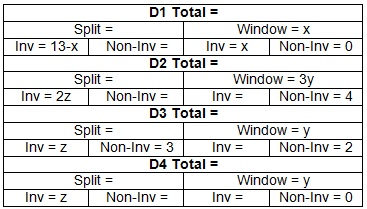
Now, let use the (i), (ii), (iii), (iv) and (v) to create a table:

As per the question, the total number of window ACs is 15.
So, x + 3y + y + y = 15
x + 5y = 15 (where x and y should be greater than or equal to 2 from condition 1)
Hence, the only solution is x = 5 and y = 2
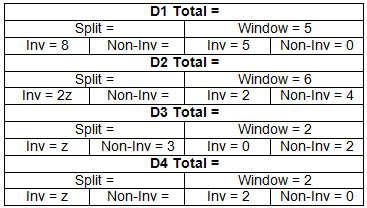
Now, use the values to fill the table:

So, the Number of split Inverter ACs is 36, which means that 8 + 2z + z + z = 36
4z = 28
z = 7
Now, use the value of z and using the (5), the number of split AC's sold by D1 is 2 × 5 = 10

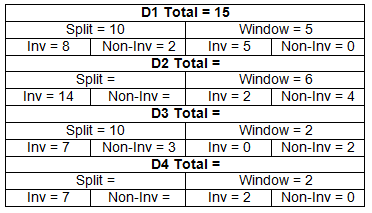
Now, by looking at the table, we get that, 14 split ACs are sold by D2.

Q12

CAT 2023 Slot 3 - DILR

Directions for Qs. 11 – 15: Refer to the following information and answer the following questions.

An air conditioner (AC) company has four dealers – D1, D2, D3 and D4 in a city. It is evaluating sales performances of these dealers. The company sells two variants of ACs – Window and Split. Both these variants can be either Inverter type or Non-inverter type. It is known that of the total number of ACs sold in the city, 25% were of Window variant, while the rest were of Split variant. Among the Inverter ACs sold, 20% were of Window variant.
The following information is also known: 
1. Every dealer sold at least two window ACs.
2. D1 sold 13 inverter ACs, while D3 sold 5 Non-inverter ACs. 
3. A total of six Window Non-inverter ACs and 36 Split Inverter ACs were sold in the city.
4. The number of Split ACs sold by D1 was twice the number of Window ACs sold by it.
5. D3 and D4 sold an equal number of Window ACs and this number was one-third of the number of similar ACs sold by D2.
6. D2 and D3 were the only ones who sold Window Non-inverter ACs. The number of these ACs sold by D2 was twice the number of these ACs sold by D3.
7. D3 and D4 sold an equal number of Split Inverter ACs. This number was half the number of similar ACs sold by D2.

What percentage of ACs sold were of Non-inverter type ?

A

33.33%

B

20.00%

C

25.00%

D

75.00%

Free Resources
Marking Scheme
Correct Answer

25.00%

Suppose, A is the total number of AC's sold.
From the given information, that the total number of ACs sold in the city, 25% were of Window variant.
Window AC's = A/4  and Split AC's = 3A/4
Now, Suppose B is the total Number of inverter ACs
From the given information, that among the Inverter ACs sold, 20% were of Window variant.
Window Inverter AC's = B/5 and Window Non-Inverter AC's = 4B/5
From the given condition 3, we get
A/4 - B/5 = 6 & 4B/5 = 36
So, B = 46 and A = 60

So, From condition-6
(i) If D1 and D4 sold no window Non-inverter ACs, then D2 sold twice as many as D3, meaning D2 sold 4 and D3 sold 2 of this type.
From condition-2
(ii) Let's say D1 sold x window inverter ACs, then the number of split inverter ACs sold would be 13 minus x.
From condition-5
(iii) Let's suppose y represents the number of window ACs sold by D3 and D4. In that case, D2 sold 3y ACs of this type.
From condition-4
(iv) Number of split ACs sold by D1 will be 2x
From condition-7
(v) Let's say z represents the number of split inverter ACs sold by D3 and D4. In that case, D2 sold twice as many, totaling 2z ACs of this type.
Now, let use the (i), (ii), (iii), (iv) and (v) to create a table:

As per the question, the total number of window ACs is 15.
So, x + 3y + y + y = 15
x + 5y = 15 (where x and y should be greater than or equal to 2 from condition 1)
Hence, the only solution is x = 5 and y = 2
Now, use the values to fill the table:

So, the Number of split Inverter ACs is 36, which means that 8 + 2z + z + z = 36
4z = 28
z = 7
Now, use the value of z and using the (5), the number of split AC's sold by D1 is 2 × 5 = 10

Now, by looking at the table, we get that total number of non-inverter ACs is 9 + 6 = 15.
So, needed percentage:
15 out of 60 i.e.   15/60 × 10 = 25%

Q13

CAT 2023 Slot 3 - DILR

Directions for Qs. 11 – 15: Refer to the following information and answer the following questions.

An air conditioner (AC) company has four dealers – D1, D2, D3 and D4 in a city. It is evaluating sales performances of these dealers. The company sells two variants of ACs – Window and Split. Both these variants can be either Inverter type or Non-inverter type. It is known that of the total number of ACs sold in the city, 25% were of Window variant, while the rest were of Split variant. Among the Inverter ACs sold, 20% were of Window variant.
The following information is also known: 
1. Every dealer sold at least two window ACs.
2. D1 sold 13 inverter ACs, while D3 sold 5 Non-inverter ACs. 
3. A total of six Window Non-inverter ACs and 36 Split Inverter ACs were sold in the city.
4. The number of Split ACs sold by D1 was twice the number of Window ACs sold by it.
5. D3 and D4 sold an equal number of Window ACs and this number was one-third of the number of similar ACs sold by D2.
6. D2 and D3 were the only ones who sold Window Non-inverter ACs. The number of these ACs sold by D2 was twice the number of these ACs sold by D3.
7. D3 and D4 sold an equal number of Split Inverter ACs. This number was half the number of similar ACs sold by D2.

What was the total number of ACs sold by D2 and D4 ?

Free Resources
Marking Scheme
Correct Answer

33

Suppose, A is the total number of AC's sold.
From the given information, that the total number of ACs sold in the city, 25% were of Window variant.
Window AC's = A/4  and Split AC's = 3A/4
Now, Suppose B is the total Number of inverter ACs
From the given information, that among the Inverter ACs sold, 20% were of Window variant.
Window Inverter AC's = B/5 and Window Non-Inverter AC's = 4B/5
From the given condition 3, we get
A/4 - B/5 = 6 & 4B/5 = 36
So, B = 46 and A = 60

So, From condition-6
(i) If D1 and D4 sold no window Non-inverter ACs, then D2 sold twice as many as D3, meaning D2 sold 4 and D3 sold 2 of this type.
From condition-2
(ii) Let's say D1 sold x window inverter ACs, then the number of split inverter ACs sold would be 13 minus x.
From condition-5
(iii) Let's suppose y represents the number of window ACs sold by D3 and D4. In that case, D2 sold 3y ACs of this type.
From condition-4
(iv) Number of split ACs sold by D1 will be 2x
From condition-7
(v) Let's say z represents the number of split inverter ACs sold by D3 and D4. In that case, D2 sold twice as many, totaling 2z ACs of this type.
Now, let use the (i), (ii), (iii), (iv) and (v) to create a table:

As per the question, the total number of window ACs is 15.
So, x + 3y + y + y = 15
x + 5y = 15 (where x and y should be greater than or equal to 2 from condition 1)
Hence, the only solution is x = 5 and y = 2
Now, use the values to fill the table:

So, the Number of split Inverter ACs is 36, which means that 8 + 2z + z + z = 36
4z = 28
z = 7
Now, use the value of z and using the (5), the number of split AC's sold by D1 is 2 × 5 = 10

Now, the total number of ACs sold by D2 and D4: = 60 – D1 – D3
= 60 – 15 – 12
= 33
Therefore, the correct answer is 33.

Q14

CAT 2023 Slot 3 - DILR

Directions for Qs. 11 – 15: Refer to the following information and answer the following questions.

An air conditioner (AC) company has four dealers – D1, D2, D3 and D4 in a city. It is evaluating sales performances of these dealers. The company sells two variants of ACs – Window and Split. Both these variants can be either Inverter type or Non-inverter type. It is known that of the total number of ACs sold in the city, 25% were of Window variant, while the rest were of Split variant. Among the Inverter ACs sold, 20% were of Window variant.
The following information is also known: 
1. Every dealer sold at least two window ACs.
2. D1 sold 13 inverter ACs, while D3 sold 5 Non-inverter ACs. 
3. A total of six Window Non-inverter ACs and 36 Split Inverter ACs were sold in the city.
4. The number of Split ACs sold by D1 was twice the number of Window ACs sold by it.
5. D3 and D4 sold an equal number of Window ACs and this number was one-third of the number of similar ACs sold by D2.
6. D2 and D3 were the only ones who sold Window Non-inverter ACs. The number of these ACs sold by D2 was twice the number of these ACs sold by D3.
7. D3 and D4 sold an equal number of Split Inverter ACs. This number was half the number of similar ACs sold by D2.

Which of the following statements is necessarily false ?

A

D2 sold the highest number of ACs.

B

D1 and D3 together sold more ACs as compared to D2 and D4 together.

C

D1 and D3 sold an equal number of Split ACs.

D

D4 sold more Split ACs as compared to D3.

Free Resources
Marking Scheme
Correct Answer

D1 and D3 together sold more ACs as compared to D2 and D4 together.

Suppose, A is the total number of AC's sold.
From the given information, that the total number of ACs sold in the city, 25% were of Window variant.
Window AC's = A/4  and Split AC's = 3A/4
Now, Suppose B is the total Number of inverter ACs
From the given information, that among the Inverter ACs sold, 20% were of Window variant.
Window Inverter AC's = B/5 and Window Non-Inverter AC's = 4B/5
From the given condition 3, we get
A/4 - B/5 = 6 & 4B/5 = 36
So, B = 46 and A = 60

So, From condition-6
(i) If D1 and D4 sold no window Non-inverter ACs, then D2 sold twice as many as D3, meaning D2 sold 4 and D3 sold 2 of this type.
From condition-2
(ii) Let's say D1 sold x window inverter ACs, then the number of split inverter ACs sold would be 13 minus x.
From condition-5
(iii) Let's suppose y represents the number of window ACs sold by D3 and D4. In that case, D2 sold 3y ACs of this type.
From condition-4
(iv) Number of split ACs sold by D1 will be 2x
From condition-7
(v) Let's say z represents the number of split inverter ACs sold by D3 and D4. In that case, D2 sold twice as many, totaling 2z ACs of this type.
Now, let use the (i), (ii), (iii), (iv) and (v) to create a table:

As per the question, the total number of window ACs is 15.
So, x + 3y + y + y = 15
x + 5y = 15 (where x and y should be greater than or equal to 2 from condition 1)
Hence, the only solution is x = 5 and y = 2
Now, use the values to fill the table:

So, the Number of split Inverter ACs is 36, which means that 8 + 2z + z + z = 36
4z = 28
z = 7
Now, use the value of z and using the (5), the number of split AC's sold by D1 is 2 × 5 = 10

From the table, we get that D1 and D3 sold 27 ACs together which is less than 60 – 27 = 33 which is sold by D2 and D4 together.

Q15

CAT 2023 Slot 3 - DILR

Directions for Qs. 11 – 15: Refer to the following information and answer the following questions.

An air conditioner (AC) company has four dealers – D1, D2, D3 and D4 in a city. It is evaluating sales performances of these dealers. The company sells two variants of ACs – Window and Split. Both these variants can be either Inverter type or Non-inverter type. It is known that of the total number of ACs sold in the city, 25% were of Window variant, while the rest were of Split variant. Among the Inverter ACs sold, 20% were of Window variant.
The following information is also known: 
1. Every dealer sold at least two window ACs.
2. D1 sold 13 inverter ACs, while D3 sold 5 Non-inverter ACs. 
3. A total of six Window Non-inverter ACs and 36 Split Inverter ACs were sold in the city.
4. The number of Split ACs sold by D1 was twice the number of Window ACs sold by it.
5. D3 and D4 sold an equal number of Window ACs and this number was one-third of the number of similar ACs sold by D2.
6. D2 and D3 were the only ones who sold Window Non-inverter ACs. The number of these ACs sold by D2 was twice the number of these ACs sold by D3.
7. D3 and D4 sold an equal number of Split Inverter ACs. This number was half the number of similar ACs sold by D2.

If D3 and D4 sold an equal number of ACs, then what was the number of Non-inverter ACs sold by D2 ?

A

7

B

5

C

6

D

4

Free Resources
Marking Scheme
Correct Answer

5

Suppose, A is the total number of AC's sold.
From the given information, that the total number of ACs sold in the city, 25% were of Window variant.
Window AC's = A/4  and Split AC's = 3A/4
Now, Suppose B is the total Number of inverter ACs
From the given information, that among the Inverter ACs sold, 20% were of Window variant.
Window Inverter AC's = B/5 and Window Non-Inverter AC's = 4B/5
From the given condition 3, we get
A/4 - B/5 = 6 & 4B/5 = 36
So, B = 46 and A = 60

So, From condition-6
(i) If D1 and D4 sold no window Non-inverter ACs, then D2 sold twice as many as D3, meaning D2 sold 4 and D3 sold 2 of this type.
From condition-2
(ii) Let's say D1 sold x window inverter ACs, then the number of split inverter ACs sold would be 13 minus x.
From condition-5
(iii) Let's suppose y represents the number of window ACs sold by D3 and D4. In that case, D2 sold 3y ACs of this type.
From condition-4
(iv) Number of split ACs sold by D1 will be 2x
From condition-7
(v) Let's say z represents the number of split inverter ACs sold by D3 and D4. In that case, D2 sold twice as many, totaling 2z ACs of this type.
Now, let use the (i), (ii), (iii), (iv) and (v) to create a table:

As per the question, the total number of window ACs is 15.
So, x + 3y + y + y = 15
x + 5y = 15 (where x and y should be greater than or equal to 2 from condition 1)
Hence, the only solution is x = 5 and y = 2
Now, use the values to fill the table:

So, the Number of split Inverter ACs is 36, which means that 8 + 2z + z + z = 36
4z = 28
z = 7
Now, use the value of z and using the (5), the number of split AC's sold by D1 is 2 × 5 = 10

So, by looking at the table, we can say that:
The number of non-inverter ACs sold by D2 is 
4 + 1 = 5

Q16

CAT 2023 Slot 3 - DILR

Directions for Qs. 16 – 20: Refer to the following information and answer the following questions.

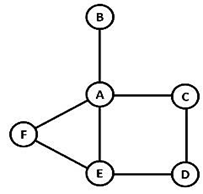
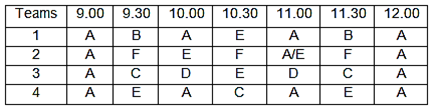
A, B, C, D, E and F are the six police stations in an area, which are connected by streets as shown below. Four teams – Team 1, Team 2, Team 3 and Team 4 – patrol these streets continuously between 09:00 hrs. and 12:00 hrs. each day.

The teams need 30 minutes to cross a street connecting one police station to another. All four teams start from Station A at 09:00 hrs. and must return to Station A by 12:00 hrs. They can also pass via Station A at any point on their journeys.
The following facts are known.
1. None of the streets has more than one team traveling along it in any direction at any point in time.
2. Teams 2 and 3 are the only ones in stations E and D respectively at 10:00 hrs.
3. Teams 1 and 3 are the only ones in station E at 10:30 hrs.
4. Teams 1 and 4 are the only ones in stations B and E respectively at 11:30 hrs.
5. Team 1 and Team 4 are the only teams that patrol the street connecting stations A and E.
6. Team 4 never passes through Stations B, D or F.

Which one among the following stations is visited the largest number of times ?

A

Station D

B

Station C

C

Station F

D

Station E

Free Resources
Marking Scheme
Correct Answer

Station E

At 9:00 a.m., it's understood that all four teams have selected distinct paths from the starting point since no street sees more than one team traveling in any direction simultaneously.
At 10:00 a.m., we know Team 2 is at station E, and Team 3 is at station D. Moreover, only Team 1 and Team 4 patrol the street connecting stations A and E.
This scenario is only possible if Team 2 traveled from A to E through F, and Team 3 arrived at station D via station C.
Also, it's confirmed that only Teams 1 and 3 are at Station E by 10:30 a.m., and Team 4 avoids passing through Stations B, D, or F. Consequently, Team 1 likely opted for the (A-B) route initially, while Team 4 likely selected the (A-E) route at 9:00 a.m.
So, Team 1 is expected to arrive at B by 9:30 a.m., return to A by 10:00 a.m., and then proceed to E by 10:30 a.m.
Given that Team 4 avoids stations B, D, and F, they can only travel through stations A, E, and C. Therefore, Team 4's routes to reach station E by 11:30 could either be (A-E-A-C-A-E) or (A-E-A-E-A-E).
Given that Team 1 is already in route from A to E at 10:00 a.m., Team 4 cannot opt for the same route at that time. Therefore, the definitive route for Team 4 to reach E by 11:30 a.m. is (A-E-A-C-A-E), and by 12:00 p.m., Team 4 will return to station A.
Therefore, the complete route map for Team 4 is (A-E-A-C-A-E-A).

Observing that Team 1 arrives at station E by 10:30 a.m., we note that they will reach station B by 11:30 a.m., indicating they must travel to B via A.
Therefore, the complete route plan for Team 1 is (A-B-A-E-A-B-A). Additionally, it's confirmed that Teams 1 and 3 are the sole occupants of station E at 10:30 a.m.

At 10:00 a.m., Team 2 has only one option: they must go from E to F since Team 3 is already on the E to D route. For Team 3 to reach A by 12:00 p.m., their only feasible route is E-D-C-A.

So, At 10:30 a.m., Team 2's possible routes back to A are either (F-A-F-A) or (F-E-F-A).
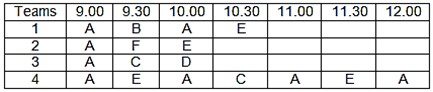
Therefore, the final table is as follows:

From the table, we can see that among the options given, Station E is the station visited the largest number of times.

Q17

CAT 2023 Slot 3 - DILR

Directions for Qs. 16 – 20: Refer to the following information and answer the following questions.

A, B, C, D, E and F are the six police stations in an area, which are connected by streets as shown below. Four teams – Team 1, Team 2, Team 3 and Team 4 – patrol these streets continuously between 09:00 hrs. and 12:00 hrs. each day.

The teams need 30 minutes to cross a street connecting one police station to another. All four teams start from Station A at 09:00 hrs. and must return to Station A by 12:00 hrs. They can also pass via Station A at any point on their journeys.
The following facts are known.
1. None of the streets has more than one team traveling along it in any direction at any point in time.
2. Teams 2 and 3 are the only ones in stations E and D respectively at 10:00 hrs.
3. Teams 1 and 3 are the only ones in station E at 10:30 hrs.
4. Teams 1 and 4 are the only ones in stations B and E respectively at 11:30 hrs.
5. Team 1 and Team 4 are the only teams that patrol the street connecting stations A and E.
6. Team 4 never passes through Stations B, D or F.

How many times do the teams pass through Station B in a day ?

Free Resources
Marking Scheme
Correct Answer

2

At 9:00 a.m., it's understood that all four teams have selected distinct paths from the starting point since no street sees more than one team traveling in any direction simultaneously.
At 10:00 a.m., we know Team 2 is at station E, and Team 3 is at station D. Moreover, only Team 1 and Team 4 patrol the street connecting stations A and E.
This scenario is only possible if Team 2 traveled from A to E through F, and Team 3 arrived at station D via station C.
Also, it's confirmed that only Teams 1 and 3 are at Station E by 10:30 a.m., and Team 4 avoids passing through Stations B, D, or F. Consequently, Team 1 likely opted for the (A-B) route initially, while Team 4 likely selected the (A-E) route at 9:00 a.m.
So, Team 1 is expected to arrive at B by 9:30 a.m., return to A by 10:00 a.m., and then proceed to E by 10:30 a.m.
Given that Team 4 avoids stations B, D, and F, they can only travel through stations A, E, and C. Therefore, Team 4's routes to reach station E by 11:30 could either be (A-E-A-C-A-E) or (A-E-A-E-A-E).
Given that Team 1 is already in route from A to E at 10:00 a.m., Team 4 cannot opt for the same route at that time. Therefore, the definitive route for Team 4 to reach E by 11:30 a.m. is (A-E-A-C-A-E), and by 12:00 p.m., Team 4 will return to station A.
Therefore, the complete route map for Team 4 is (A-E-A-C-A-E-A).

Observing that Team 1 arrives at station E by 10:30 a.m., we note that they will reach station B by 11:30 a.m., indicating they must travel to B via A.
Therefore, the complete route plan for Team 1 is (A-B-A-E-A-B-A). Additionally, it's confirmed that Teams 1 and 3 are the sole occupants of station E at 10:30 a.m.

At 10:00 a.m., Team 2 has only one option: they must go from E to F since Team 3 is already on the E to D route. For Team 3 to reach A by 12:00 p.m., their only feasible route is E-D-C-A.

So, At 10:30 a.m., Team 2's possible routes back to A are either (F-A-F-A) or (F-E-F-A).
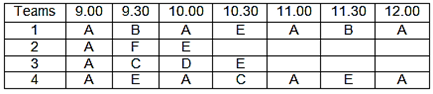
Therefore, the final table is as follows:

From the data available in the table, we can see that the teams have crossed the B Station 2 times in the given time period.
So, the correct answer is 2.

Q18

CAT 2023 Slot 3 - DILR

Directions for Qs. 16 – 20: Refer to the following information and answer the following questions.

A, B, C, D, E and F are the six police stations in an area, which are connected by streets as shown below. Four teams – Team 1, Team 2, Team 3 and Team 4 – patrol these streets continuously between 09:00 hrs. and 12:00 hrs. each day.

The teams need 30 minutes to cross a street connecting one police station to another. All four teams start from Station A at 09:00 hrs. and must return to Station A by 12:00 hrs. They can also pass via Station A at any point on their journeys.
The following facts are known.
1. None of the streets has more than one team traveling along it in any direction at any point in time.
2. Teams 2 and 3 are the only ones in stations E and D respectively at 10:00 hrs.
3. Teams 1 and 3 are the only ones in station E at 10:30 hrs.
4. Teams 1 and 4 are the only ones in stations B and E respectively at 11:30 hrs.
5. Team 1 and Team 4 are the only teams that patrol the street connecting stations A and E.
6. Team 4 never passes through Stations B, D or F.

Which team patrols the street connecting Stations D and E at 10 : 15 hrs ?

A

Team 2

B

Team 1

C

Team 4

D

Team 3

Free Resources
Marking Scheme
Correct Answer

Team 3

At 9:00 a.m., it's understood that all four teams have selected distinct paths from the starting point since no street sees more than one team traveling in any direction simultaneously.
At 10:00 a.m., we know Team 2 is at station E, and Team 3 is at station D. Moreover, only Team 1 and Team 4 patrol the street connecting stations A and E.
This scenario is only possible if Team 2 traveled from A to E through F, and Team 3 arrived at station D via station C.
Also, it's confirmed that only Teams 1 and 3 are at Station E by 10:30 a.m., and Team 4 avoids passing through Stations B, D, or F. Consequently, Team 1 likely opted for the (A-B) route initially, while Team 4 likely selected the (A-E) route at 9:00 a.m.
So, Team 1 is expected to arrive at B by 9:30 a.m., return to A by 10:00 a.m., and then proceed to E by 10:30 a.m.
Given that Team 4 avoids stations B, D, and F, they can only travel through stations A, E, and C. Therefore, Team 4's routes to reach station E by 11:30 could either be (A-E-A-C-A-E) or (A-E-A-E-A-E).
Given that Team 1 is already in route from A to E at 10:00 a.m., Team 4 cannot opt for the same route at that time. Therefore, the definitive route for Team 4 to reach E by 11:30 a.m. is (A-E-A-C-A-E), and by 12:00 p.m., Team 4 will return to station A.
Therefore, the complete route map for Team 4 is (A-E-A-C-A-E-A).

Observing that Team 1 arrives at station E by 10:30 a.m., we note that they will reach station B by 11:30 a.m., indicating they must travel to B via A.
Therefore, the complete route plan for Team 1 is (A-B-A-E-A-B-A). Additionally, it's confirmed that Teams 1 and 3 are the sole occupants of station E at 10:30 a.m.

At 10:00 a.m., Team 2 has only one option: they must go from E to F since Team 3 is already on the E to D route. For Team 3 to reach A by 12:00 p.m., their only feasible route is E-D-C-A.

So, At 10:30 a.m., Team 2's possible routes back to A are either (F-A-F-A) or (F-E-F-A).
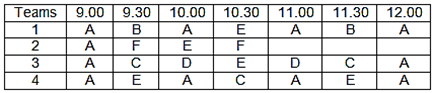
Therefore, the final table is as follows:

From the above table, we can infer that at 10:15 am Team 3 is travelling from Station D to Station E.
So, the correct answer is Team 3.

Q19

CAT 2023 Slot 3 - DILR

Directions for Qs. 16 – 20: Refer to the following information and answer the following questions.

A, B, C, D, E and F are the six police stations in an area, which are connected by streets as shown below. Four teams – Team 1, Team 2, Team 3 and Team 4 – patrol these streets continuously between 09:00 hrs. and 12:00 hrs. each day.

The teams need 30 minutes to cross a street connecting one police station to another. All four teams start from Station A at 09:00 hrs. and must return to Station A by 12:00 hrs. They can also pass via Station A at any point on their journeys.
The following facts are known.
1. None of the streets has more than one team traveling along it in any direction at any point in time.
2. Teams 2 and 3 are the only ones in stations E and D respectively at 10:00 hrs.
3. Teams 1 and 3 are the only ones in station E at 10:30 hrs.
4. Teams 1 and 4 are the only ones in stations B and E respectively at 11:30 hrs.
5. Team 1 and Team 4 are the only teams that patrol the street connecting stations A and E.
6. Team 4 never passes through Stations B, D or F.

How many times does Team 4 pass through Station E in a day ?

Free Resources
Marking Scheme
Correct Answer

2

At 9:00 a.m., it's understood that all four teams have selected distinct paths from the starting point since no street sees more than one team traveling in any direction simultaneously.
At 10:00 a.m., we know Team 2 is at station E, and Team 3 is at station D. Moreover, only Team 1 and Team 4 patrol the street connecting stations A and E.
This scenario is only possible if Team 2 traveled from A to E through F, and Team 3 arrived at station D via station C.
Also, it's confirmed that only Teams 1 and 3 are at Station E by 10:30 a.m., and Team 4 avoids passing through Stations B, D, or F. Consequently, Team 1 likely opted for the (A-B) route initially, while Team 4 likely selected the (A-E) route at 9:00 a.m.
So, Team 1 is expected to arrive at B by 9:30 a.m., return to A by 10:00 a.m., and then proceed to E by 10:30 a.m.
Given that Team 4 avoids stations B, D, and F, they can only travel through stations A, E, and C. Therefore, Team 4's routes to reach station E by 11:30 could either be (A-E-A-C-A-E) or (A-E-A-E-A-E).
Given that Team 1 is already in route from A to E at 10:00 a.m., Team 4 cannot opt for the same route at that time. Therefore, the definitive route for Team 4 to reach E by 11:30 a.m. is (A-E-A-C-A-E), and by 12:00 p.m., Team 4 will return to station A.
Therefore, the complete route map for Team 4 is (A-E-A-C-A-E-A).

Observing that Team 1 arrives at station E by 10:30 a.m., we note that they will reach station B by 11:30 a.m., indicating they must travel to B via A.
Therefore, the complete route plan for Team 1 is (A-B-A-E-A-B-A). Additionally, it's confirmed that Teams 1 and 3 are the sole occupants of station E at 10:30 a.m.

At 10:00 a.m., Team 2 has only one option: they must go from E to F since Team 3 is already on the E to D route. For Team 3 to reach A by 12:00 p.m., their only feasible route is E-D-C-A.

So, At 10:30 a.m., Team 2's possible routes back to A are either (F-A-F-A) or (F-E-F-A).
Therefore, the final table is as follows:

From the table, we can easily see that only the Team 4 is passing through the Station E twice a day i.e 2 times in a day.
So, the correct answer is 2.

Q20

CAT 2023 Slot 3 - DILR

Directions for Qs. 16 – 20: Refer to the following information and answer the following questions.

A, B, C, D, E and F are the six police stations in an area, which are connected by streets as shown below. Four teams – Team 1, Team 2, Team 3 and Team 4 – patrol these streets continuously between 09:00 hrs. and 12:00 hrs. each day.

The teams need 30 minutes to cross a street connecting one police station to another. All four teams start from Station A at 09:00 hrs. and must return to Station A by 12:00 hrs. They can also pass via Station A at any point on their journeys.
The following facts are known.
1. None of the streets has more than one team traveling along it in any direction at any point in time.
2. Teams 2 and 3 are the only ones in stations E and D respectively at 10:00 hrs.
3. Teams 1 and 3 are the only ones in station E at 10:30 hrs.
4. Teams 1 and 4 are the only ones in stations B and E respectively at 11:30 hrs.
5. Team 1 and Team 4 are the only teams that patrol the street connecting stations A and E.
6. Team 4 never passes through Stations B, D or F.

How many teams pass through Station C in a day ?

A

1

B

2

C

3

D

4

Free Resources
Marking Scheme
Correct Answer

2

At 9:00 a.m., it's understood that all four teams have selected distinct paths from the starting point since no street sees more than one team traveling in any direction simultaneously.
At 10:00 a.m., we know Team 2 is at station E, and Team 3 is at station D. Moreover, only Team 1 and Team 4 patrol the street connecting stations A and E.
This scenario is only possible if Team 2 traveled from A to E through F, and Team 3 arrived at station D via station C.
Also, it's confirmed that only Teams 1 and 3 are at Station E by 10:30 a.m., and Team 4 avoids passing through Stations B, D, or F. Consequently, Team 1 likely opted for the (A-B) route initially, while Team 4 likely selected the (A-E) route at 9:00 a.m.
So, Team 1 is expected to arrive at B by 9:30 a.m., return to A by 10:00 a.m., and then proceed to E by 10:30 a.m.
Given that Team 4 avoids stations B, D, and F, they can only travel through stations A, E, and C. Therefore, Team 4's routes to reach station E by 11:30 could either be (A-E-A-C-A-E) or (A-E-A-E-A-E).
Given that Team 1 is already in route from A to E at 10:00 a.m., Team 4 cannot opt for the same route at that time. Therefore, the definitive route for Team 4 to reach E by 11:30 a.m. is (A-E-A-C-A-E), and by 12:00 p.m., Team 4 will return to station A.
Therefore, the complete route map for Team 4 is (A-E-A-C-A-E-A).

Observing that Team 1 arrives at station E by 10:30 a.m., we note that they will reach station B by 11:30 a.m., indicating they must travel to B via A.
Therefore, the complete route plan for Team 1 is (A-B-A-E-A-B-A). Additionally, it's confirmed that Teams 1 and 3 are the sole occupants of station E at 10:30 a.m.

At 10:00 a.m., Team 2 has only one option: they must go from E to F since Team 3 is already on the E to D route. For Team 3 to reach A by 12:00 p.m., their only feasible route is E-D-C-A.

So, At 10:30 a.m., Team 2's possible routes back to A are either (F-A-F-A) or (F-E-F-A).
Therefore, the final table is as follows:

From the table, we can infer that Team 3 and Team 4 are passing through the Station C on the mentioned day.
So, the correct answer is 2.

Solved by Stalwart Experts

Our team of MBA educators with 10+ years experience provides accurate, verified solutions. Meet the Team

Trusted by thousands of MBA aspirants — Updated regularly
×
Popup Form