All Courses / CAT / CAT 2024 Slot 2 - Quant

CAT 2024 Slot 2 - Quant

Previous Year Questions with Detailed Solutions

22 Questions CAT Free Access

Practice CAT 2024 Slot 2 - Quant previous year questions with step-by-step solutions from the CAT exam. Every question includes the correct answer and a full worked explanation — no need to leave the page.

Q1

CAT 2024 Slot 2 - Quant

Bina incurs 19% loss when she sells a product at Rs 4860 to Shyam, who in turn sells this product to Hari. If Bina would have sold this product to Shyam at the purchase price of Hari, she would have obtained 17% profit. Then, the profit, in rupees, made by Shyam is

Free Resources
Marking Scheme
Correct Answer

2160

Let the cost price of the item be C
We are given that Bina sells this at 19% loss or at (1 − 0.19)C = 0.81C at 4860
This gives us the value of C at Rs. 6000
If Bina had sold this at 17% profit, the selling price would have been 1.17 × 6000 = 7020
So Shyam bought the product at 4860 and sold it to Hari at 7020
Giving the profit made by Shyam to be 7020 − 4860 = 2160
Q2

CAT 2024 Slot 2 - Quant

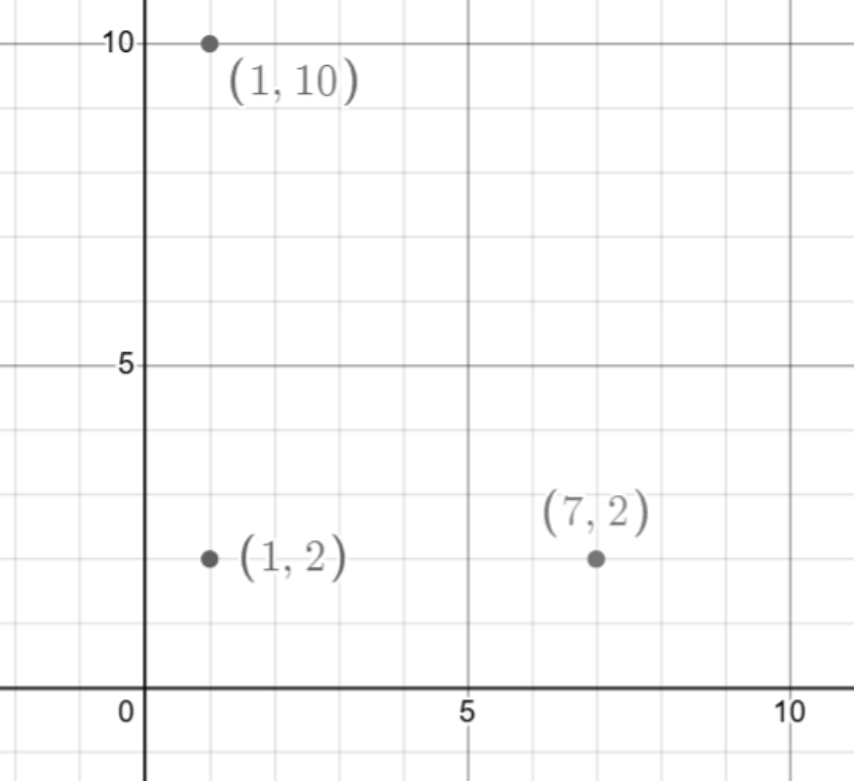
The coordinates of the three vertices of a triangle are: (1, 2), (7, 2) and (1, 10). Then the radius of the incircle of the triangle is

Free Resources
Marking Scheme
Correct Answer

2

Upon drawing a rough sketch of the coordinates given, we realise that this is a right-angled triangle.

The three side lengths are 6, 8 and 10 units
The inradius of a circle can be calculated using the formula: rs = Area, where s is the semi-perimeter of the triangle
The Area would be 1/2 × 6 × 8 = 24
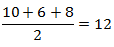
And the semi-perimeter would be

Giving the inradius to be 24/12 = 2 units

Q3

CAT 2024 Slot 2 - Quant

A fruit seller has a stock of mangoes, bananas and apples with at least one fruit of each type. At the beginning of a day, the number of mangoes make up 40% of his stock. That day, he sells half of the mangoes, 96 bananas and 40% of the apples. At the end of the day, he ends up selling 50% of the fruits. The smallest possible total number of fruits in the stock at the beginning of the day is

Free Resources
Marking Scheme
Correct Answer

340

Let us assume the initial stock of all the fruits is S.
Let us take we have 'b' and 'a' mangoes initially.
Stock of Mangoes = 40% of S = 2S/5
The total number of fruits sold are Mangoes Sold + Apples Sold + Bananas Sold
= 2S/10 + 96 + 4a/10 = S/2 (Given)
S/5 + 96 + 2a/5 = S/2
S = (4a + 960)/3
4a/3 + 320
'a' has to be a multiple of 3 for the above term to be an integer.
But 'a' has to be a multiple of 5 for 4a/10 to be an integer.
The smallest value of 'a' satisfying both conditions is 15.
4a/3 + 320 = 4(15)/3 + 320 = 340

Q4

CAT 2024 Slot 2 - Quant

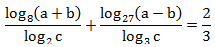
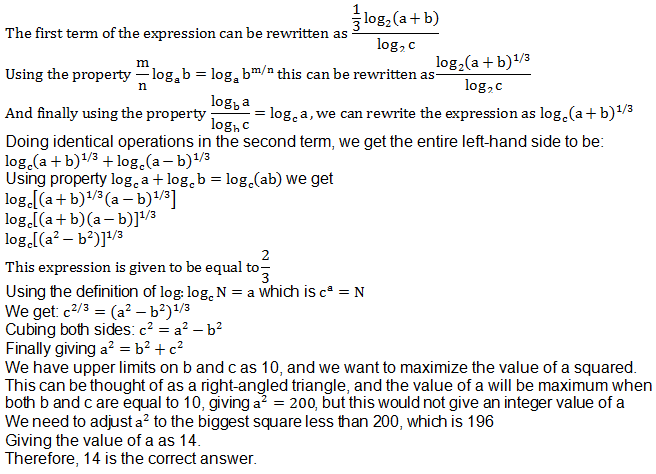
If a, b and c are positive real numbers such that a > 10 ≥ b ≥ c and  then the greatest possible integer value of a is
Free Resources
Marking Scheme
Correct Answer

14

Q5

CAT 2024 Slot 2 - Quant

A function f maps the set of natural numbers to whole numbers, such that f(xy) = f(x)f(y) + f(x) + f(y) for all x, y and f(p) = 1 for every prime number p. Then, the value of f(160000) is

A

4095

B

8191

C

2047

D

1023

Free Resources
Marking Scheme
Correct Answer

4095

Looking at the additional information about the prime numbers should make one realise that they are the key to solving the question.
f(16000) can be written as f(28 × 54)
Now, we can try to find these individual values:
For any prime p: f(p) = 1
f(p2) = f(p) f(p) + f(p) + f(p) = 1 + 1 + 1 = 3
f(p3) = f(p2) f(p) + f(p2) + f(p) = 3 + 3 + 1 = 7
This way, we can find the function output for any prime number raised to a power.
We can see that each new exponent is twice the previous output +1, solving this way till prime raised to power 8
f(p4) = 7 + 7 + 1 = 15
f(p5) = 15 + 15 + 1 = 31
f(p6) = 31 + 31 + 1 = 63
f(p7) = 63 + 63 + 1 = 127
f(p8) = 127 + 127 + 1 = 255
Using these values in the original expression of f(28 × 54) = f(28) f(54) + f(28) + f(54) we get
f(28 × 54) = (255 × 15) + 255 + 15 = 4095

Q6

CAT 2024 Slot 2 - Quant

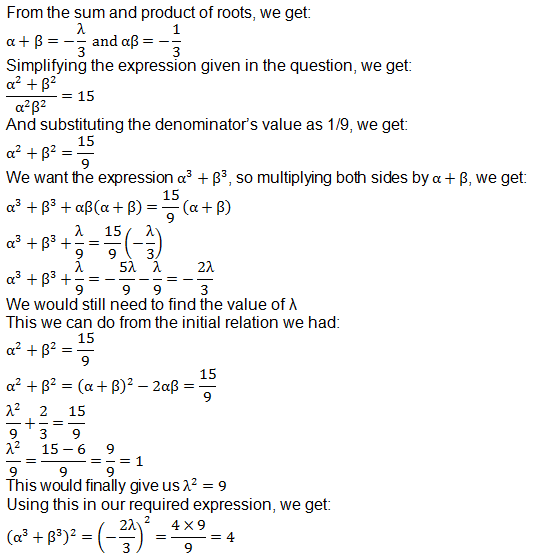
The roots α, β of the equation 3x2 + λx − 1 = 0, satisfy 1/α2 + 1/β2 = 15. The value of (α3 + β3)2, is

A

16

B

1

C

4

D

9

Free Resources
Marking Scheme
Correct Answer

4

Q7

CAT 2024 Slot 2 - Quant

When Rajesh's age was same as the present age of Garima, the ratio of their ages was 3 : 2. When Garima's age becomes the same as the present age of Rajesh, the ratio of the ages of Rajesh and Garima will become

A

3 : 2

B

4 : 3

C

5 : 4

D

2 : 1

Free Resources
Marking Scheme
Correct Answer

5 : 4

Let's take Rajesh and Garima's ages to be R and G, respectively
From the given ratio, we can see that Rajesh is older than Garima, so let's take R = G + x
When Rajesh was of age G, which was x years ago, Garima was of G-x years old
Giving the ratio as G/(G - x) = 3/2
This gives us G as 3x, which in turn gives R as 4x
We are asked the ratio when Gramia becomes 4x years old.
By that time, Rajesh will be 5x years old.
Giinv their ratio as 5x/4x = 5 : 4

Q8

CAT 2024 Slot 2 - Quant

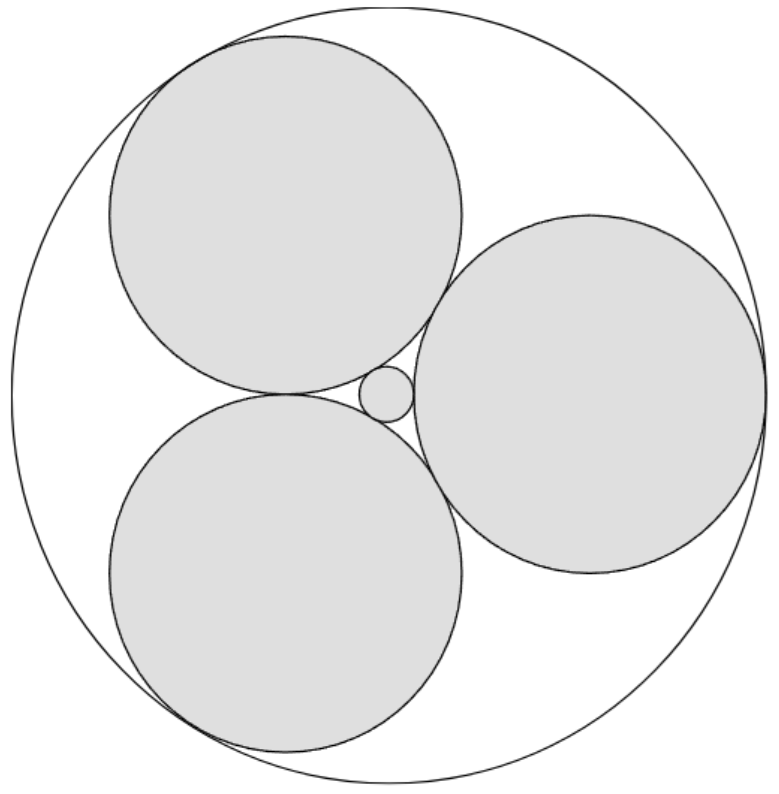
Three circles of equal radii touch (but not cross) each other externally. Two other circles, X and Y, are drawn such that both touch (but not cross) each of the three previous circles. If the radius of X is more than that of Y, the ratio of the radii of X and Y is

A

7 + 4√3 : 1

B

4 + 2√3 : 1

C

4 + √3 : 1

D

2 + √3 : 1

Free Resources
Marking Scheme
Correct Answer

7 + 4√3 : 1

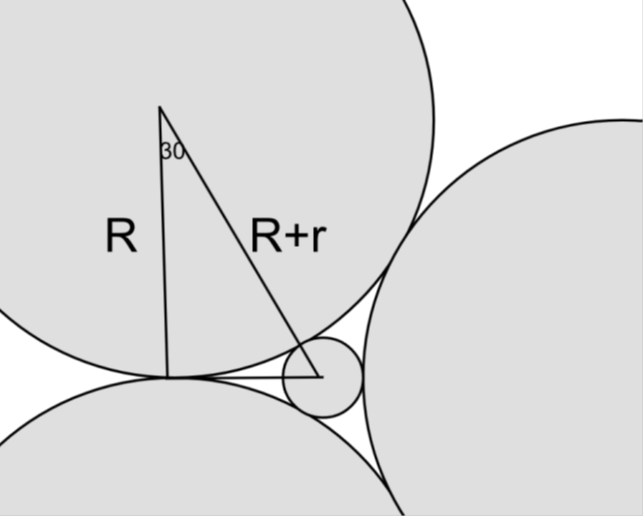
Let's take the radius of the original circles to be R and that of the circle in between the three circles to be r.

Joining the centres of the three circles, we will get an equilateral triangle or length 2R.
The distance between the circle's centre and the original circle's centre would be R + r.

Using this right angle triangle, we can get the relation: R/(R + r) = √3/2
We can take R = √3a and R + r as 2a, this would give us r as R = (2 - √3)a
The outer circle will have a radius of 2R + r
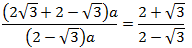
We need to find the ratio of (2R + r)/r
This will be equal to

= 4 + 3 + 4√3 = 7 + 4√3 : 1

Q9

CAT 2024 Slot 2 - Quant

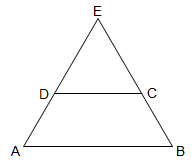
ABCD is a trapezium in which AB is parallel to CD. The sides AD and BC when extended, intersect at point E. If AB = 2 cm, CD = 1 cm, and perimeter of ABCD is 6 cm, then the perimeter, in cm, of ?AEB is

A

8

B

10

C

9

D

7

Free Resources
Marking Scheme
Correct Answer

8

The simplest way to visualise this would be with symmetry.

We can take AD to be x and CB to be 3 – x; since the perimeter of ABCD is 6, and AB and CD are given as 2 and 1 cm, respectively, that leaves AD + BC as three only.
We can see that triangles AEB and DEC are similar, with the lengths of AB being double of CD, essentially making D the mid-point of AE and C the mid-point of EB.
Through this, we get the length of DE and CE to be x and 3 – x.
Give us the AE and BE lengths as 2x and 6 – 2x, respectively.
Giving the perimeter of AEB as 2x + 6 – 2x + 2 = 8 cm

Q10

CAT 2024 Slot 2 - Quant

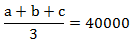
A company has 40 employees whose names are listed in a certain order. In the year 2022, the average bonus of the first 30 employees was Rs 40000, of the last 30 employees was Rs 60000, and of the first 10 and last 10 employees together was Rs 50000. Next year, the average bonus of the first 10 employees increased by 100%, of the last 10 employees increased by 200% and of the remaining employees was unchanged. Then, the average bonus, in rupees, of all the 40 employees together in the year 2023 was

A

95000

B

90000

C

80000

D

85000

Free Resources
Marking Scheme
Correct Answer

95000

We can divide the list into 4 elements: the first 10 as a, the next 10 as b, the next 10 as c, and the last 10 as d
From the relations we are given, we can form the equations: 

Adding the first two equations, we get a + 2(b + c) + d = 300,000
We can substitute the value of a + d as 100,000 to get b + c as 100,000
Using this value in the first and second equation would give a and d as 20,000 and 80,000, respectively.
We are told that the average of the first 10 employees increases by 100%, that is, it changes from 20,000 to 40,000
The average of the last 10 increases by 200%; that is, it changes from 80,000 to 240,000
The total of all the four elements would be 40,000 + 100,000 + 240.000 = 380,000
Giving the average to be 38000/4 = 95000

Q11

CAT 2024 Slot 2 - Quant

Amal and Vimal together can complete a task in 150 days, while Vimal and Sunil together can complete the same task in 100 days. Amal starts working on the task and works for 75 days, then Vimal takes over and works for 135 days. Finally, Sunil takes over and completes the remaining task in 45 days. If Amal had started the task alone and worked on all days, Vimal had worked on every second day, and Sunil had worked on every third day, then the number of days required to complete the task would have been

Free Resources
Marking Scheme
Correct Answer

139

We can take the work done by Amal, Vimal and Sunil to be A, V and S, respectively.
Let's take the total work they did to be T.
We are given the equations:
150A + 150V = T ...(1)
100V + 100S = T ...(2)
75A + 135V + 45S = T ...(3)
Adding (1) and (2), we get: 150A + 250V + 100S = 2T ...(4)
And multiplying (3) with 2 we get: 150A + 270V + 100S = 2T ...(5)
Subtracting (5) from (4), we get 10S = 20V or simply S = 2V
Using this in (2), we get the total work T to be 300V, and using that result in (1), we get A = V
Therefore, the work done by A, V and S equals V, V and 2V units per day.
Now, in the question, we are given work cycles.
To simplify the calculations, we should consider a time duration that is the LCM of the period taken by the three agents, which in this case would be 6
In 6 days, Amal will work for 6 days, doing 6V units of work.
Vimal will work for 3 days, doing 3V units of work.
Sunil will work for 2 days, doing 4V units of work.
So, in one 6-day cycle, 13V units of work will be done.
Dividing the total work (300V) by 13V we can see that in 23 cycles 299V units of work will be done.
These 23 cycles will be 23 × 6 = 138 days
The remaining 1V units of work will be done the next day.
Therefore, a total of 139 days will be required.

Q12

CAT 2024 Slot 2 - Quant

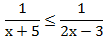
All the values of x satisfying the inequality  are

A

x < – 5 or 3/2 < x ≤ 8

B

– 5 < x < 3/2 or x > 3/2

C

x < – 5 or x > 3/2

D

– 5 < x < 3/2 or 3/2 < x ≤ 8

Free Resources
Marking Scheme
Correct Answer

x < – 5 or 3/2 < x ≤ 8


There are two critical points for the inequality to consider: x = – 5 and x = 3/2
Region I: x is greater than 3/2
In this scenario, both the terms would be positive; cross-multiplying, we get the relation 2x – 3 ≤ x + 5
Giving the boundary x ≤ 8, hence giving us the valid range as 3/2 < x  8
Region II: – 5 < x < 3/2
In this case, the right-hand side will be a negative value, and hence, the sign would change when multiplying, giving the inequality
2x – 3 ≥ x + 5
Which will give x > 8, which is out of bounds for this region
Another way is to put a value in the region to check for the validity of the inequality; by putting x = 0, we could see that the inequality does not hold in this region
Region III: x less than – 5
In this scenario, both the terms are negative, essentially giving us the same boundary as region 1; we take the lower bounds, giving us that x has to be less than 5
Therefore, for the given inequality to hold true x < – 5 or 3/2 < x ≤ 8

Q13

CAT 2024 Slot 2 - Quant

Anil invests Rs 22000 for 6 years in a scheme with 4% interest per annum, compounded half-yearly. Separately, Sunil invests a certain amount in the same scheme for 5 years, and then reinvests the entire amount he receives at the end of 5 years, for one year at 10% simple interest. If the amounts received by both at the end of 6 years are equal, then the initial investment, in rupees, made by Sunil is

A

20860

B

20640

C

20480

D

20808

Free Resources
Marking Scheme
Correct Answer

20808

Let's take the amount invested by Sunil to be X.
The amount received by Anil at the end of 6 years would be 

The amount received by Sunil at the end of 5 years would be X (1.02)10
In the 6th year, Sunil invests this at a simple interest of 10%, giving him an interest of X (1.02)10 × 0.1
Giving the total amount with him at the end of 6 years to be X (1.02)10 × (1 + 0.1)
Equating the final amount with Sunil and Anil, we get:
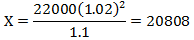
X (1.02)10 × (1.1) = 22000 (1.02)12

Q14

CAT 2024 Slot 2 - Quant

A bus starts at 9 am and follows a fixed route every day. One day, it traveled at a constant speed of 60 km per hour and reached its destination 3.5 hours later than its scheduled arrival time. Next day, it traveled twothirds of its route in one-third of its total scheduled travel time, and the remaining part of the route at 40 km per hour to reach just on time. The scheduled arrival time of the bus is

A

7 : 00 pm

B

7 : 30 pm

C

9 : 00 pm

D

10 : 30 pm

Free Resources
Marking Scheme
Correct Answer

7 : 30 pm

Let's take the scheduled time taken by the bus to be t
From the first statement (bus travelling at 60 kmph), we can get the total distance travelled by bus to 60(t + 3.5)
The second scenario gives us that the bus covered two-thirds of the distance in one-third of the time, meaning that the remaining one-third distance was covered in two-thirds of the time, giving us the relation (1/3)st covered in (2/3)t giving the speed to be  s/2 which is given as 40 km/h, thereby giving the usual speed of the bus to be 80 km/hr
Now the first relation we get 60(t + 3.5) = 80t
Giving us t = 10.5 hours
Thus, the bus usually takes 10.5 hours on its journey.
Staring at 9:00, it will complete the journey at 7:30 pm
Therefore, option b is the correct answer.

Q15

CAT 2024 Slot 2 - Quant

If m and n are natural numbers such that n > 1, and mn = 225 × 340, then m – n equals

A

209932

B

209937

C

209942

D

209947

Free Resources
Marking Scheme
Correct Answer

209947

We must bring the right-hand side in the form so that everything has the same power.
25 has factors 1, 5 and 25
The only common factor 40 and 25 have is 5 (other than 1 of course, which does not work)
So the right-hand side can be rewritten as (25)5 × (38)5
(32 × 81 × 81)5
(209952)5
Giving the value of m – n as 209952 – 5 = 209947

Q16

CAT 2024 Slot 2 - Quant

When 3333 is divided by 11, the remainder is

A

5

B

10

C

1

D

6

Free Resources
Marking Scheme
Correct Answer

5

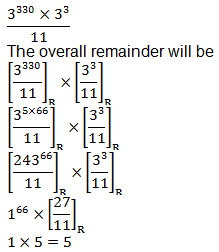
There are multiple ways of solving these sorts of questions. One method is to look for powers of the term in the numerator that leave a remainder of 1 or -1 when divided by the denominator.
Noting down the powers of 3, 3, 9, 27, 81, 243
243 is one such number, 242 is multiple of 11 (11 times 22), hence 243 will leave a remainder of 1 when divided by 11.
243 is 3 raised to power 5; we can rewrite the given term as

Q17

CAT 2024 Slot 2 - Quant

If x and y are real numbers such that 4x2 + 4y2 – 4xy – 6y + 3 = 0, then the value of (4x + 5y) is

Free Resources
Marking Scheme
Correct Answer

7

In such questions, we should be trying to complete the squares.
We see a xy term; we need to accommodate that in a square that has both x and y terms.
Since there is only one other term with x, we also need to have it entirely in the square.
(2x – y)2 = 4x2 + y2 – 4xy
Using this in the given equation, we are left with
(2x – y)2 + 3y2 + 3 – 6y
This can be written as (2x – y)2 + 3(y2 + 1 – 2y)
(2x – y)2 + 3(y – 1)2 = 0
Since both the squares add up to 0, this is only possible when the squares themselves are 0
This would give us y = 1 from the second term, and using that, we get x = 1/2 from the first term.
Therefore the value of 4x + 5y will be 2 + 5 = 7

Q18

CAT 2024 Slot 2 - Quant

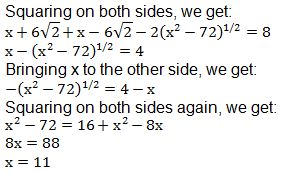
If , then x equals

Free Resources
Marking Scheme
Correct Answer

11

Q19

CAT 2024 Slot 2 - Quant

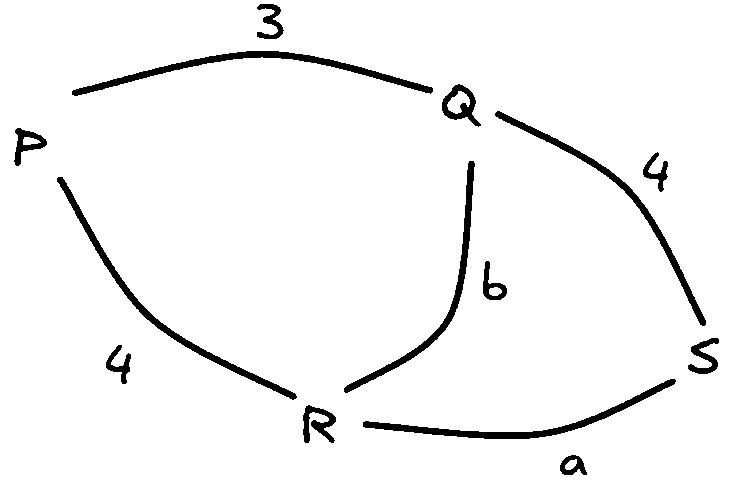
P, Q, R and S are four towns. One can travel between P and Q along 3 direct paths, between Q and S along 4 direct paths, and between P and R along 4 direct paths. There is no direct path between P and S, while there are few direct paths between Q and R, and between R and S. One can travel from P to S either via Q, or via R, or via Q followed by R, respectively, in exactly 62 possible ways. One can also travel from Q to R either directly, or via P, or via S, in exactly 27 possible ways. Then, the number of direct paths between Q and R is

Free Resources
Marking Scheme
Correct Answer

7

Let's take the number of paths between Q and R to be b and the number of paths between R and S to be a

We are given the paths from P to S through R (which would be 4a), the paths from P to S through Q (which would be 12) and the paths from P to Q to R to S, which would be 3ab) is equal to 62
Giving the relation 4a + 12 + 3ab = 62
Or 4a + 3ab = 50
The paths from Q to R directly (which would be b), through P( which would be 12) and through S (which would be 4a) are 27
Giving the relation b + 12 + 4a = 27
Or 4a + b = 15
Subtracting this equation from the first one we got, we get 3ab - b = 35, or b(3a - 1) = 35
b can be 1, 3, 5 or 7
Substituting these values in the second equation, we see that it can not be 1 or 5, leaving only 3 or 7 as the possible values.
Substituting b as 3 in the first equation would give 13a = 50, which is not true.
Substituting bas 7 in the first equation would give 25a = 50, which would give a = 2
We are asked the number of paths from Q to R, which is b = 7
Therefore, 7 is the correct answer.

Q20

CAT 2024 Slot 2 - Quant

If x and y satisfy the equations |x| + x + y = 15 and x + |y| − y = 20, then (x − y) equals

A

5

B

10

C

15

D

20

Free Resources
Marking Scheme
Correct Answer

15

We can consider the quadrants of a graph:
First quadrant: Both x and y are positive
This would change the equation to 2x + y = 15 and x = 20, giving a negative value of y; hence, this is not the case.
Second quadrant: x is negative, but y is positive
This would change the equations to y = 15 and x = 20, giving a positive value of x, which hence can not be the case.
Third quadrant: Both x and y are negative
This would change the equation to y = 15 and x − 2y = 20; this gives a positive value of y and hence can not be the case.
Fourth quadrant: x is positive, but y is negative
This would change the equations to 2x + y = 15 and x − 2y = 20; this gives the value of x as 10 and y as − 5, which would lie in the fourth quadrant.
The value of x − y would be 10 − (− 5) = 15

Q21

CAT 2024 Slot 2 - Quant

A vessel contained a certain amount of a solution of acid and water. When 2 litres of water was added to it, the new solution had 50% acid concentration. When 15 litres of acid was further added to this new solution, the final solution had 80% acid concentration. The ratio of water and acid in the original solution was

A

3 : 5

B

5 : 3

C

5 : 4

D

4 : 5

Free Resources
Marking Scheme
Correct Answer

3 : 5

Let's start from the step when there was 50% concentration.
Let's take there to ee 2T solution: T acid and T water.
Adding 15 litres of acid increases the acid concentration to 80%, giving the equation 
Solving this would give us T = 5
This means that there were 5 litres of acid and 5 litres of water after mixing 2 litres of water.
Therefore, there would be 5 litres of acid and 3 litres of water before adding the water.
We are asked the ratio of water to acid, which would be 3 : 5

Q22

CAT 2024 Slot 2 - Quant

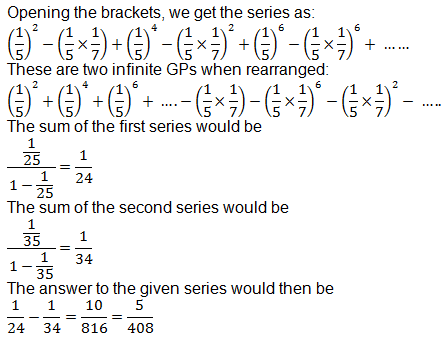
The sum of the infinite series  is equal to

A

5/408

B

7/408

C

5/816

D

7/816

Free Resources
Marking Scheme
Correct Answer

5/408

Solved by Stalwart Experts

Our team of MBA educators with 10+ years experience provides accurate, verified solutions. Meet the Team

Trusted by thousands of MBA aspirants — Updated regularly
×
Popup Form