Q1
IPMAT 2024 - Quantitative Aptitude
The number of factors of 1800 that are multiple of 6 is ________
Marking Scheme
1800 = 23 × 32 × 52
= 2 × 3x (22 × 31 × 52)
= 6x (22 × 31 × 52)
Number of factors of 1800 which are also multiple of 6 = Number of factors of the highlighted part of the number = (2 + 1)(1 + 1)(2 + 1)
= 3 × 2 × 3 = 18
Q2
IPMAT 2024 - Quantitative Aptitude
The number of real solutions of the equation  is _________
Marking Scheme
For real solution there are three cases possible:
Case I: (any integer)0 = 1
∴ x2 − 5x + 6 = 0
(x − 2)(x − 3) = 0
x = 2 or 3
Case II: (1)any integer = 1
∴ x2 − 15x + 55 = 1
x2 − 15x + 54 = 0
(x − 9)(x − 6) = 0
x = 6 or 9
Case III: (− 1)any even integer = 1
∴ x2 − 15x + 55 = − 1
x2 − 15x + 56 = 0
(x − 7)(x − 8) = 0
x =7 or 8
But we need to check whether the exponent x2 − 5x + 6 is even or not for x = 7 & 8.
Putting x = 7 in x2 − 5x + 6 we get 20,which is even.
Putting x = 8 in x2 − 5x + 6 we get 30, which is again even.
Thus both 7 and 8 are valid solutions,as well.
∴ Total the total number of real solutions for the given equation is 6 i.e (2, 3, 6, 9, 7, 8)
Q3
IPMAT 2024 - Quantitative Aptitude
In a group of 150 students, 52 like tea, 48 like juice and 62 like coffee. If each student in the group likes at least one among tea, juice and coffee, then the maximum number of students that like more than one drink is _____
Marking Scheme
We know, n(T ∪ J ∪ C) = x + y + z …(i)
And also, n(T) + n(J) + n(C) = x + 2y + 3z …(ii)
Where, x, y and z represent number of students who drink exactly, one, exactly two and all three drinks.
We have to find out the maximum number of students that like more than one drink.
It means those students who like exactly two or exactly three drinks i.e. the maximum possible value of y + z.
Given n(T ∪ J ∪ C) = 150; n(T) = 52; n(J) = 48; n(C) = 62
Subtracting (i) from (ii), we get
n(T) + n(J) + n(C) – n(T ∪ J ∪ C) = y + 2z
162 – 150 = (y + z) + z
12 = (y + z) + z
The maximum value of (y + z) can be 12, when is z is 0 & y is 12.
Q4
IPMAT 2024 - Quantitative Aptitude
Let ABC be a triangle right-angled at B with AB = BC = 18. The area of largest rectangle that can be inscribed in this triangle and has B as one of the vertices is ______
Marking Scheme
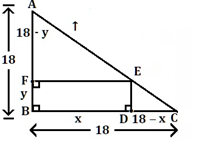
Let BD = x, BF = y
We have to find maximum value of area of rectangle BDEF i.e. maximum value of x.y.
Let the area of rectangle BDEF, A = x ⋅ y …... (i)
?AFE ~?ABC (AA criteria)
∴ AF/AB = FE/BC
(18 − y)/18 = x/18
y = x − 18 .….. (ii)
Putting y = x − 18 in eqn. (i), we per–
A = x(x − 18)
A = x2 − 18x
Differentiating A w.r.t x, we get dA/dx = 2x − 18
Equating dA/dx to 0, in order to get the value x for which area,
A will be maximum, we get
dA/dx = 2x − 18 = 0
x = 9
∴ x = y = 9
∴ Maximum area of rectangle BDEF = x.y
= 9 × 9 = 81
Q5
IPMAT 2024 - Quantitative Aptitude
A fruit seller has oranges, apples and bananas in the ratio 3 : 6 : 7. If the number of oranges is a multiple of both 5 and 6, then the minimum number of fruits the seller has is _____
Marking Scheme
Let the number of oranges, apples and bananas be 3x, 6x and 7x.
As the number of oranges is multiple of both 5 & 6 i.e. 30 (LCM of 5 & 6 is 30).
Their minimum number could be 30 only.
∴ 3x = 30
Hence x = 10 (minimum)
For minimum number of total fruits = 3x + 6x + 7x = 16x
16 × 10 = 160
Q6
IPMAT 2024 - Quantitative Aptitude
The number of pairs (x, y) of integers satisfying the inequality |x − 5|+|y − 5| ≤ 6 is _____
Marking Scheme
Taking x – 5 = X and y – 5 = Y, we get |X|+|Y| ≤ 6
Here, if x and y are integers, then X and Y will also be integers.
Case I: X + Y ≤ 6
Case II: X – Y ≤ 6
Case III: – X + Y ≤ 6
Case IV: – X – Y ≤ 6
Plotting the graphs of above inequalities:
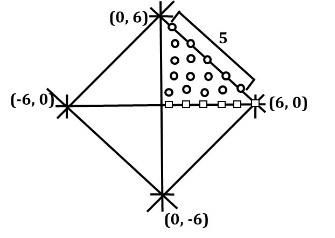
Counting the number of integral coordinates (X, Y) in the 1st quadrant, we get 5 + 4 + 3 + 2 + 1 = 15 points. (as shown in the diagram)
So, in all 4 quadrants, total number of points with integral coordinates will be 15 × 4 = 60 points.
Now, counting the number of points with integral coordinate (X, Y) on + x-axis, we get, 6 points.
So, total points on all 4-axes, 6 × 4 = 24 points. Also, the origin (0, 0).
Total number of points (X, Y) with integral coordinates satisfying all the 4 inequalities = 60 + 24 + 1 = 85
Thus, the corresponding pairs of (x, y) will also be 85
Q7
IPMAT 2024 - Quantitative Aptitude
The price of a chocolate is increased by x% and then reduced by x%. The new price is 96.76% of the original price. Then x is _____This is an integer type question
Marking Scheme
Let the original price of chocolates be P.
Final price = Original Price x MF1 x MF2
Here, MF is multiplying factor and it is equals to (1 + % change) in case of increase & equals (1 − % change) in case of decrease.
∴ Final price = Original price x (1 + x%) x (1 − x%)
96.76%P = P [1−(x%)2]
96.76% P = P – P (x%)2
96.76% P = 100% P – (x%)2P
96.76 = 100 – x2%
x2% = 3.24
x2 = 324
x = 18
Q8
IPMAT 2024 - Quantitative Aptitude
Let f and g be two functions defined by f(x) = |x + |x|| and g(x) = 1/x for x ≠ 0. If f(a) + g(f(a)) = 13/6 for some real a, then the maximum possible value of f(g(a)) is ______
Marking Scheme
f(x) = |x +|x|| and g(x) = 1/x for x ≠ 0
Given f(a) + g(f(a)) = 13/6
f(a) + 1/f(a) = 13/6
[f(a)]2 + 1 = f(a) × 13/6
6[f(a)]2 + 6 = 13 × f(a)
Let f(a) = t
∴ 6t2 − 13t + 6 = 0
Solving above quadratic equation, we get, t = f(a) = 3/2 or 2/3
Case I:
If f(a) = 3/2
∴|x +|x||= 3/2
x +|x|= 32 or − 32 ........ (i)
We know |x| = +x for x > 0 & |x|= − x for x < 0,
Taking x < 0 will not lead to any solution of x.
So, taking x > 0, and substituting |x| with +x in eqn.(i), we get
x + x = 2x = 3/2 or − 3/2
We will get, x = 3/4 (valid) & x = −3/4 (invalid)
Case II:
If f(a) = 2/3
∴|x +|x||= 2/3
x +|x|= 2/3 or − 2/3
When x > 0, |x| = +x,
Substituting in eqn.(i) we get, x + x = 2x = 2/3 or = −2/3
x = 2/6 = 1/3 (valid) or −2/6 = −1/3 (invalid)
Now, f(g(a)) =|g(a) +|g(a)|| = |1/x +|1/x||
For x = 3/4
f(g(a)) = |4/3 +|4/3|| = 8/3 and for x = 1/3
f(g(a)) = |3 + |3||= 6
So, the maximum value of f(g(a)) = 6
Q9
IPMAT 2024 - Quantitative Aptitude
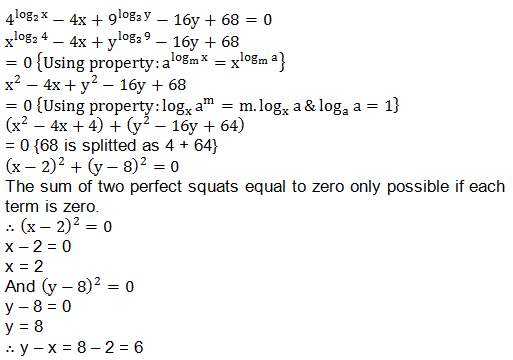
If  , then y − x equals _______
Q10
IPMAT 2024 - Quantitative Aptitude
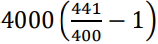
Person A borrows Rs 4000 from another person B for a duration of 4 years. He borrows a portion of it at 3% simple interest per annum, while the rest at 4% simple interest per annum. If B gets Rs 520 as total interest, then the amount A borrowed at 3% per annum in Rs is _______
Marking Scheme
Let the first portion borrowed at 3% p.a. SI be Rs x
And the other portion borrowed at 4% p.a. be Rs (4000 − x)
∴ Total interest = SI1 + SI2

13000 = 3x + 16000 − 4x
x = 3000
∴ Amount borrowed at 3% p.a.SI was Rs 3000
Q11
IPMAT 2024 - Quantitative Aptitude
The number of triangles with integer sides and with perimeter 15 is _______
Marking Scheme
One equilateral triangle with sides (5, 5, 5)
Three isosceles triangles (7, 7, 1), (6, 6, 3) and (4, 4, 7)
Reason: The measure of two equal sides cannot be less than 4 or more than 7. Taking two equal sides as 8 will make sum of these two sides only as 16, more than the perimeter. Taking two equal sides as 3 each, the third side will be 9, eventually not following the property of triangle.
Three scalene triangles (7, 6, 2), (7, 5, 3), (6, 5, 4)
Reason: The maximum measure of two equal sides of the triangle can be 7 or 6 only. Taking 8 as the largest side of the triangle will leave us with the sum of other two sides as 7. Taking 5 as the largest side of triangle we end up getting an equilateral triangle which we have already considered before. 4 cannot be the largest side.
Total number of possible triangles is 7.
Q12
IPMAT 2024 - Quantitative Aptitude
If 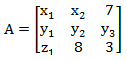 is a matrix such that the sum of all three elements along any row, column or diagonal are equal to each other, then the value of determinant of A is ______
Marking Scheme
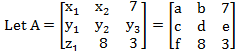
Let the sum of all three elements along any row, column or diagonal be S.
Then, f = S – (8 + 3) = S – 11 …...(i) (from the bottom row)
d = S – (7 + f) …....(ii) (from one of the diagonals)
From equations (i) and (ii), we get
d = S – (7 + S – 11)
∴ d = 4
Also, b = S – (8 + d) = S – 12 (from the middle column) …....(iii)
a = S – (b + 7) (from the first row)…....(iv)
From equations (iii) and (iv), we get a = 5 & b = 0
∴ S = 12
∴ The matrix A comes out to be 
Determinant |A| = 5(4 × 3 − 8 × 2) + 0(2 × 1 − 6 × 3) + 7(6 × 8 − 1 × 4)
= 5(12 − 16) + 0 + 7(48 − 4)
= − 20 + 0 + 308 = 288
Q13
IPMAT 2024 - Quantitative Aptitude
Directions for Qs. 13 - 15: Study the following table and answer the questions based on it
The following table shows the number of employees and their median age in eight companies located in a district.
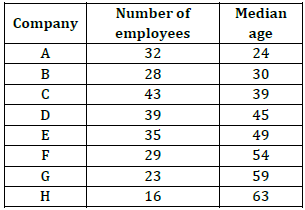
It is known that the age of all employees are integers. It is known that the age of every employee in A is strictly less than the age of every employee in B, the age of every employee in B is strictly less than the age of every employee in C..... the age of every employee in G is strictly less than the age of every employee in H.
The highest possible age of an employee of company A is ______
Marking Scheme
Median is defined as the positional mean of the given values.
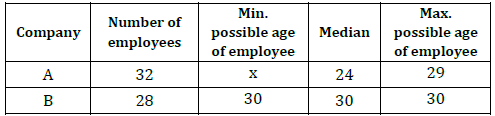
Highest possible age of an employee of company A can be 29.
This is possible when the least possible age of any employee is 30 years, which is feasible in the given scenario.
(when the age of 15 employees each is equal to 30).
Q14
IPMAT 2024 - Quantitative Aptitude
Directions for Qs. 13 - 15: Study the following table and answer the questions based on it
The following table shows the number of employees and their median age in eight companies located in a district.
It is known that the age of all employees are integers. It is known that the age of every employee in A is strictly less than the age of every employee in B, the age of every employee in B is strictly less than the age of every employee in C..... the age of every employee in G is strictly less than the age of every employee in H.
The median age of an employee across the eight companies is ______
Marking Scheme
Total number of employees = 32 + 28 + 43 + 39 + 35 + 29 + 23 + 16
= 245
Median age of all these employees = age of the employee at the middle most position when all the employees are arranged in ascending/ descending order of their age.
Middle position will be (245 + 1)/2 = 123
∴ The age of employee whose position is 123rd.
Adding, number of employees of companies A, B and C = 32 + 28 + 43 = 103.
To reach 123rd position, we need to add 20 employees of company D.
We know, the age of 20th employee of company D = median age of the employees of the company D = 45 years. (Here, 20th position will be the middle most position when all 39 employees are arranged in ascending / descending order of their age)
Therefore, median age of an employee across all eight companies = 45 years
Q15
IPMAT 2024 - Quantitative Aptitude
Directions for Qs. 13 - 15: Study the following table and answer the questions based on it
The following table shows the number of employees and their median age in eight companies located in a district.
It is known that the age of all employees are integers. It is known that the age of every employee in A is strictly less than the age of every employee in B, the age of every employee in B is strictly less than the age of every employee in C..... the age of every employee in G is strictly less than the age of every employee in H.
In company F, the lowest possible sum of the ages of all employees is ______
Marking Scheme
Lowest possible sum of ages of all the employees of company F, is only possible when the maximum possible age of any employee of company E is 49 and not more.
In that case, the minimum possible age of employees of company F, can be 50.
Now, company F has 29 employees with median 54.
That means there can be 14 employees with age 50 each and 15 employees with age 54 each.
∴ Sum total of age of 29 employees company F = 14 × 50 + 15 × 54 = 700 + 810 = 1510
Q16
IPMAT 2024 - Quantitative Aptitude
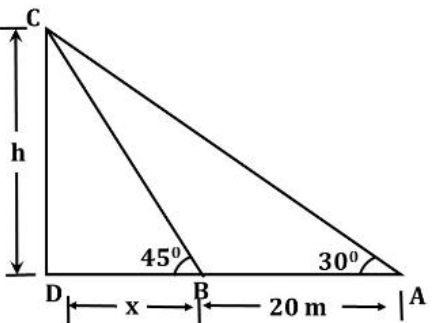
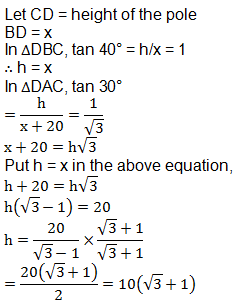
The angle of elevation of the top of a pole from a point A on the ground is 30°. The angle of elevation changes to 45°, after moving 20 metres towards the base of the pole. Then the height of the pole, in metres, is
Q17
IPMAT 2024 - Quantitative Aptitude
If |x + 1| + (y + 2)2 = 0 and ax − 3ay = 1, then the value of a is
Marking Scheme
Given that |x + 1| + (y + 2)2 = 0
Sum of an absolute value & a perfect square value can be equal to 0 only when each of these terms is equal to 0.
∴ |x + 1| = 0
x = − 1
And (y + 2)2 = 0
y + 2 = 0
y = −2
Putting the values of x and y in the equation, ax − 3ay
= 1, we get
a (− 1) − 3a (− 2) = 1
− a + 6a = 1
a = 1/5
Q18
IPMAT 2024 - Quantitative Aptitude
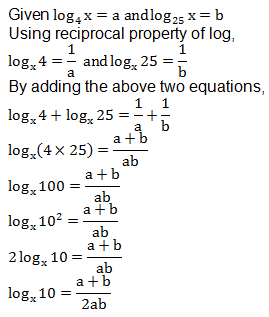
If log4x = a and log25x = b then logx10 is
Q19
IPMAT 2024 - Quantitative Aptitude
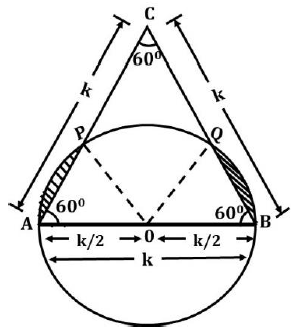
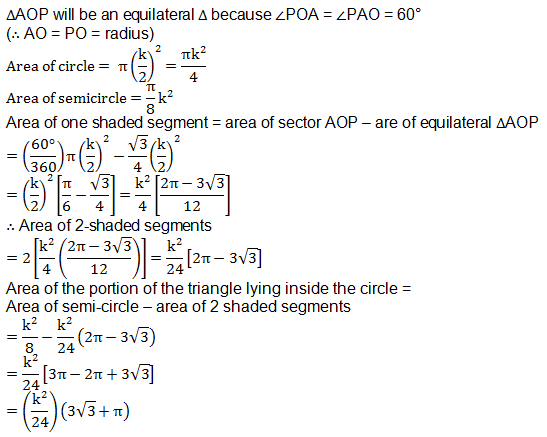
Let ABC be an equilateral triangle, with each side of length k. If a circle is drawn with diameter AB, then the area of the portion of the triangle lying inside the circle is
Q20
IPMAT 2024 - Quantitative Aptitude
Let ABC be a triangle with AB = AC and D be a point on BC such that ∠BAD = 30°. If E is a point on AC such that AD= AE, then ∠CDE equals
Marking Scheme
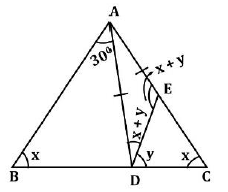
In ?ABD, ∠ABD = ∠ACD = x (let′s say) (? AB = AC)
Now, take ∠CDE = y
∠AED = x + y (Using exterior angle property)
∴ ∠ADE = x + y (ADE is an isosceles ?, AD = AE)
∴ ∠DAE = 180° − (2x + 2y)
Using angle sum property, in ?ABC
A + ∠B + ∠C =
x + (30° + 180 − 2x − 2y) + x = 180°
2y = 30°
y = ∠CDE = 15°
Q21
IPMAT 2024 - Quantitative Aptitude
If 5 boys and 3 girls randomly sit around a circular table, the probability that there will be at least one boy sitting between any two girls, is
Marking Scheme
“At Least one boy sitting between any two girls” can be inferred as “No two girls should sit together”.
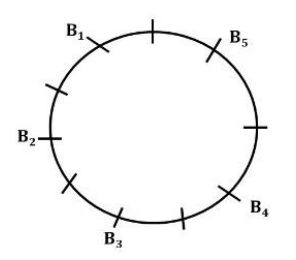
First, arrange 5 boys around a circular table. This can be done in (5 – 1)! = 4!
Now, there are 5 gaps available where we can make 3 girls sit in 5P3 ways.
In this arrangement, no two girls will be sitting together.
Total ways = 4! × 5P3
Probability 
Q22
IPMAT 2024 - Quantitative Aptitude
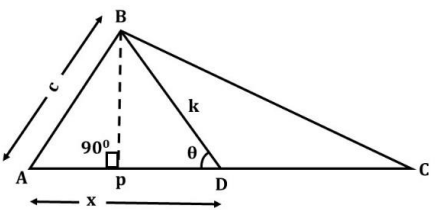
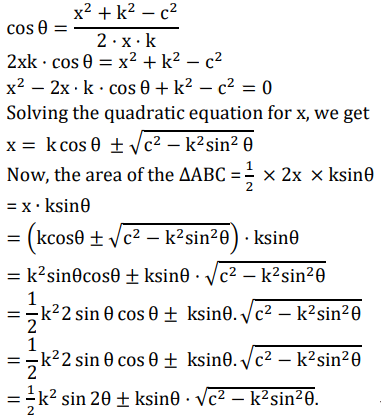
The side AB of a triangle ABC is c. The median BD is of length k. If ∠BDA = θ < 90°, then the area of triangle ABC is
Q23
IPMAT 2024 - Quantitative Aptitude
Let 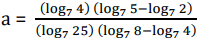 . Then the value of 5a is
Marking Scheme
Given,
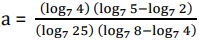
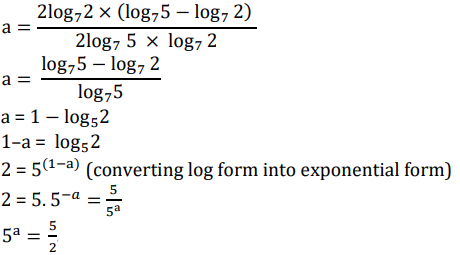
Q24
IPMAT 2024 - Quantitative Aptitude
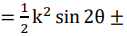
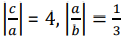
Marking Scheme
Given that
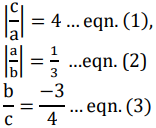
Also ac > 0. It means,
(i) either both a and c are positive values, or
(ii) both a ad c are negative values.
Let’s take case-(i), a and c are +ve values.
From equation (3), we can say c is + 4x then b = − 3x
Consequently, from equation (1), a = + x (a & c should be of the same sign)
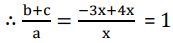
Let’s take case-(ii), a and c are -ve values
From equation (3), we can say c is − 4x then b = +3
Consequently, from equation (1), a = − x (a & c should be of the same sign)
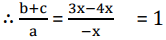
In either of the cases considered above, the value of the expression is equal to 1.
Q25
IPMAT 2024 - Quantitative Aptitude
The difference between the maximum real root and the minimum real root of the equation (x2 − 5)4 + (x2 − 7)4 = 16 is
Marking Scheme
(?2 − 5)4 + (?2 − 7)4 = 16
(?2 − 6 + 1)4 + (?2 − 6 − 1)4 = 16
Take x2 − 6 = t….(i)
(t + 1)4 + (t − 1)4 = 16
(t4 + 4 t3 + 6 t2 + 4t + 1) + (t4 − 4t3 + 6t2 − 4t + 1) = 16
2(t4 + 6t2 + 1) = 16
t4 + 6t2 − 7 = 0
Let t4 = k2
k2 + 6k − 7 = 0
(k + 7)(k − 1) = 0
k = − 7, k = 1
k = t2 = − 7 (not possible, because a perfect square can't be negative)
∴ t2 = 1
t = ± 1
Putting t = 1 in the equation (i), we get
x2 − 6 = 1
x2 = 7
x = ± √7
Putting t = − 1 in the equation (i), we get
x2 − 6 = − 1
x2 = 5
x = ± √5
Difference between maximum root (+ √7) and minimumroot − √7) is
√7 − (− √7) = 2√7
Q26
IPMAT 2024 - Quantitative Aptitude
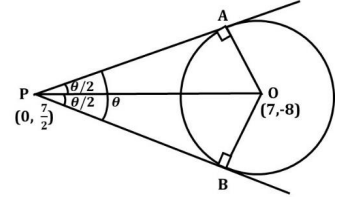
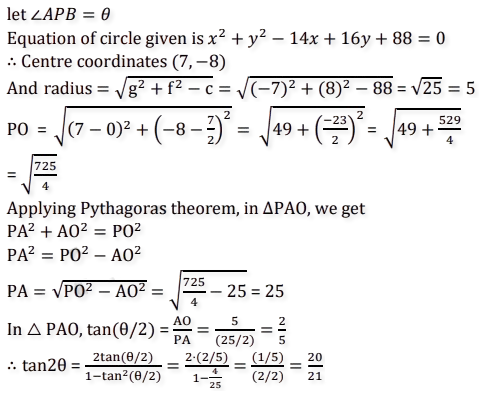
If θ is the angle between the pair of tangents drawn from the point A (0, 7/2) to the circle x2 + y2 − 14x + 16y + 88 = 0, then tan θ equals
Q27
IPMAT 2024 - Quantitative Aptitude
The numbers 22024 and 52024 are expanded and their digits are written out consecutively on one page. The total number of digits written on the page is
Marking Scheme
For number of digits of 22024
log 22024 = 2024 log 2 = 2024 × 0.301 = 609.28
Number of digits in 22024 = 609 + 1 = 610
For number of digits of 52024
log 52024 = 2024 log 5 = 2024 × 0.699 = 1414.71
Number of digits in 52024 = 1414 + 1 = 1415
So, the total digits when 22024 + 52024 are written out consecutively is 610 + 1415 = 2025
Q28
IPMAT 2024 - Quantitative Aptitude
A boat goes 96 km upstream in 8 hours and covers the same distance moving downstream in 6 hours. On the next day boat starts from point A, goes downstream for 1 hour, then upstream for 1 hour and repeats this four more time that is, 5 upstream and 5 downstream journeys. Then the boat would be
Marking Scheme
Upstream Speed = (Distance travelled upstream)/(Time taken) = 96/8 = 12 km/h
Downstream speed = (Distance travelled downstream/(Time taken) = 96/6 = 16 km/h
In one trip upstream and downstream, travelling for an hour each, the boat will be effectively 4 km (12km up followed by 16 down) downstream of A.
So, in total 5 such trip the boat will be 4 × 5 = 20 km downstream of A
Q29
IPMAT 2024 - Quantitative Aptitude
If the shortest distance of a given point to a given circle is 4 cm and the longest distance is 9 cm, then the radius of the circle is
Marking Scheme
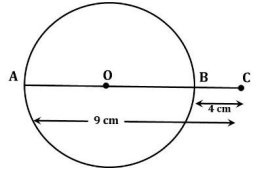
Case I: Point C lies anywhere outside the circle.
AC = 9 cm
BC = 4 cm
AC = 2r + BC = 9 cm
2r + 4 = 9 cm
r = 2.5 cm
Case II:
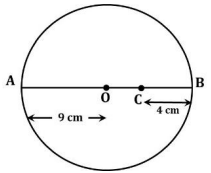
Point C lies anywhere inside the circle.
BC = 4 cm
AC = 9cm
2r = AC + BC = 9 + 4 = 13 cm
2r = 13 cm
r = 6.5 cm
So, the radius of the circle can be 2.5 cm or 6.5 cm.
Q30
IPMAT 2024 - Quantitative Aptitude
In a survey of 500 people, it was found that 250 owned a 4-wheeler but not a 2-wheeler, 100 owned a 2-wheeler but not a 4-wheeler, and 100 owned neither a 4-wheeler nor a 2-wheeler. Then the number of people who owned both is
Marking Scheme
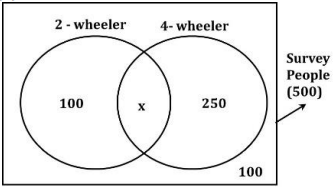
Let, n(FW) – Number of people who owns 4-wheelers, n(TW) – Number of people who owns 2-wheelers, n(FW ∪ TW) – Number of people who owns at least one of the vehicles, and n(FW ∩ TW) – Number of people who owns both type of vehicles
Now, the number of people who owns at least one of the vehicles = Total people surveyed – Number of people who owns none
(FW ∪ TW) = 500 – 100 = 400
Using the standard formula in set theory,
n(FW ∪ TW) = n(FW) + n(TW) – n(FW ∩ TW)
400 = 250 + 100 – n(FW ∩ TW)
So, the number of people who owned both are (FW ∩ TW) = 50
Q31
IPMAT 2024 - Quantitative Aptitude
The sum of a given infinite geometric progression is 80 and the sum of its first two terms is 35. Then the value of n for which the sum of its first n terms is closest to 100, is
Marking Scheme
Let the series be a, ar, ar2 …..
Given: Sum∞ = a/(1 − r) = 80 …(i)
Also, a + ar = a(1 + r) = 35 …(ii)
80(1 – r) (1 + r) = 35
1 – r2 = 35/80 = 7/16
r2 = 9/16
r = ± 3/4
Substituting r = 3/4 in eq.(i) we get a = 20
These values of a and r, won’t lead the sum of series to 100 as sum of infinite terms is 80 only.
Substituting r = − 3/4 in eq.(i) we get a = 140.
a1 = 140;
a2 = 140 × − 3/4 = −105;
a3 = − 105 × − 3/4 = 78.75;
a4 = − 78.75 × − 3/4 = − 59.0625;
a5 = − 59.0625 × − 3/4 = 44.296875 & so on.
Adding first 5 terms of the series, we get
a1 + a2 + a3 + a4 + a5 = 98.984375 ≈ 100
So, the sum of first 5 terms of the series when r = − 3/4 and a = 140 gives the sum close to 100.
Q32
IPMAT 2024 - Quantitative Aptitude
Let n be the number of ways in which 20 identical balloons can be distributed among 5 girls and 3 boys such that everyone gets at least one balloon and no girl gets fewer balloons than a boy does. Then
Marking Scheme
Let us give one balloon to each one of them.
So, we are now left with 12 balloons to be distributed.
CASE I:
G1 G2 G3 G4 G5 B1 B1 B1
Giving no balloons to any boy and distributing remaining 12 balloons to the 5 girls.
Total ways = 12+5−1C5−1 = 16C4 = 1820 ways.
[By using the formula r−1Cn+r−1]
CASE II:
Giving 1 balloon to one of the boys, which can be done in 3 ways
And distributing remaining 11 balloons to the 5 girls, such that each girl should get at least one balloon.
This can be done in 10C4 = ways.
∴ Total ways 3 × 10C4 = 3 × 210 = 630 ways.
CASE III:
Giving 1 balloon each to 2 boys, which again can be done in 3 ways.
And distributing remaining 10 balloons to the 5 girls, such that each girl should get at least one balloon.
This can be done in 9C4 ways.
∴ Total ways 3 × 9C4 = 3 × 126 = 378 ways.
CASE IV:
Given 1 balloon to each of the 3 boys and distributing remaining 9 balloons to the 5 girls such that each girl should get at least one balloon.
∴ Total way = 1 × 8C4 = 70 way
CASE V:
Giving 2 balloon to exactly one boy which can be done in 3 ways and distributing remains 10 balloons to the 5 girls such that each get at least 2 balloons which can be done in only 1 way.
∴ Total ways = 3 × 1 = 3 ways
Adding all the possible ways obtained in all the 5 cases, we get
1820 + 630 + 378 + 70 + 3 = 2901 ways.
Q33
IPMAT 2024 - Quantitative Aptitude
The greatest number among 2300, 3200, 4100, 2100 + 3100 is
Marking Scheme
Option (a) 3200 = (32)100 = 9100
Option (c) 4100
Option (d) 2300 = (23)100 = 8100
Clearly, among the option (a), (c) and (d) the exponent is same.
So, the option with largest base will be largest.
So, among these three options, option (a) is largest.
Now option (b) is 2100 + 3100 < 3100 + 3100
Or, 2100 + 3100 < 2x 3100
And, 2x3100 is certainly less than 3200 i.e. option (a)
That means, option (b) is less than option (a).
∴ Option (a) is the highest.
Q34
IPMAT 2024 - Quantitative Aptitude
The number of values of x for which  is defined as an integer is
Marking Scheme
Th given expression can also be written as 17−xC3x+1.
At x = 0, we get 17C1 (an integer)
At x = 1, we get 16C4 (an integer)
At x = 2, we get 15C7 (an integer)
At x = 3, we get 14C10 (an integer)
At x = 4, we get 13C13 (an integer)
At x = 5, we get 12C16 (the expression is not defined)
After putting x = 5 or more, the expression will not be defined.
So, x can take only 5 values i. e. 0, 1, 2, 3, 4.
Q35
IPMAT 2024 - Quantitative Aptitude
The number of solutions of the equation x1 + x2 + x3 + x4 = 50, where x1, x2, x3, x4 are integers with x1 ≥ 1, x2 ≥ 2, x3 ≥ 0, x4 ≥ 0 is
Marking Scheme
Given x1 + x2 + x3 + x4 = 50 …(i)
And x1 ≥ 1 or x1 − 1 ≥ 0 |x2 ≥ 2 or x2 − 2 ≥ 0 |x3 ≥ 0|x4 ≥ 0
Let x1 − 1 = a |x2 − 2 = b |x3 = c |x4 = d
So, now we have a, b, c, d ≥ 0
Equation (i) can be written as (a + 1) + (b + 2) + c + d = 50
Or, a + b + c + d = 47
We have to find non-negative integer solution of above equation.
It can be find be find out using the formula n+r−1Cr−1 where, n = 47 & r = 4
∴ Total number of solutions = 47+4−1C4−1 = 50C3
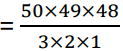
= 19600
Q36
IPMAT 2024 - Quantitative Aptitude
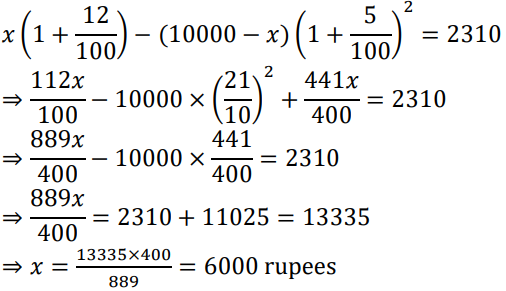
Sagarika divides her savings of 10000 rupees to invest across two schemes A and B. Scheme A offers an interest rate of 10% per annum, compounded halfyearly, while scheme B offers a simple interest rate of 12% per annum. If at the end of first year, the value of her investment in scheme B exceeds the value of her investment in scheme A by 2310 rupees, then the total interest, in rupees, earned by Sagarika during the first year of investment is
Q37
IPMAT 2024 - Quantitative Aptitude
A fruit seller had a certain number of apples, bananas and oranges at the start of the day. The number of bananas was 10 more than the number of apples, and the total number of bananas and apples was a multiple of 11. She was able to sell 70% of apples, 60% of bananas, and 50% of oranges during the day. If she was able to sell 55% of the fruits she had at the start of the day, then the minimum number of oranges she had at the start of the day was
Marking Scheme
Let the number of apples and oranges be x and y.
Then the number of bananas = x + 10
Total number of fruits = 2x + y + 10
As per the question, x + (x +10) = 11k (where k is a multiple of 11)
2x + 10 = 11k
k = (2x + 10)/11 ...….(i)
Also, total fruits sold by the seller can be expressed in two ways.
Equating both the expressions, we get

14x + 12x + 120 + 10y = 22x + 11y + 110
4x + 10 = y ...…(ii)
Now, it is given that the fruit seller sold 70% of apples i.e. 7x/10
In order to keep this number an integer, x must be a multiple of 10.
The smallest value of x in eqn.(i), for which k = (2x+10)/11 will be an integer is 50, a multiple of 10.
Substituting, x = 50 in eqn.(ii), we get
y = 4(50) + 10 = 210 oranges.
Q38
IPMAT 2024 - Quantitative Aptitude
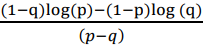
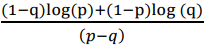
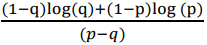
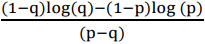
The terms of a geometric progression are real and positive. If the pth term of the progression is q and the qth term is p, then the logarithm of the first term is
Marking Scheme
We know nth term of a G.P. is given by the formula,
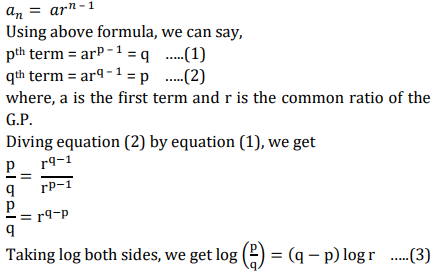
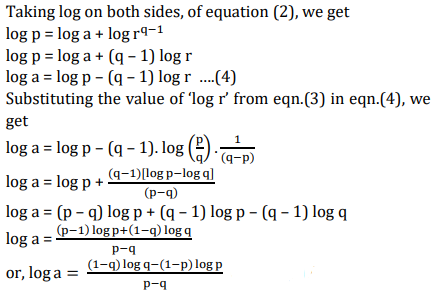
Q39
IPMAT 2024 - Quantitative Aptitude
The number of real solutions of the equation x2 − 10|x| − 56 = 0 is
Marking Scheme
x2 − 10|x| − 56 = 0
We know, if x ≥ 0, then |x| = + x
x2 − 10x − 56 = 0
(x − 14)(x + 4) = 0
x = 14 or − 4 (only one root, + 14 is valid)
Also, if x < 0, then |x| = − x
x2 − 10(− x) − 56 = 0
x2 + 10x − 56 = 0
(x + 14)(x − 4) = 0
x = − 14 or + 4 (only one root, − 14 is valid)
So, only 2 real solutions.
Q40
IPMAT 2024 - Quantitative Aptitude
The smallest possible number of students in a class if the girls in the class are less than 50% but more than 48% is
Marking Scheme
Let the number of girls be G and total number of students be N.
Given that, 40% N < G < 50%
12N/25 < G < 1N/2
Multiplying throughout by 50, we get
24N < 50G < 25N
Here 50G is a number which is multiple of 50.
Now checking with the options:
Option (a), 25 (starting with the smallest of all the given options)
24 × N = 24 × 25 = 600
And, 25 × N = 25 × 25 = 625
So, there is no multiple of 50 in this range.
Option (c), 27 (the second smallest value in the given options)
24 × N = 24 × 27 = 648
And, 25 × N = 25 × 25 = 675
So, there lies a multiple of 50 in this range i.e. 650.
So, option (c) satisfies. Ans.
Verification:
50G = 650
G = 13, N = 27
13/27 × 100 = 48.14% which lies between 48% and 50%.
Q41
IPMAT 2024 - Quantitative Aptitude
Directions for Qs. 41 - 45: Read the information and answer the following questions
In an election there were five constituencies S1, S2, S3, S4 and S5 with 20 voters each all of whom voted. Three parties A, B and C contested the elections.
The party that gets maximum number of votes in a constituency wins that seat. In every constituency there was a clear winner. The following additional information is available:
• Total number of votes obtained by A, B and C across all constituencies are 49, 35 and 16 respectively.
• S2 and S3 were won by C while A won only S1.
• Number of votes obtained by B in S1, S2, S3, S4 and S5 are distinct natural numbers in increasing order.
The constituency in which B got lower number of votes compared to A and C is
Marking Scheme
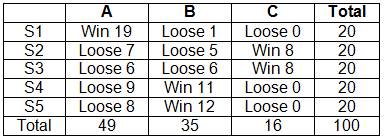
From point (2), we can conclude that C must have 8 votes each in S3 and S4, that so as up to 16.
It also means C did not get any votes in S1, S2 and S5.
It also implied that B must have win S4 and S5 constituencies as ‘A’ has won only in S1.
Now in S3 and S4, possible combination of votes A and B can be (5, 7), (7, 5) or (6, 6) in that order respectively.
By doing hit and trial, we can come to a conclusion that B must have win 11 and 12 votes in S4 and S5 respectively.
And also, it must have received 1, 5 and 6 votes in S1, S2 and S2 constituency from point (3).
From the completed table we can see, B got lower number of votes compared to A and C only in S2.
Q42
IPMAT 2024 - Quantitative Aptitude
Directions for Qs. 41 - 45: Read the information and answer the following questions
In an election there were five constituencies S1, S2, S3, S4 and S5 with 20 voters each all of whom voted. Three parties A, B and C contested the elections.
The party that gets maximum number of votes in a constituency wins that seat. In every constituency there was a clear winner. The following additional information is available:
• Total number of votes obtained by A, B and C across all constituencies are 49, 35 and 16 respectively.
• S2 and S3 were won by C while A won only S1.
• Number of votes obtained by B in S1, S2, S3, S4 and S5 are distinct natural numbers in increasing order.
The number of votes obtained by B in S2 is
Marking Scheme
From point (2), we can conclude that C must have 8 votes each in S3 and S4, that so as up to 16.
It also means C did not get any votes in S1, S2 and S5.
It also implied that B must have win S4 and S5 constituencies as ‘A’ has won only in S1.
Now in S3 and S4, possible combination of votes A and B can be (5, 7), (7, 5) or (6, 6) in that order respectively.
By doing hit and trial, we can come to a conclusion that B must have win 11 and 12 votes in S4 and S5 respectively.
And also, it must have received 1, 5 and 6 votes in S1, S2 and S2 constituency from point (3).
From the completed table we can see, B got lower number of votes compared to A and C only in S2.
Q43
IPMAT 2024 - Quantitative Aptitude
Directions for Qs. 41 - 45: Read the information and answer the following questions
In an election there were five constituencies S1, S2, S3, S4 and S5 with 20 voters each all of whom voted. Three parties A, B and C contested the elections.
The party that gets maximum number of votes in a constituency wins that seat. In every constituency there was a clear winner. The following additional information is available:
• Total number of votes obtained by A, B and C across all constituencies are 49, 35 and 16 respectively.
• S2 and S3 were won by C while A won only S1.
• Number of votes obtained by B in S1, S2, S3, S4 and S5 are distinct natural numbers in increasing order.
Assume that A and C had formed an alliance and any voter who voted for either A or C would have voted for this alliance. Then the number of seats this alliance would have won is
Marking Scheme
From point (2), we can conclude that C must have 8 votes each in S3 and S4, that so as up to 16.
It also means C did not get any votes in S1, S2 and S5.
It also implied that B must have win S4 and S5 constituencies as ‘A’ has won only in S1.
Now in S3 and S4, possible combination of votes A and B can be (5, 7), (7, 5) or (6, 6) in that order respectively.
By doing hit and trial, we can come to a conclusion that B must have win 11 and 12 votes in S4 and S5 respectively.
And also, it must have received 1, 5 and 6 votes in S1, S2 and S2 constituency from point (3).
From the completed table we can see, B got lower number of votes compared to A and C only in S2.
Q44
IPMAT 2024 - Quantitative Aptitude
Directions for Qs. 41 - 45: Read the information and answer the following questions
In an election there were five constituencies S1, S2, S3, S4 and S5 with 20 voters each all of whom voted. Three parties A, B and C contested the elections.
The party that gets maximum number of votes in a constituency wins that seat. In every constituency there was a clear winner. The following additional information is available:
• Total number of votes obtained by A, B and C across all constituencies are 49, 35 and 16 respectively.
• S2 and S3 were won by C while A won only S1.
• Number of votes obtained by B in S1, S2, S3, S4 and S5 are distinct natural numbers in increasing order.
The number of votes obtained by A in S5 is
Marking Scheme
From point (2), we can conclude that C must have 8 votes each in S3 and S4, that so as up to 16.
It also means C did not get any votes in S1, S2 and S5.
It also implied that B must have win S4 and S5 constituencies as ‘A’ has won only in S1.
Now in S3 and S4, possible combination of votes A and B can be (5, 7), (7, 5) or (6, 6) in that order respectively.
By doing hit and trial, we can come to a conclusion that B must have win 11 and 12 votes in S4 and S5 respectively.
And also, it must have received 1, 5 and 6 votes in S1, S2 and S2 constituency from point (3).
From the completed table we can see, B got lower number of votes compared to A and C only in S2.
Q45
IPMAT 2024 - Quantitative Aptitude
Directions for Qs. 41 - 45: Read the information and answer the following questions
In an election there were five constituencies S1, S2, S3, S4 and S5 with 20 voters each all of whom voted. Three parties A, B and C contested the elections.
The party that gets maximum number of votes in a constituency wins that seat. In every constituency there was a clear winner. The following additional information is available:
• Total number of votes obtained by A, B and C across all constituencies are 49, 35 and 16 respectively.
• S2 and S3 were won by C while A won only S1.
• Number of votes obtained by B in S1, S2, S3, S4 and S5 are distinct natural numbers in increasing order.
Comparing the number votes obtained by A across different constituencies, the lowest number of votes were in constituency
Marking Scheme
From point (2), we can conclude that C must have 8 votes each in S3 and S4, that so as up to 16.
It also means C did not get any votes in S1, S2 and S5.
It also implied that B must have win S4 and S5 constituencies as ‘A’ has won only in S1.
Now in S3 and S4, possible combination of votes A and B can be (5, 7), (7, 5) or (6, 6) in that order respectively.
By doing hit and trial, we can come to a conclusion that B must have win 11 and 12 votes in S4 and S5 respectively.
And also, it must have received 1, 5 and 6 votes in S1, S2 and S2 constituency from point (3).
From the completed table we can see, B got lower number of votes compared to A and C only in S2.






 . If ac > 0, then
  equals